Deputy Minister of Environment and Energy Nikos Tsafos points out an accounting error in Green Tank’s comparison of electricity prices between Greece and the EU.
In a related post on LinkedIn, he states the following:
“I am following with interest the discussion that has arisen from Green Tank’s study titled ‘Trends in Greece’s Retail Electricity Market.’
The key finding of the analysis—at least as reported by the media—is as follows: “Greece’s retail electricity market remains consistently among the most expensive in the EU-27 in terms of the competitive portion of bills set by providers.”
Green Tank is a highly reputable institute and always makes a substantial contribution to public discourse. In this particular analysis, however, it has made an “accounting” error. Let me explain.
The analysis is based on Eurostat data (attached). For convenience, I am reproducing the relevant table. Green Tank focuses on the so-called “competitive component”—listed in the table as “energy and supplies”—and correctly concludes that the figure of €161 for Greece is one of the highest in Europe. So far, so good.
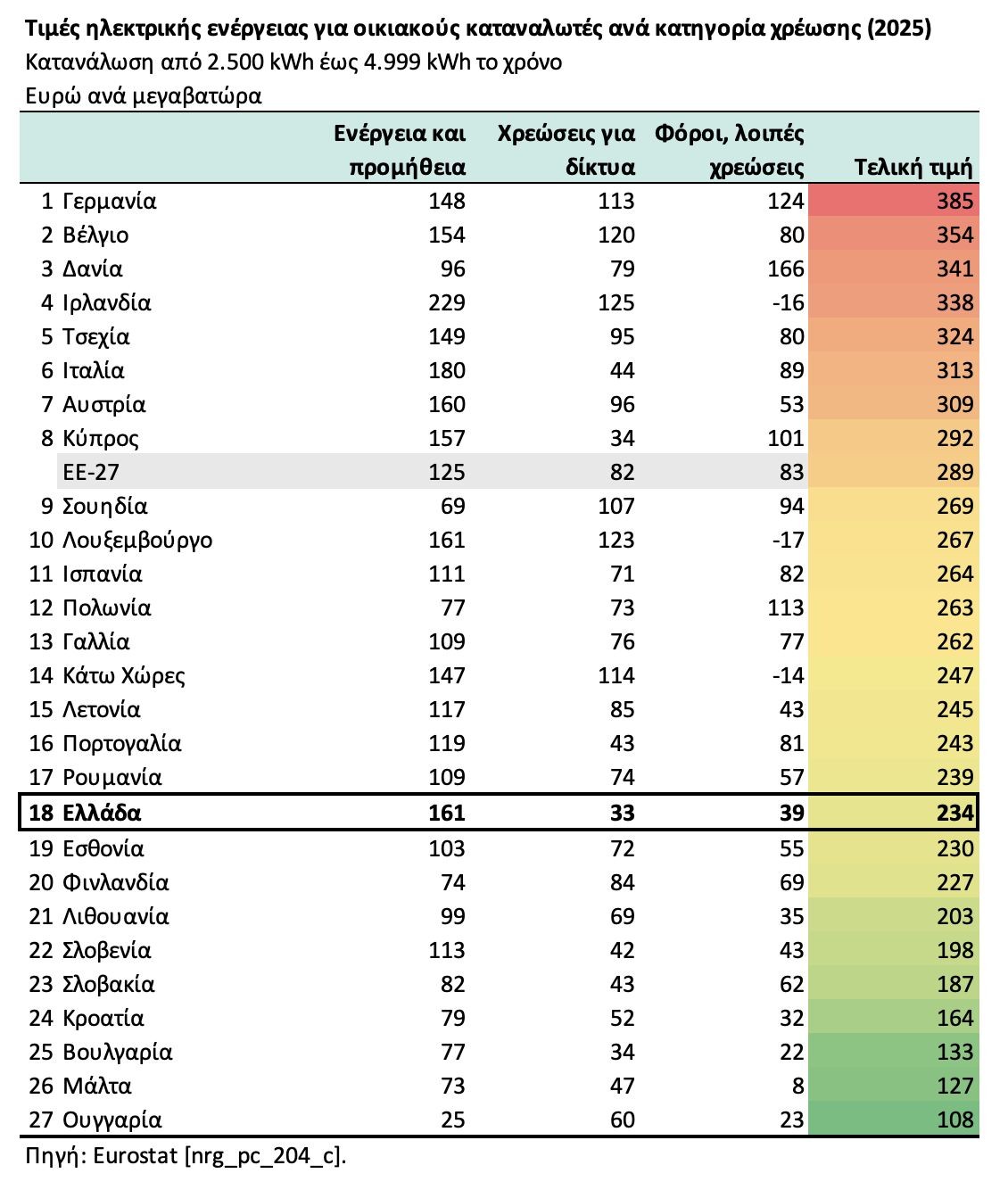
The problem arises from the comparison with other European countries. In Greece, the “competitive component” is not simply the “competitive component” per se. It includes (a) system and grid losses, and (b) all costs for system stabilization (reserves and other services).
In other countries, these costs are often included in network charges—as the table also shows: Greece has the lowest network charges in all of Europe (€33), and there are countries with network charges that are double or triple those of Greece.
Therefore, the conclusion that “Greece pays a lot for energy” stems from a misinterpretation of the numbers. There are costs that we include in the “energy and supply” column, while other countries include them in “network charges.” We are very high in one column and very low in the other. The issue is an accounting one, not an energy one.
The same problem applies to the comparison Green Tank makes between wholesale and retail. To go from wholesale to retail , one must add (a) the surcharge accounts (losses, reserves, system stability), (b) losses in the HEDNO grid, and (c) the margin of the supply companies.
When one calculates all costs in their entirety, the apparent “gap” between wholesale and retail narrows significantly, and thus the remaining profitability is considerably lower than what appears at first glance in the charts of Green Tank’s analysis.
Let me conclude with the obvious: consumers care about the final price, not which category the individual costs fall into—and in terms of the final price, our country is the 10th cheapest in the EU and 19% below the European average for 2025.