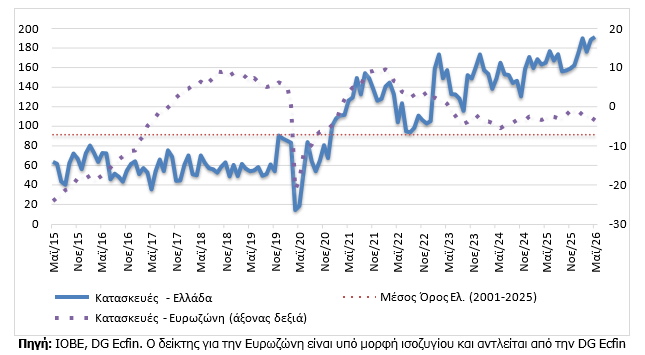
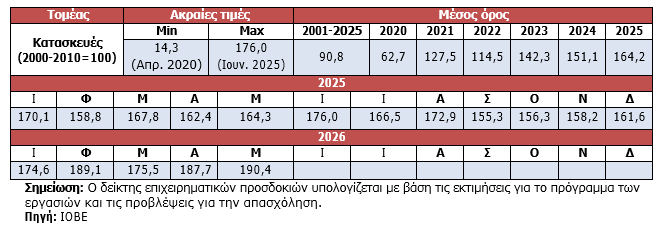
The Construction Business Expectations Index stood at 190.4 points in May, up from 187.7 points in April, marking a higher level than the 164.3 points recorded in the same month last year, according to the latest “Economic Climate Survey” by the Foundation for Economic and Industrial Research (IOBE).
This increase was the result of a significant improvement in the already high expectations for private projects, while expectations for public projects weakened slightly. Among the index’s key variables, the mildly positive forecasts for companies’ work schedules declined slightly, while positive forecasts for employment improved sharply.
Specifically, the index for business activity forecasts stood at +28 (down from +33) points, with nearly half of businesses expressing optimism about the level of activity in the coming quarter. Regarding employment forecasts, the relevant index improved significantly to +41 (from +32) points, with 42% (up from 34%) of respondents forecasting an increase in jobs and just 1% of businesses expecting a decrease.
As for the remaining data, assessments of current business activity are trending sharply downward and stand at +31 points, down from +44 points the previous month, while in the area of prices, inflation expectations are at slightly higher levels compared to April (+37 from +32 points).
Finally, 15% of businesses report unimpeded business operations. At least half of businesses (51%) now cite labor shortages as the main obstacle to their operations, 8% cite low demand, and 14% cite other cyclical factors.
Regarding the degree of uncertainty in the economic environment, this has increased significantly, as 45.3% of businesses believe that future growth is difficult or relatively difficult to predict, compared to 37.6% in April.
Business Expectations Index in Construction
A breakdown by sector:
The business expectations index for private construction showed a significant increase, reaching 213 points (up from 204.2), remaining at significantly higher levels than the corresponding figure from last year (139.4 points). Positive forecasts for the level of planned work declined slightly to +66 (from +72) points, while expectations for employment strengthened significantly, reaching +58 (from +39) points.
As for the remaining indicators, positive assessments of current business activity remained at +71 points, while regarding prices, inflationary trends strengthened compared to the previous month (+59 points in the relevant balance, up from +50 in April).
Finally, only 5% of businesses report no obstacles to their operations. In contrast, at least two out of three businesses (67%) cite labor shortages, 4% cite a lack of financing, and 18% cite other cyclical factors as key obstacles to their operations.
Public Works
The business expectations index for public works construction is trending marginally downward. It stood at 136.9 points (down from 138.2 in April), significantly lower than its level from the same period last year (180.4 points). Regarding the sector’s order book, the April index of -31 points stood at -30 points. In employment forecasts, the relevant balance fell to +16 points from +19 points in the previous period.
Most companies in the sector (84%) expect employment levels to remain unchanged, while 16% anticipate an increase. The index of assessments regarding the level of current business activity fell to -28 points from -2 points the previous month, while the price balance remained at seasonal norms at +4 points.
Finally, 30% of businesses report unimpeded business operations, with 27% citing labor shortages, another 11% citing a lack of financing, and 9% citing other cyclical factors as the main obstacle to their operations.
Construction Business Expectations Index