From construction sites and industrial facilities to hotels, logistics centers, and care services, businesses are seeking staff they often cannot find in the domestic market.
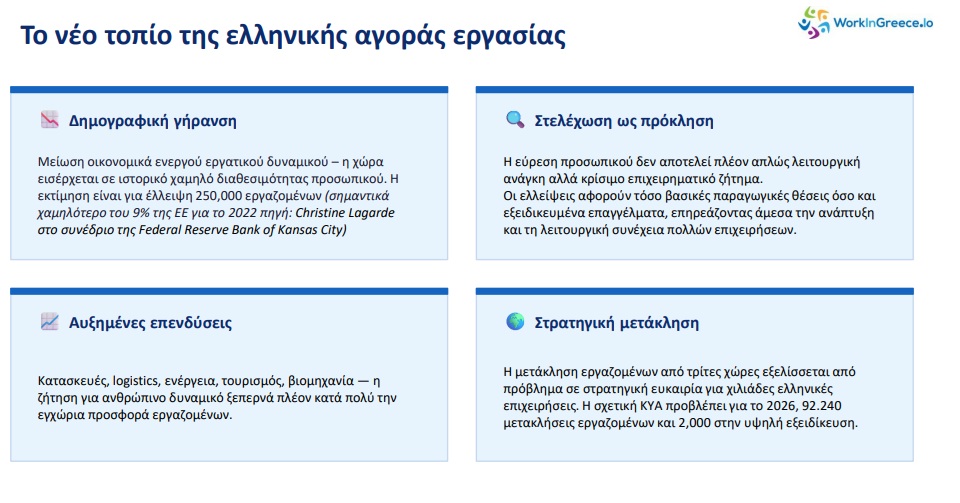
In this environment, the recruitment of workers from third countries has shifted from a supplementary solution to a key mechanism for meeting labor needs, with more than 92,000 positions projected for 2026.
The Greek labor market currently faces a significant challenge. The demographic aging of the population, the decline in the economically active workforce, and the increased demand for personnel in critical sectors of the economy have created a major labor shortage.
According to data provided by businesses, our country faces a shortage of approximately 250,000 workers, a fact that directly impacts the domestic economy. Some of these vacancies will be filled by recruiting workers from third countries. According to the plans of the relevant ministries, more than 92,000 positions for recruited workers and an additional 2,000 highly specialized positions are projected for 2026.
And while for Greek business owners, the need to fill vacancies may be what drives the process, what determines the salaries of foreign workers and what motivates them to work in Greece?
WorkInGreece.io, an online platform specializing in the recruitment of foreign workers, conducted a study, some of whose findings are presented by Euro2day.gr, according to which, the wages of posted workers are not determined by their nationality but by objective professional criteria, such as experience, certifications, technical training, and language skills.
The foundation upon which the wage policy for workers from third countries is based is the principle of “Equal Pay for Equal Work.” According to the study, two employees performing the same work with the same qualifications should be paid equally, regardless of their country of origin.
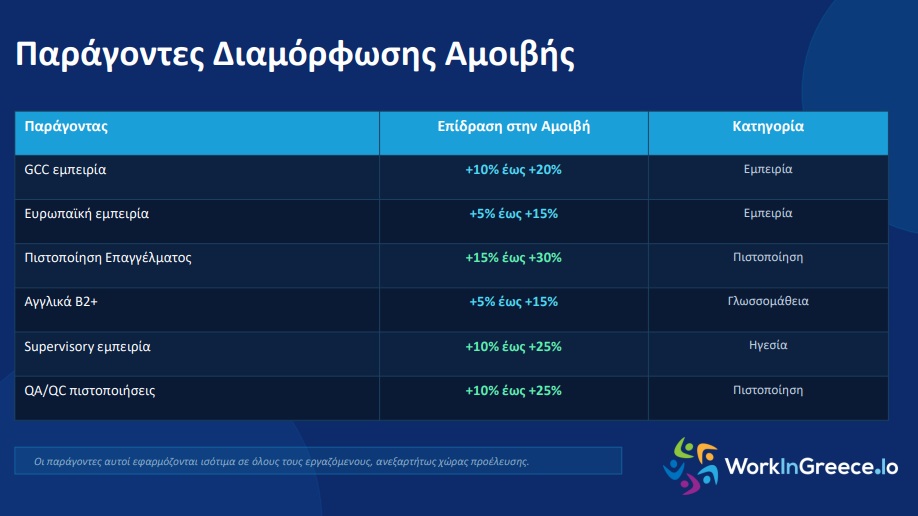
The factors that increase an employee’s salary are:
- Previous work experience.
- Professional certifications.
- Knowledge of the English language.
- Previous work experience in European countries.
- Experience in Gulf Cooperation Council (GCC) countries.
- Management or supervisory experience.
- Quality certifications (QA/QC).
Salary increases can range from 5% to 30% depending on the employee’s qualifications.
This groundbreaking study was conducted on a sample of 948 expatriate employees and is perhaps the first comprehensive effort to document actual salary data by specialty, skill, and industry. This research not only sheds light on the needs of the labor market but also on the obligations companies undertake to attract and retain the workforce they need.
As Vangelis Kanellopoulos, CEO of the platform specializing in recruitment, aptly notes, “For the first time, a systematic mapping of actual wage data by specialty and skill level is being undertaken, highlighting that meeting the needs of the labor market entails significant financial costs for businesses. The data show that employers are not only required to meet their legal wage obligations but also to offer competitive compensation and benefits packages in an international labor market where employees now have multiple options.”
It is indicative that net monthly earnings range from approximately 800 euros for unskilled positions in warehouses and construction work, up to €5,000 in exceptional cases for specialized chefs, primarily of Asian cuisine, employed in ultra-luxury hotels.
At the same time, in special cases, salaries can reach as high as 4,500 euros for highly specialized, certified quality assurance and quality control (QA/QC) professionals with international certifications, specialized graduate degrees, and many years of international experience in demanding energy projects.
This significant gap between unskilled and skilled labor reflects the growing value of certifications, years of international experience, specialized training, and technical skills in the modern Greek labor market.
Indeed, the widespread perception that workers from third countries drive down wages is not supported by the data. On the contrary, the increased demand for skilled personnel is leading to wage increases in many professions, particularly in highly specialized fields. Furthermore, international demand from other EU countries and the Middle East is driving up workers’ wages.
In the construction sector, for example, which faces the greatest labor shortages, wages show a striking range. A construction worker earns between 800 and 1,350 euros net per month, while a skilled concrete worker can earn between 1,050 and 2,050 euros net per month, depending on their experience and technical training. In exceptional cases, this can reach up to €2,600 if the worker has many years of experience managing a crew or a construction site.
The highest salaries are found in specialties with international certifications. A certified 6G welder can earn between €1,500 and €2,800 if they have extensive experience (15+ years) on major energy, petrochemical, or industrial projects in the Middle East or other international markets. There have also been exceptional cases where earnings approach €3,300.
Similar figures are reported in the industrial and manufacturing sectors. Industrial workers start at €850, but salaries increase significantly as technical expertise and industry-specific requirements (such as in the food or pharmaceutical sectors) rise. Salaries for CNC machine operators start at €1,100 and reach €1,800.
In positions of responsibility, such as Production Engineers with many years of experience and specialized education, salaries can reach €3,800 per month.
The tourism sector is also of particular interest, where staffing needs remain enormous despite the steady increase in wages in recent years. Waiters’ salaries range from €950 to €1,500, while for employees with exceptional experience, they can reach €2,000 (in luxury hotels).
In high-responsibility positions, earnings increase dramatically, especially since they can perform managerial duties. For example, Restaurant Manager salaries range from €1,800 to €2,500, while in ultra-luxury hotels or large tourist complexes, and provided they combine significant managerial experience with responsibility for large teams of staff, salaries can, in exceptional cases, reach €4,500.
Significant shortages are also evident in the health and care sector, which is directly affected by the aging population and shortages in the public health sector. Caregivers for the elderly are paid between €900 and €1,700, depending on their experience and skills, while nurses can earn up to €2,800, and those with specialization in intensive care units can earn up to €3,500 for highly specialized work.
Qualifications
Another key finding of the study is that salaries are not determined by nationality but by qualifications. Previous work experience, language skills, professional certifications, experience in European or Arab labor markets, and knowledge of international quality standards can increase earnings by 5% to 30%. In other words, the market rewards skills rather than the employee’s origin.
Of course, companies seek different specializations depending on the workers’ country of origin. Workers from Egypt are mainly employed in construction, agricultural work, and fishing, while a significant number of workers from Bangladesh and Pakistan are employed in industry, warehouses, logistics, and the primary sector.
The Philippines remains a key source of personnel for elderly care, domestic support, and healthcare services, while India frequently supplies workers for agricultural work, technical professions, and food service.
In recent years, demand for workers from countries such as Nepal and Vietnam has also been increasing, primarily for hotels, tourism services, and manufacturing activities. This picture shows that the labor market is gradually developing specialized channels for recruiting personnel, depending on the needs of each sector and the professional characteristics of workers from each country.
It also highlights something else: the battle to attract workers is not decided solely by salary. Housing, transportation, meals, airfare, retention bonuses, and career advancement opportunities are now key components of the employment package. In many cases, especially in island and tourist areas where housing costs are high, housing benefits prove to be just as important as the salary itself.
Specifically, the following are considered particularly important in the overall benefits package:
- Provision of housing.
- Transportation to and from work.
- Free meals or meal vouchers.
- Airfare coverage.
- Retention bonus.
- Career advancement opportunities.
- Training and Greek language courses.
According to the survey data, salary remains the most important criterion for choosing an employer, but housing and other benefits have a decisive influence on employees’ final decision.