According to an analysis by the Panhellenic Exporters Association and the Center for Export Research and Studies (KEEM), based on provisional data from ELSTAT, exports surged significantly by €1.37 billion in April 2026, or by 35.7%, reaching €5.20 billion compared to €3.83 billion in the same month of 2025. Excluding petroleum products, they increased significantly (7.9%), resulting in exports reaching €3.38 billion from €3.13 billion, i.e., an increase of €246.6 million.
Imports increased in April 2026 (9.6% or €641.1 million) and reached €7.35 billion compared to €6.71 billion in the same month of 2025. Excluding petroleum products, imports of goods stood at €5.65 billion, down from €5.70 billion, representing a slight decrease of €49.1 million, or -0.9%.
As a result of these developments, the trade deficit narrowed in the month under review in 2026 by €725.1 million, or -25.2%, to €2.16 billion from €2.88 billion in the corresponding month of 2025. Excluding petroleum products, the trade balance decreased by 11.5% or €295.7 million, reaching just €2.27 million from €2.57 million in April of last year.
As for total exports during the January-April period, they increased by 11.3% to €17.77 billion from €15.97 billion, meaning they expanded by €1.80 billion compared to the same period in 2025.
Excluding petroleum products, exports for the first four months of 2026 stood at €12.97 billion, up from €12.44 billion, representing an increase of €525.5 million, or 4.2%.
Imports (including petroleum products) for the period January –April 2025 increased by 3.3%, rising by €895.1 million, with their total value reaching €28.21 billion compared to €27.32 billion during the corresponding period of 2025. Excluding petroleum products, imports rose slightly to €21.87 billion from €21.50 billion, an increase of €363.2 million, or 1.7%.
As a result of the above, the trade deficit in the first four months of 2026 narrowed by 8% to €10.44 billion from €11.34 billion in the first four months of 2025. Excluding petroleum products, the trade deficit decreased by 1.8% to €8.90 billion from €9.06 billion, i.e., it shrank by €162.3 million.
Export trends by geographic region
Regarding export trends by geographic region in April 2025, the very strong growth in our shipments to EU countries (20.2%) continues, as does the “giant” increase to third countries (59.8%). When oil products are excluded, the picture remains positive for exports to EU countries (10.3%), but it almost vanishes for exports to third countries, where they are increasing, albeit at a rate of just 2.9% compared to the same month last year.
Regarding the share of exports destined for the markets of EU member states, including petroleum products, this figure fell by 7 percentage points to just 53.9%, compared to 60.9% in the corresponding month of 2025. The picture is inversely proportional for the share of exports to third countries, which stood at 46.1% compared to 39.1%. Excluding petroleum products, the share of exports to EU countries stands at 68.5% and to third countries at 31.5%, a fact that demonstrates the catalytic role played by the more than doubling (152.1%) of the value of exports of petroleum products and fuels.
Examining the distribution of exports for the period January–April 2026, it is found that the total value of exports, including petroleum products, increased to EU countries (12.1%) as well as to third countries by 10.2%. Excluding petroleum products, the picture remains unchanged for EU countries (7.8%), but differs for third countries, where exports decreased (-2.8%).
Performance by sector
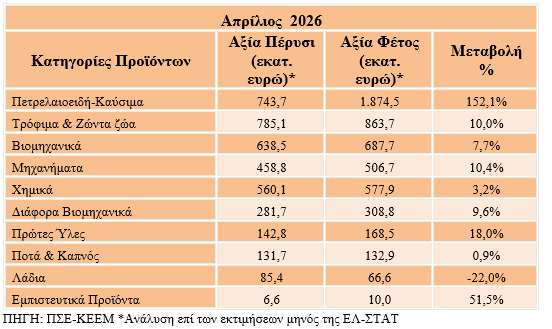
Regarding the major product categories, in April 2026, upward trends were recorded across all product sectors, with the sole exception of the Oils sector (-22%).
More specifically, percentage increases were recorded in the categories of Petroleum Products-Fuels (152.1%), Food (10%), Industrial Goods (7.7%), Chemicals (3.2%), Machinery (10.4%), Miscellaneous Industrial Goods (9.6%), Raw Materials (18%), Beverages & Tobacco (0.9%), and in the low-value exports of Confidential Products (51.5%).
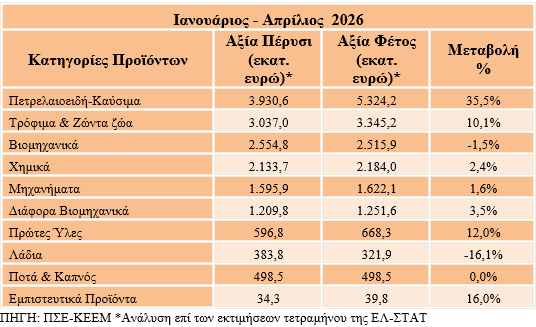
Looking at the four-month period from January to April 2026, exports increased in 7 of the 10 major product categories: Petroleum Products-Fuels (35.5%), Food (10.1%), Chemicals (2.4%), Machinery (1.6%), Miscellaneous Industrial Goods (3.5%), Raw Materials (12%), and Confidential Products (16%), which have a low export value, compared to the corresponding four-month period last year.
At the same time, however, exports of Industrial Goods (-1.5%) and Oils (-16.1%) declined compared to the first four months of 2025. Finally, exports of Beverages & Tobacco remained at the same levels (€498.5 million).
The President of the Panhellenic Exporters Association, Mr. Alcibiades Kalambokis, commented on the above as follows: “April 2026 was a landmark month for Greek exports, recording an impressive increase of +35.7% overall and +7.9% excluding petroleum products. This is the strongest monthly performance of 2026, with the momentum extending to nearly all product sectors and particularly impressive results in Petroleum Products (152.1%), Food (10%), and Industrial Goods (7.7%). At the same time, the trade deficit shrank drastically by -25.2%, while the surge in exports to third countries (+59.8%) is noteworthy.
The four-month period from January to April 2026 ended on a strong positive note for Greek exports, with an overall increase of +11.3% and +4.2% excluding petroleum products. Following the partial weakness of the first two months, the impressive recovery in March and April fully offset the losses and gave a new boost to export performance. Particularly encouraging is the increase in exports to the EU (+12.1%) as well as to third countries (+10.2%). At the same time, the trade deficit for the four-month period narrowed by -8.0% (€903.8 million), confirming the steady trend toward consolidation in foreign trade.
A similar picture is observed in exports to the United States. Despite the Trump administration’s reinstatement of tariffs, the uncertainty surrounding new trade policies, and fears of a slowdown in the U.S. economy, Greek exports to the U.S. market remained on an upward trajectory during the first four months of the year, recording a 14.5% increase.
There are moments in the economy when the data seem to defy the prevailing conditions. March and, even more so, April 2026 were two such moments. During a period marked by escalating geopolitical tensions in the Middle East, uncertainty in international markets, and concerns about the state of global trade, Greek exports not only held steady but recorded an impressive rise.
This performance takes on even greater significance when one considers that it followed two difficult months. In January, exports fell by 11.9%, and in February by 3.6%. However, the momentum of the March-April period not only offset the losses but also brought the first four months of the year into positive territory.
This development can hardly be described as circumstantial. It reflects the systematic effort of Greek companies to invest in the quality, innovation, and diversification of their products. At the same time, it reflects the growing recognition of Greek products in demanding international markets, as well as the strategic choice of many companies to expand their international presence, thereby reducing their dependence on a single market or geographic region.
Of course, there is no room for complacency. Geopolitical risks remain, trade tensions may intensify, and the global economy continues to navigate uncharted waters. However, the data for April and the first four months send a clear message: Greek exports have gained resilience that we would have found hard to imagine just a few years ago. And this is perhaps the most optimistic sign for the future of the Greek economy at a time when uncertainty is becoming the new normal.”