The gap between the reduction in inequality observed in Greece in recent years, according to statistical data, and households’ subjective experience of worsening inequality is highlighted in the IOBE study titled “The Multiple Dimensions of Inequality in Greece.”
The key findings of the new study by the Foundation for Economic and Industrial Research — IOBE were presented at a special event by Antonis Mavropoulos, senior researcher at IOBE, while Jonathan Cribb, deputy director of the Institute for Fiscal Studies (IFS) in London, delivered a speech on inequality trends in Europe. This was followed by a discussion featuring Panos Tsakloglou, professor at the Athens University of Economics and Business, former Deputy Minister of Labor, and member of the Monetary Policy Council of the Bank of Greece; Irini Andriopoulou, senior economist at the Council of Economic Experts, and Niki Kalavrezou, research team leader at the European Centre for Social Welfare Policy and Research in Vienna. The event was moderated by Nikos Vettas, General Director of IOBE and professor at the Athens University of Economics and Business.
A key finding of the study is that, despite the significant progress recorded over the past decade in key inequality indicators, the daily experience of a large proportion of Greek households continues to be characterized by economic insecurity, limited opportunities, and difficulty accessing basic goods and services.
Income inequality has declined compared to the crisis years; employment has strengthened, and the economy has returned to a growth trajectory; however, many citizens continue to perceive inequality as particularly acute and a large proportion report that they struggle to meet their needs.
This complex reality highlights that inequality cannot be assessed solely through income distribution. The quality of work, access to quality education, health inequalities, the adequacy of long-term care services, and the ever-increasing pressure from housing costs have a decisive impact on the actual level of household well-being and opportunities for social mobility.
The study examines the evolution of inequalities in Greece during the period 2015–2025 through six interrelated dimensions—income, the labor market, education, health, long-term care, and housing—highlighting both areas where substantial progress has been made and structural weaknesses that continue to limit opportunities for a significant portion of the population.
The key finding is that Greece today exhibits lower levels of inequality compared to the crisis period, yet it has not yet bridged the gap between positive macroeconomic and statistical developments and citizens’ everyday experience. Consequently, it is understandable why the sense of inequality remains strong, even during a period of improvement in many indicators, and this highlights the need for policies that will strengthen not only incomes but also equal access to opportunities and basic services.
Key findings of the study by sector
Income inequality
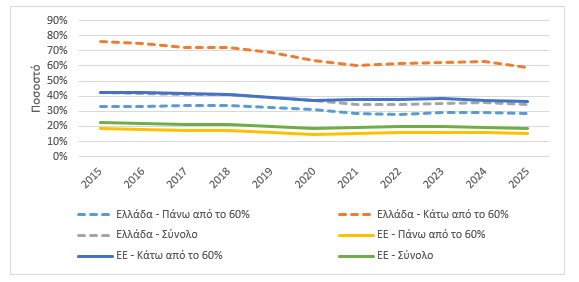
The picture of income inequality in Greece presents a contradiction. On the one hand, key indicators show improvement compared to the crisis years, as the economic recovery was accompanied by a reduction in income inequality and an increase in employment. On the other hand, the daily experience of many households remains more negative. The majority of citizens continue to report that they struggle to meet their basic needs, while the sense of unequal treatment and limited opportunities remains strong. The findings indicate that a reduction in inequality as measured by statistical indicators does not automatically translate into a corresponding improvement in economic security for everyone.
Key Findings
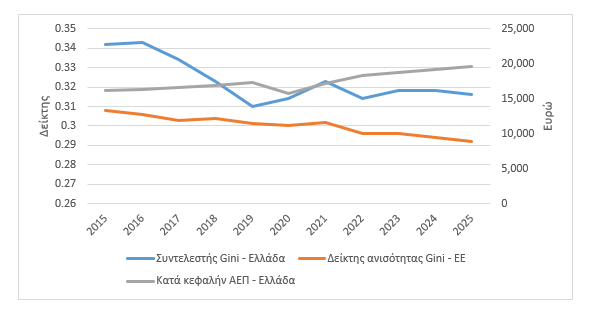
The Gini coefficient, a well-established measure of inequality, fell from 34.2% in 2015 to 31.6% in 2025.
About 68% of households report having difficulty making ends meet, compared to 19% in the EU.
Income from self-employment shows the greatest inequality among all sources of income.
Young people aged 16–24 remain the age group at highest risk of poverty.
Single-parent households and families with many children continue to face the greatest risk of economic vulnerability.
Gini inequality index and GDP per capita
Labor market
The labor market has been a key driver of improved economic conditions over the past decade, as unemployment has fallen significantly and employment has risen. However, certain structural features continue to fuel inequalities and limit social mobility. High self-employment, low labor force participation among specific groups (particularly women and people with disabilities), persistent long-term unemployment, and limited coverage by collective bargaining agreements perpetuate disparities in income and opportunities.
Key findings
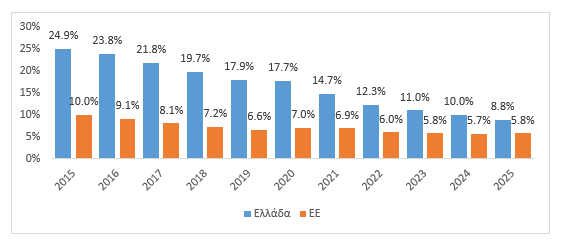
Unemployment fell from 24.9% in 2015 to 8.8% in 2025.
The self-employed still account for 24.3% of the total workforce, the highest share in the EU.
The VAT compliance gap fell from 24% in 2019 to 11% in 2023, but the informal economy remains high.
Greece has the third-lowest labor force participation rate in the EU.
Over 50% of the unemployed remain in long-term unemployment.
Unemployment rate
Education
Education remains the most important mechanism for social mobility. Despite the significant increase in the number of higher education graduates, opportunities for educational advancement continue to depend largely on a family’s socioeconomic background. The heavy reliance on private tutoring and the difficulties in completing studies limit the equalizing role of the educational system.
Key findings
The percentage of adults with a higher education degree increased from 26.5% to 32.6%.
Greece ranks among the countries with the lowest intergenerational educational mobility in Europe.
Only about 12% of children from low educational backgrounds reach the highest levels of education.
More than half of students exceed the expected duration of their studies.
Pre-university education remains a key tool for preparing students for access to higher education.
Health
Despite improvements recorded since the crisis, access to health services continues to be significantly influenced by income. The high reliance on out-of-pocket payments shifts a significant portion of the cost to households, resulting in lower-income groups facing greater barriers to prevention, diagnosis, and treatment.
Key findings
Greece has one of the highest rates of private health spending in the EU.
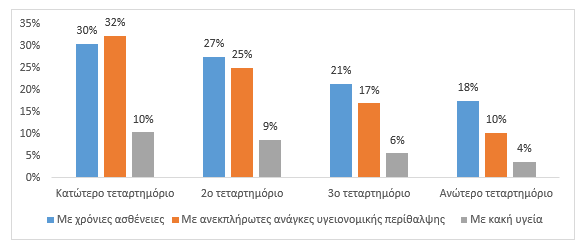
Thirty-two percent of individuals in the lowest income quartile report unmet health needs, compared to 10% in the highest.
Chronic diseases affect 30% of people in the lowest income quartile, compared to 18% in the highest.
Economic inequalities translate into significant differences in health status and healthy life expectancy.
Percentage of people with health problems by income quartile
Long-term care
Long-term care is defined as the set of services and support aimed at individuals who, due to physical and/or mental frailty or disability, are dependent on assistance for activities of daily living for an extended period of time and/or require continuous care.
Long-term care is one of the weakest pillars of social protection in Greece. As the population ages rapidly, the country continues to rely primarily on the family to provide care, a fact that creates significant economic and social burdens, particularly for women.
Key findings
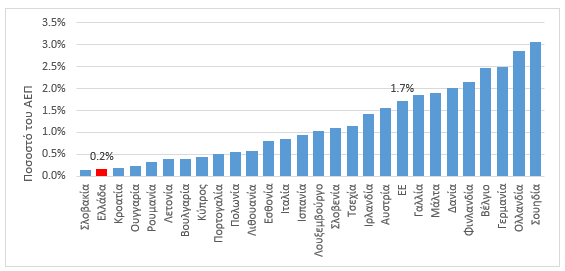
Public spending on long-term care amounts to just 0.16% of GDP, compared to 1.71% in the EU.
Greece ranks among the lowest in Europe in terms of funding for care services.
Lower-income groups face greater difficulties in meeting their care needs.
Informal family care remains the dominant support mechanism.
Total public expenditure on long-term care (as a percentage of GDP), 2023
Housing
Housing is emerging as a potential source of inequality in Greece. The sharp rise in rents and housing costs since 2018 has significantly increased pressure on households, particularly among lower-income groups and young people. At the same time, rising property values are widening the gap between homeowners and renters.
Key findings
Housing costs for lower-income groups remain among the highest in Europe.
The rise in rents since 2018 has disproportionately burdened low-income renters.
Homeownership is declining among younger and financially weaker households.
The inability to meet energy and housing obligations has worsened since 2021.
Housing insecurity is linked to lower educational and professional prospects.
Share of housing costs in disposable income in Greece and the EU