Yannis Konstantinidis, Chief Strategy, Transformation & Wholesale at the OTE Group, at an event organized by the Ministry of Digital Governance and Artificial Intelligence on the spatial planning of modern data centers.
Mr. Konstantinidis emphasized that Greece, thanks to OTE’s investments, has the infrastructure needed to handle the massive traffic required by data centers.
OTE’s advanced connectivity infrastructure, both within and outside Greece
Beginning his remarks, Mr. Konstantinidis noted that the two key elements of a digital hub are data centers and connectivity infrastructure. He noted that “if data centers are the heart of the digital economy, digital connectivity infrastructure is the arteries that constantly feed this entire ecosystem.”
He emphasized that the country possesses a strategic advantage— its geographical location—serving as a “bridge” between the Middle East, Asia, the Mediterranean, Africa, and Eastern and Central Europe, and explained how the OTE Group ensures advanced digital connectivity infrastructure for the country by leveraging this geostrategic advantage through three key features: 1) high capacity to handle ever-increasing traffic, 2) reliability and redundancy with alternative routes, and 3) superior quality in terms of speed and latency.
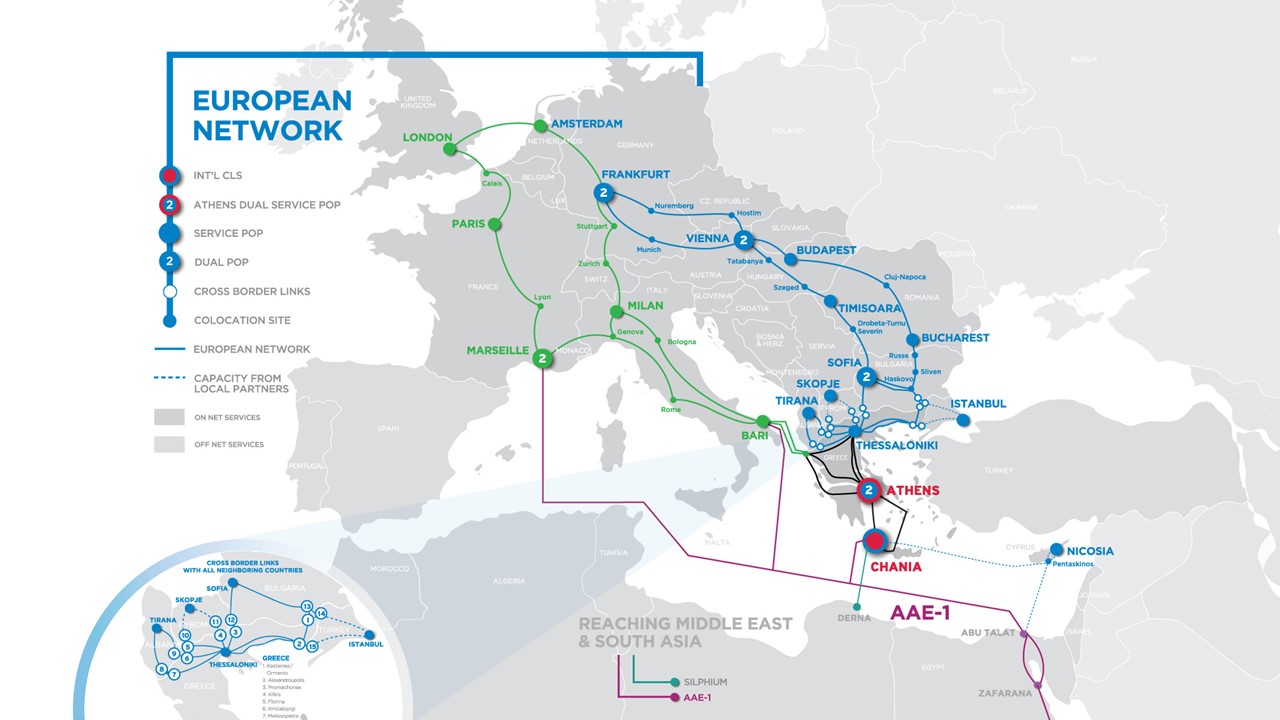
Specifically, he noted that Greece is connected via the Mediterranean to one of the largest intercontinental cables today, the Asia-Africa-Europe-1 (AAE1), in which OTE participates alongside other major providers. This 25,000-kilometer cable, which starts in Hong Kong, terminates in Greece at Chania, Crete. As Mr. Konstantinidis noted, “its capacity is enormous, capable of handling approximately 60 Tbps, which is about 12 times Greece’s total broadband traffic.”
He added: “Beyond the undersea infrastructure, there are also terrestrial cross-border interconnections with all neighboring countries, and in particular with Turkey, which serves as an additional key gateway for the country for traffic from the east. There, we have a cross-border interconnection of around 10Tbps.”
Regarding domestic infrastructure, Mr. Konstantinidis noted that OTE’s backbone network is undoubtedly the largest fiber-optic network, encompassing both terrestrial and submarine infrastructure, with a total length of 56,000 km. In fact, eight new submarine cables are currently under construction in the Aegean Sea.
Regarding Greece’s international interconnection with Europe, Mr. Konstantinidis noted that OTE possesses by far the best infrastructure, with three distinct physical routes: 1) via the Balkans with the Trans-Balkan optical backbone reaching as far as Frankfurt and Amsterdam, 2) via Italy with the Corfu-Bari submarine cable, and from there via terrestrial fiber-optic cables to Frankfurt and Paris/London, and finally, as a backup for all of the above, 3) the Asia-Africa-Europe-1 submarine cable that “lands” in Bari and Marseille.
“We are talking about an optical network with a total length of 17,000 kilometers and a capacity of approximately 20–25 Tbps,” he emphasized. Concluding the section on international connectivity, he assured that“if someone chooses to invest in a data center in Greece, particularly with regard to connectivity, they can feel completely secure.”
The OTE Group, he added, is present in all of the country’s operational data centers, providing them with approximately 5 Tbps of interconnection capacity, which is constantly being upgraded.
OTE’s strategic role in Greece’s digital maturity
When asked about Greece’s daily connectivity and digital maturity, the Chief Strategy, Transformation & Wholesale of the OTE Group stated that for a country to become a digital hub, a key prerequisite is for the country itself to be digitally “mature.” “We at the OTE Group have made this a key strategic priority and have even incorporated it into our vision. As we grow as a company, we want to simultaneously elevate the country to the top ranks of digital maturity in Europe,” he emphasized. To this end, the Group has been making significant long-term investments in FTTH and 5G, upgrading the country’s infrastructure with the most modern networks.
Specifically, he noted that OTE operates the largest fiber-optic network in Greece, covering over 2.1 million households and businesses, with the goal of reaching 3.5 million by 2030, including the key UFBB project, thereby achieving coverage of over 70% of the country’s total lines. Similarly, in mobile telephony, nationwide 5G population coverage exceeds 99%. For 5G SA, COSMOTE TELEKOM’s network is the first and, to date, the only commercially available one in the country, with nationwide population coverage at 78%.
Concluding his remarks, Mr. Konstantinidis emphasized that these impressive results are concrete proof that the country, with OTE’s decisive contribution, is laying the groundwork to become more competitive, resilient, and ready for the digital economy of the future.