The responses from members of KEFIM’s Greek Panel of Economists regarding the subsidy to offset the rise in fuel prices caused by the war in Iran are almost evenly split.
A total of 20 Greek economists responded to the Panel’s March survey. Of these, 40% agree that the government should consider granting such an allowance, 45% disagree, while 15% are undecided. It should be noted that the question was sent to the panel members prior to the announcement of these specific government support measures.
Responses
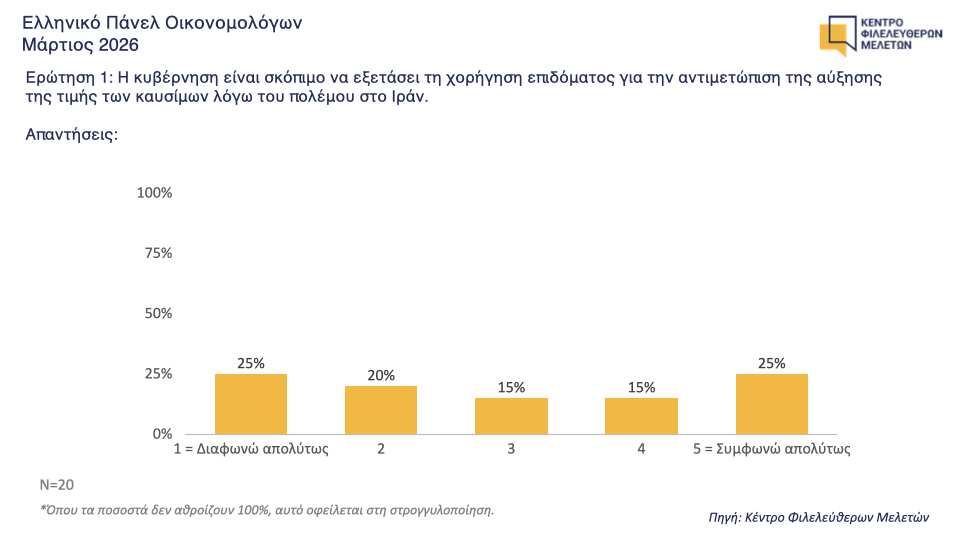
The new geopolitical crisis in the Middle East and its impact on energy and fuel prices bring a familiar economic policy dilemma back to the forefront: whether, to what extent, and in what manner it is appropriate for the state to intervene to mitigate the costs faced by households and businesses, or whether, on the contrary, it should avoid interventions that might weaken price signals, burden the budget, and delay the necessary adjustment of consumption.
In their explanatory comments, which are fully available on the KEFIM website, the Panel members highlight the tension between the need for immediate protection of vulnerable households and the risks associated with a generalized subsidy policy.
Those who take a positive stance emphasize that the rise in energy costs constitutes an external and often unbearable burden, which may justify temporary state support, especially when it disproportionately affects lower-income households or fuel-intensive productive activities.
In contrast, more cautious or negative views emphasize that a fuel subsidy may blunt the signal sent by the price increase, thereby reducing incentives to conserve energy. At the same time, they point out that the evaluation of such a measure cannot be conducted independently of its funding mechanism, the duration of the energy crisis, and its relationship to alternative interventions, such as reducing fuel taxes or more strictly targeting income support.
Weighted responses
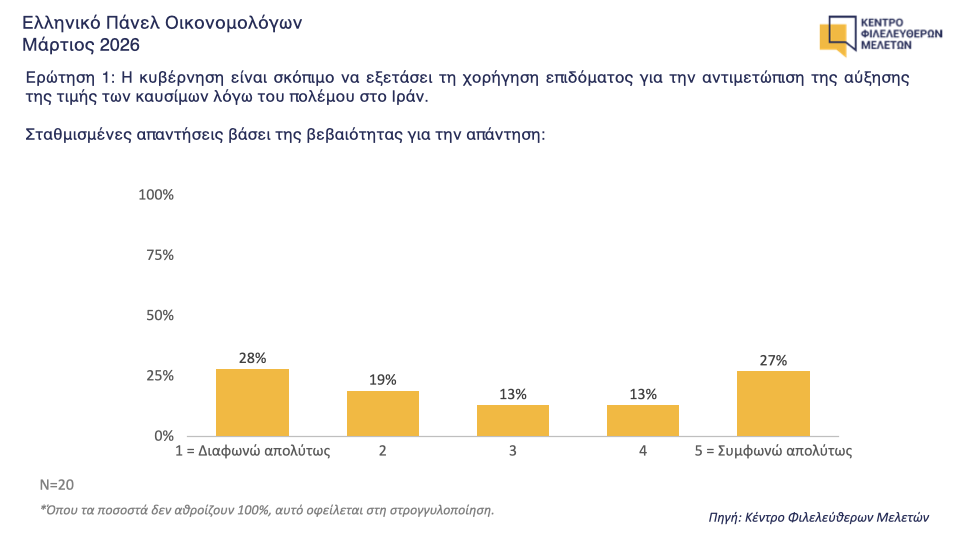
The overall picture that emerges is that members of the Greek Panel of Economists do not necessarily reject every form of intervention in response to a sharp and exogenous increase in fuel costs. However, they view the logic of across-the-board subsidies with clear reservation, especially when these are not accompanied by strict targeting, a clear time limit, and a specified fiscal source.