Households will soon be able to plug in a type of solar system that is particularly popular abroad: so-called “ balcony photovoltaics” (plug-and-play photovoltaics), which, at a low cost of 700–1,000 euros, promise savings of 20%–30% on a typical annual electricity bill.
The provision enabling their use in Greece was included in the Ministry of Environment and Energy’s bill currently before Parliament, with the provision covering systems up to 800 watts that can be installed on both balconies and rooftops, with the exact details regarding their operation to be specified in a ministerial decision to be issued in May.
These plug-and-play systems, which derive their name from their ease of installation, are particularly widespread abroad, both because of their low cost and because their operation is extremely simple. They rely on so-called synchronisation, meaning that the energy generated by the photovoltaic system is consumed at the same time by the home’s electrical appliances.
This, in turn , means that the amount of energy drawn from the grid by household appliances at that moment is reduced, so the owner of the panels saves money. Of course, when there is no consumption at the time the energy is generated, it is not stored, nor can it be sold back to the grid; it is simply lost.
Here is a 10-point guide to everything you need to know about these systems, according to Stelios Psomas, energy consultant for the Association of Photovoltaic Companies (SEF) :
How do they work?
Plug-and-play systems are called “balcony photovoltaics,” but they can be installed anywhere that suits the consumer—whether on a balcony or a rooftop, provided there is space. They take up 3–6 square meters of clear space, are sold in retail stores, are very easy to install (usually DIY), and operate very simply. All you need to do is plug them into a Schuko outlet inside your home.
Can I sell the generated energy to the grid?
No, the energy is for self-consumption only. The energy produced automatically covers the home’s demand. This means that the microinverter “reads” the energy being generated by the photovoltaic system at that moment and directly covers the consumption of household appliances (refrigerator, stove, water heater, etc.) at that time. These systems have nothing to do with the so-called net metering, i.e., the fact that the consumer can sell excess energy back to the grid after meeting their own needs and, of course, receive compensation for it.
How much energy do they produce, and what savings do they achieve?
Two panels with a total capacity of 800 watts produce—depending on the building—1,000–1,200 kWh of energy per year and can achieve 20%–30% savings on a typical annual electricity bill.
How much do they cost?
The cost of purchasing the equipment is low, in the range of 700–1,000 euros, which is the same as or lower than a solar water heater.
What type of consumers are they aimed at?
They are ideal for low-income households, as well as for renters. This is because the owner can easily remove them and reinstall them in their new home.
What happens in the event of a power outage?
In the event of a malfunction or power outage affecting that specific supply, plug-and-play PV systems must stop generating electricity and feeding it into the grid.
Most of the microinverter systems available on the market meet these specifications, meaning they have built-in safety systems that automatically shut down the photovoltaic system’s output in the event of a power outage. Moreover, the vast majority of companies that manufacture microinverters are European.
How can I be sure this will actually be the case?
Since it cannot be ruled out that products not meeting the above criteria may appear on the Greek market, the Ministry of Environment and Energy’s decision on net billing, to be issued in May, will require owners of plug-and-play systems to register them on a special platform to be established by HEDNO for this purpose, for safety reasons.
What exactly will this platform be?
Essentially, the owner of the photovoltaic system will be required to provide detailed information on the Operator’s platform regarding the basic characteristics of the model they purchased, its wattage, and its type, so that HEDNO can determine the safety specifications of each system. In any case, the Ministry of Environment and Energy’s decision in May will precisely outline the solutions and obligations for owners.
What does the experience of other countries show?
Plug-and-play solar systems are particularly popular in Germany, where there are now nearly 1.2 million such systems, while 27 U.S. states are promoting legislation that will enable their operation.
In Germany, “balcony solar panels” have been exempt from VAT for years, while the city of Berlin has established generous subsidy programs, offering around 500 euros to households that purchase such systems. Countries that use a zero VAT rate as an incentive for their adoption also include the United Kingdom, Croatia, Ireland, and the Netherlands.
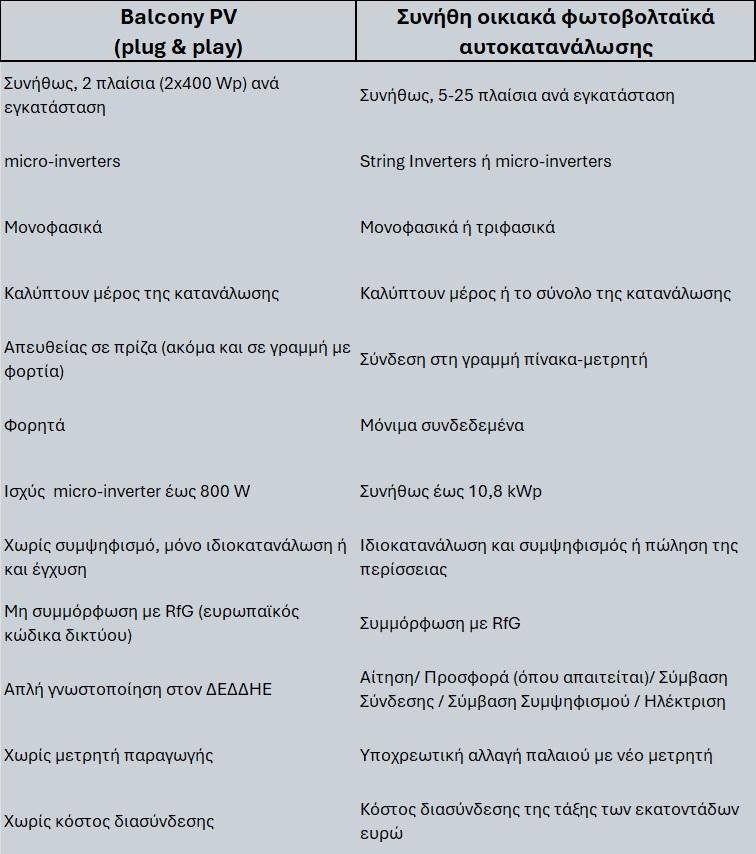
This is a completely different category from standard residential solar panels and they operate in a completely different way, as shown in the comparative table below.