Significant delays in the implementation of key legal provisions, circulars, and court rulings create uncertainty, inequalities, and a constant risk of fiscal derailment of the social security system, at a time when the system will be required—sooner or later—to comply, possibly with retroactive effect.
With the help of the well-known attorney Dimitris Bourlos, who specializes in and understands social security issues like few others, we have compiled some representative cases that reveal a rather disheartening and certainly revealing picture.
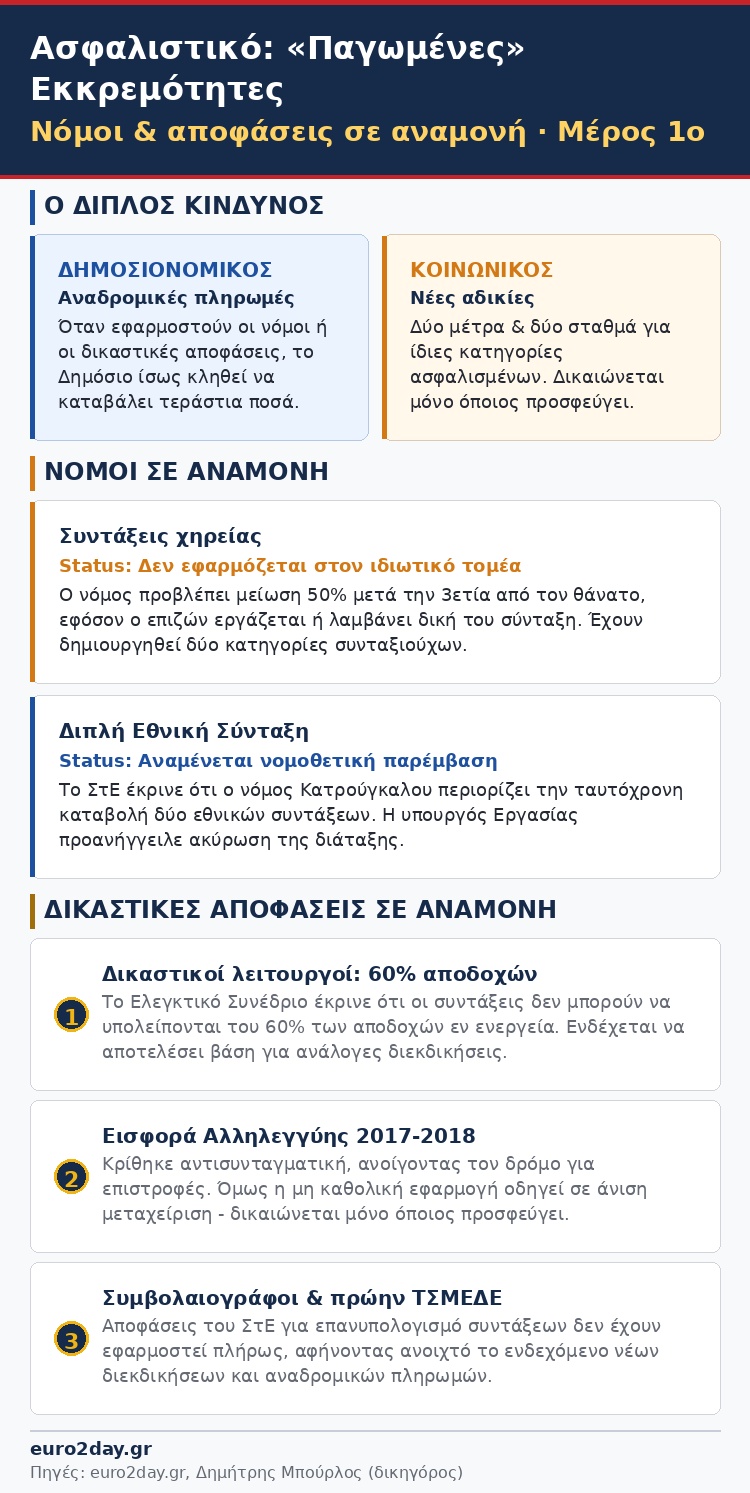
As long as the social security system operates under “frozen” laws and inactive court rulings, it cannot be considered stable. On the contrary, it accumulates obligations that will eventually have to be fulfilled. And when that happens, the risk is twofold: on the one hand, fiscal, as implementation may be accompanied by retroactive payments or refunds; and on the other hand, social, as any decision, after so many years of delay, will create new injustices.
Pensioners are the ones who feel this situation most acutely. They are faced with a system where the rules are not applied uniformly and the final outcome often depends on whether they take legal action.
This not only places a burden on them but also leads to a new wave of legal claims, exacerbating the vicious cycle. Moreover, there are many who, when the government decides to enforce the laws or court rulings, will be required to repay enormous sums, which will throw their family plans into disarray.
Widow’s pensions
The most telling example is how the law is applied regarding the widow’s pension system. According to the law, three years after the insured person’s death, the surviving spouse’s pension must be reduced by 50% if they are working or receiving their own pension.
However, this provision, although enacted, has almost never been applied in the private sector. Thus, two categories of pensioners have emerged: those who continue to receive a full survivor’s pension (70% of the pension the deceased received or was entitled to) and those who have suffered reductions.
The possibility of retroactive application of the law raises legitimate fears of retroactive claims, which would be socially and politically explosive.
On the other hand, as long as the law is not applied, some people experience the injustice of the system, which applies double standards to the same categories of insured individuals—and indeed to those who have experienced the loss of their loved ones.
The situation is similar in cases of widow’s pensions combined with old-age pensions from the former OGA. The unique nature of these pensions, which include a strong welfare component, leads to dramatic reductions when the state portion is removed and only the contributory portion remains. If the projected 50% reduction in the widow’s pension is also added, the final amount becomes extremely low, raising concerns about a decent standard of living.
The national pension
Another critical issue is the payment of a double national pension in cases where a pensioner receives both a pension based on their own entitlement and a widow’s pension. In recent days, the long-awaited decision of the Council of State was issued, which holds that the 2016 Katrougkalos Law restricts the simultaneous payment of two national pensions.
A 2023 circular sought to “resolve” the issue, but it too “ended up on the back burner.” According to Labor Minister Niki Kerameos, who is tasked with managing an issue for which she has not legislated, as soon as the Council of State’s decision is finalized, there will be legislative action to repeal the provision of the Katrougkalos Law. Thus, double pensions will not be reduced—at least as far as the National Pension component is concerned.
The courts
At the same time, judicial rulings are creating additional pressure. The Court of Auditors has ruled that the pensions of judicial officials cannot fall below 60% of their active-duty salaries. This is a ruling with broader implications, as it may serve as a basis for similar claims by other categories of retirees.
At the same time, the same court has ruled that the Solidarity Contribution for the years 2017 and 2018 is unconstitutional, paving the way for refunds. However, the non-universal application of these rulings leads to unequal treatment, as only those who take legal action appear to be vindicated. The State, like another Pontius Pilate, refuses to provide a definitive solution to the issue.
Disability Pensions
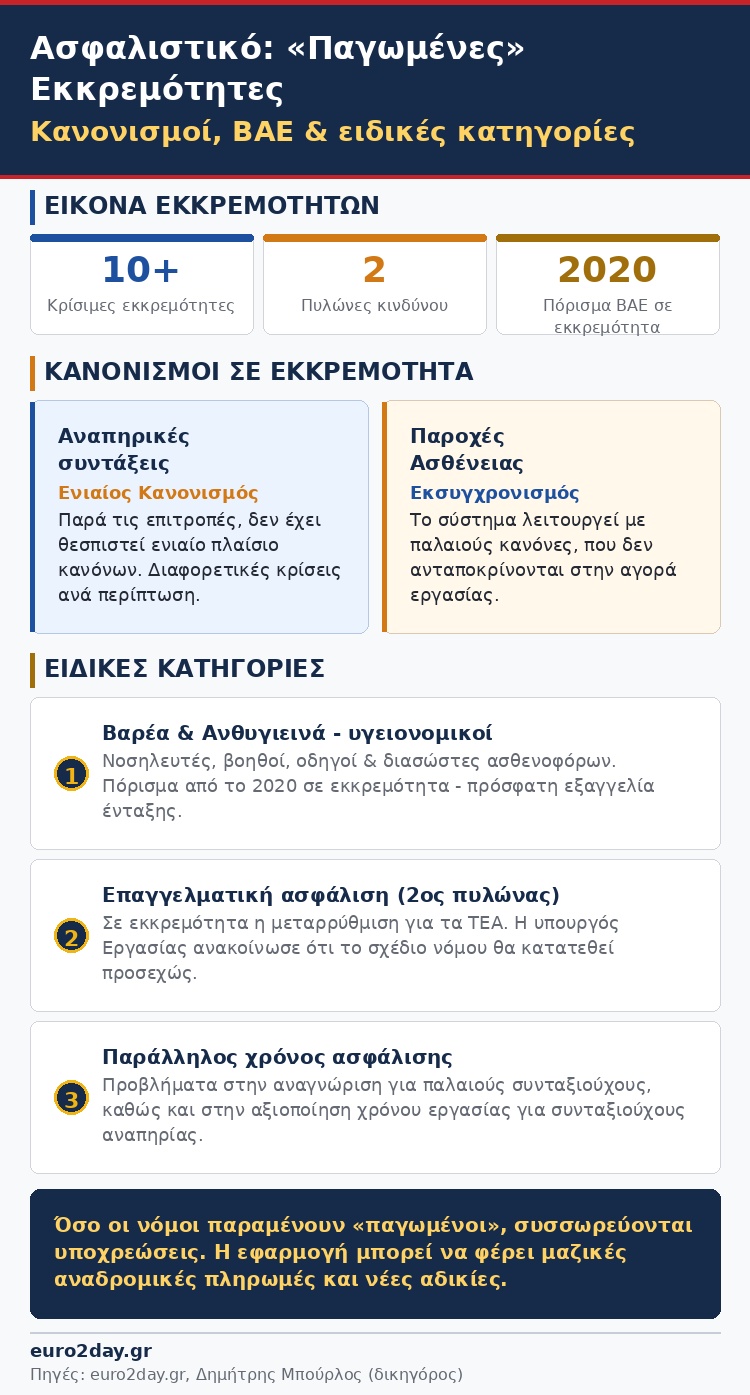
Significant delays are also being recorded in the area of disability pensions. Despite the establishment of repeated committees, a unified framework of rules— a Single Regulation—has not yet been adopted. This results in varying practices and judgments depending on the case, creating a sense of injustice among insured individuals.
The same situation applies to key regulations, such as the Sickness Benefits Regulation and the Insurance Regulation for employees and the self-employed. The delay in modernizing them means that the system continues to operate under outdated or fragmented rules that do not meet the contemporary needs of the labor market. This is all the more true given that the EFKA is seeking to create a new, unified, and modern information system.
Occupational insurance
In the area of occupational insurance, an announcement regarding the re-reform of the Occupational Insurance Funds remains pending, despite its importance for the sustainability of the overall system. Strengthening the second pillar could relieve pressure on the public system, but delays are postponing this possibility. The minister in charge, Niki Kerameos, recently stated that the draft bill is already in the pipeline and will be submitted to Parliament in the near future.
Of particular interest are the cases of pension recalculations for specific categories, such as notaries and former TSEMEDE insured individuals, following decisions by the Council of State. These decisions have not been fully implemented, leaving open the possibility of new claims and retroactive payments.
Even the recent announcement regarding the inclusion of nurses, nursing assistants, drivers, and ambulance attendants in the Heavy and Unhealthy Occupations category at hospitals had been pending for years, despite the fact that a relevant report had been drafted as early as 2020. In fact, the failure to implement it for a number of workers deprives them of the possibility of more favorable pay or retirement terms, even though the report concludes that they too should be included.
Similar problems are also found in the recognition of parallel insurance periods for older retirees, as well as in the calculation of work time for disability pensioners.
In all these cases, the absence of clear and implemented rules leads to delays and disputes.