Significant potential for tourism growth outside the peak season despite the signs of improvement recorded in recent years in reducing seasonality.Greek tourism continues to depend heavily on the summer season, according to a new study by Data Appeal Mabrian, which examines trends in inbound tourism demand across five key European Mediterranean destinations—Greece, Spain, Italy, Croatia, and Portugal, focusing on seasonality indicators, air connectivity, traveler profiles, pricing trends, and demand drivers.
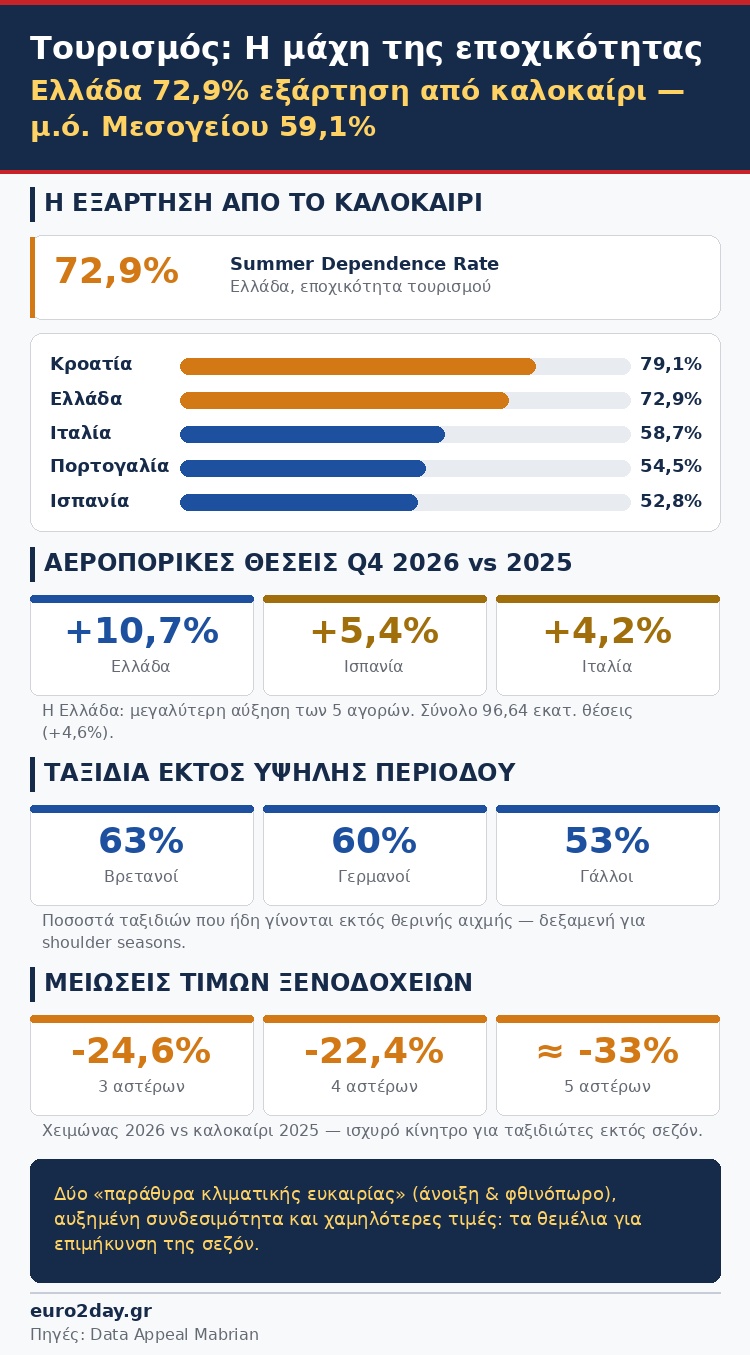
Based on the findings, regarding Greece, the “Summer Dependence Rate” stands at 72.9%, significantly higher than the average for European Mediterranean countries, which is 59.1%.
This places Greece well behind more established destinations such as Spain, which has the lowest degree of dependence on the summer season at 52.8%, as well as Portugal (54.5%) and Italy (58.7%). Only Croatia shows greater dependence on the summer season, at 79.1%.
The positive signs
The study, however, also notes positive signs for the Greek market, as it observes a gradual expansion of tourism activity during the so-called “shoulder seasons”—that is, the periods preceding and following summer, namely spring and fall.
Air connectivity appears to play a decisive role in extending the tourist season. According to data from Data Appeal Mabrian, in the fourth quarter of 2026, Greece recorded the largest increase in available airline seats among the five countries under review.
Specifically, during the period from October - December 2026, the availability of airline seats to Greece is expected to increase by 10.7% compared to the same period in 2025, a performance that significantly exceeds those of Spain (+5.4%) and Italy (+4.2%).
In total, 96.64 million airline seats will be available across the five markets by the end of 2026, an increase of 4.6% year-over-year.
The improvement in connectivity applies to both low-cost airlines and traditional carriers, which are now expanding their operations beyond the summer peak season.
Weather conditions also represent a significant advantage for Greece. According to the Perception of Climate Index (PCI), Greece is among the countries with two “climate opportunity windows”—that is, periods when actual weather conditions exceed travelers’ expectations. According to the study, one “window” is in late winter and early spring, and the other is during the fall.
These periods can serve as a lever to attract short- and medium-haul travelers, particularly from mature European markets such as the United Kingdom, Germany, and France.
The survey data show that 63% of trips by British travelers, 60% by Germans, and 53% by French travelers already take place outside the peak tourist season, a fact that creates significant growth potential for Greek destinations.
At the same time, the report identifies increased interest from specific categories of travelers, such as digital nomads, young professionals, and retirees, who are increasingly opting for off-peak travel.
Lower prices as a competitive advantage
Pricing policy also plays a significant role in stimulating demand during the off-season . According to the survey, hotel prices in the winter of 2026 were significantly lower compared to the summer of 2025.
Price reductions averaged 24.6% for three-star hotels and 22.4% for four-star hotels, while prices at five-star properties were nearly one-third lower.
Finally, Data Appeal Mabrian notes that many of the most attractive tourist activities for visitors to the European destinations under review—such as cultural experiences, nature activities, and gastronomy— are by their nature less… seasonal, offering significant potential for further balancing demand beyond peak periods.