The policy models already implemented by three European Union countries (Spain, Ireland, and Croatia) will serve as a “roadmap” for resolving the major housing problem that exists across Europe.
At Greece’s initiative, the housing issue will be at the top of the agenda for discussions at the informal Eurogroup meeting to be held tomorrow in Nicosia, chaired by Minister of National Economy and Finance Kyriakos Pierrakakis, at a time when the housing market crisis is affecting nearly all European countries.
The head of the Eurozone Finance Ministers’ Council aims to launch a substantive dialogue on policies that can be implemented at the European level, as soaring rents, the lack of available housing, and increased pressure on major cities now pose a common challenge for the economies of the eurozone.
The 21 member countries participating in the Eurogroup will exchange experiences and draw ideas for effective affordable housing policies, based on the successful housing policy models implemented by Spain, Ireland, and Croatia.
A common feature of all three countries is that they do not limit themselves to a single measure. They primarily combine a tax on vacant properties, social housing, subsidies, and policies to increase supply and restrict short-term rentals, recognizing that the housing crisis requires a multi-level and long-term strategy.
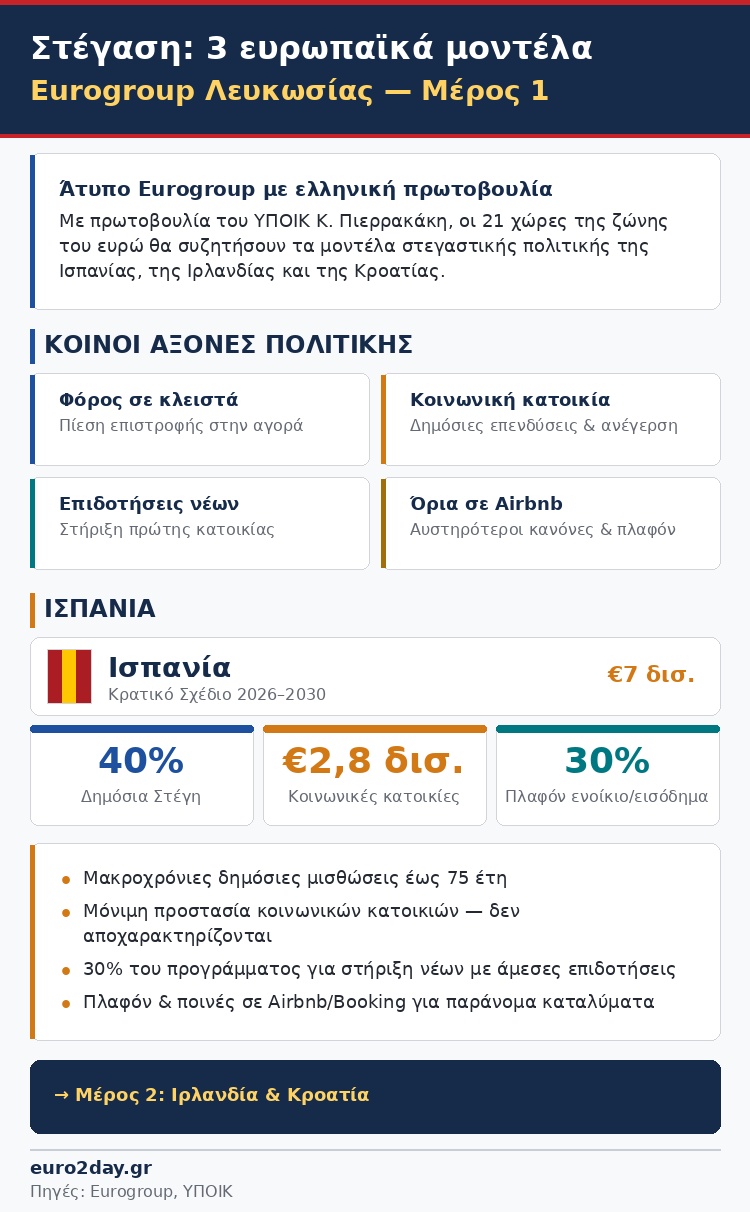
Three countries
Spain has approved the 2026–2030 National Housing Plan, worth 7 billion euros, which triples public investment to address the housing crisis, skyrocketing rents, and speculation.
The pillars of the Iberian country’s housing policy are:
- Expansion of Public Housing (40% of the budget).
- To boost the housing stock, approximately €2.8 billion will be allocated for the construction and acquisition of new social and public housing.
- Subsidized or social housing built with public funds is now permanently protected and may not be reclassified or sold to private individuals.
- Launch of a new public system for affordable, long-term rental housing (up to 75 years), with rent capped at 30% of beneficiaries’ income.
- Part of the total budget will be allocated to the renovation of existing buildings, with an emphasis on accessibility and the “green” transition.
- To address depopulation, housing will be built in degraded or remote-depopulated areas of the country.
A large portion (nearly 30%) of the Spanish housing program aims to support young people through direct subsidies and housing assistance, as the country has one of the highest rates in Europe of young people unable to leave their parents’ homes.
On the short-term rental front, strict restrictions and caps are being introduced, along with obligations for major platforms (such as Airbnb and Booking.com) to immediately remove illegal or unlicensed tourist accommodations.
Ireland’s Plan
Ireland is implementing the national plan “Delivering Homes, Building Communities 2025–2030” with a record-breaking budget of €11.3 billion for 2026 alone. The goal is to build 300,000 new homes by 2030 to address the severe housing crisis.
The key measures that have been implemented fall into three main categories:
- Strict rent controls (in effect since last March) with the imposition of a national cap of 2%. Rent increases across the country (and not just in selected areas) can no longer exceed 2% annually or the rate of inflation, whichever is lower.
However, to prevent private investment from stalling, brand-new apartments (with construction starting after June 2025) are exempt from the 2% cap, and their rent increases are tied exclusively to inflation.
Landlords may adjust rent to current market rates only if a tenant voluntarily moves out or if a 6-year lease term expires through no fault of the landlord.
- Regarding tax incentives, the VAT rate on the sale of finished apartments has been drastically reduced from 13.5% to 9% through 2030 to offset construction costs for developers.
Furthermore, a tax of at least 7% on the market value has been imposed on owners who allow properties to fall into disrepair, forcing them to either renovate or sell them.
Companies investing in the state-run“Cost Rental”model (affordable rents that cover only construction/management costs) are fully exempt from corporate tax on this income.
- From the budget, €2.9 billion is allocated directly for the construction of 10,200 new social housing units and the purchase of existing properties by the state.
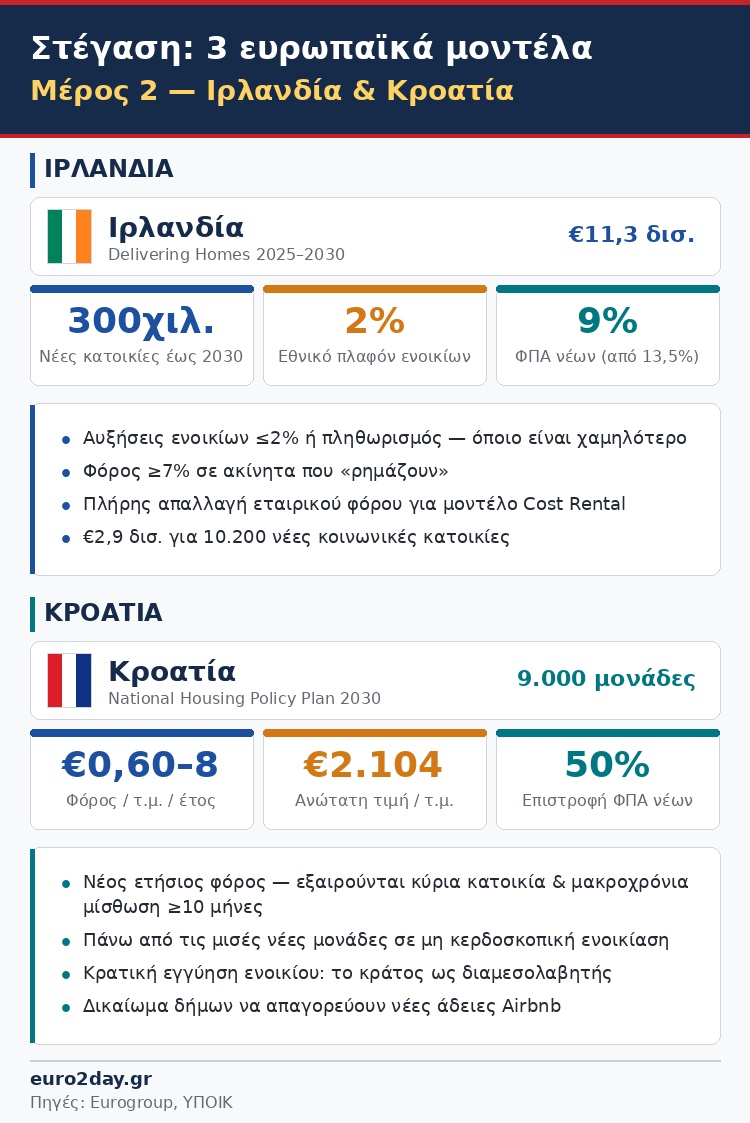
Croatian Model
Croatia is implementing the National Housing Policy Plan through 2030. This plan is accompanied by a radical tax reform on real estate, which aims to combat the massive housing shortage caused by short-term leases and vacant apartments.
Croatia’s model revolves around the following key measures:
- To compel owners to put vacant homes on the long-term rental market, a new annual property tax has been introduced. The tax ranges from 0.60 to 8 euros per square meter per year. It applies to all residential properties, vacation homes, and vacant apartments. The exact amount is determined by municipalities based on location and age.
Owners who use the property as their primary residence or rent it out under a long-term lease for at least 10 months a year are exempt from the tax.
- The government has also introduced a law on affordable housing. For new apartments built through the state program, a maximum sale price of 2,104 euros per square meter has been set.
Plans are in place to construct and make available approximately 9,000 new housing units by 2030, at least half of which will be allocated exclusively for non-profit, affordable rental housing.
- The government offers one-time cash payments and acts as an intermediary (state rent guarantee) to encourage private individuals to make their vacant apartments available for affordable rent.
- To help young people up to age 45 buy their own homes, significant tax breaks are being implemented, such as: a 50% VAT refund for the purchase of a newly built property, and a full exemption or refund of the transfer tax for the purchase of a primary residence.
- At the same time, to address the problem of overtourism, a tourism law was passed that gives municipalities the right to set strict limits and ban new Airbnb licenses in areas where housing has become unaffordable for permanent residents.

Greece
As for our country, government plans are focused on new measures to boost housing construction and utilization. The three-year tax exemption already in place for properties returning to the market, renovation programs for vacant homes, and energy upgrades are just the beginning. The government is also considering additional tax and financial incentives to activate more properties that currently remain unused.
Particular emphasis is also placed on the new framework for social compensation, through which public properties can be utilized to create new housing based on social criteria. At the same time, the “My Home 1” and “My Home 2” programs continue to serve as a key tool for helping young people access homeownership, while ways to expand the pool of eligible recipients and increase available resources are being explored.