The short-term rental market in Greece is experiencing strong growth ahead of the summer, with demand rising at a rate that exceeds the European average.
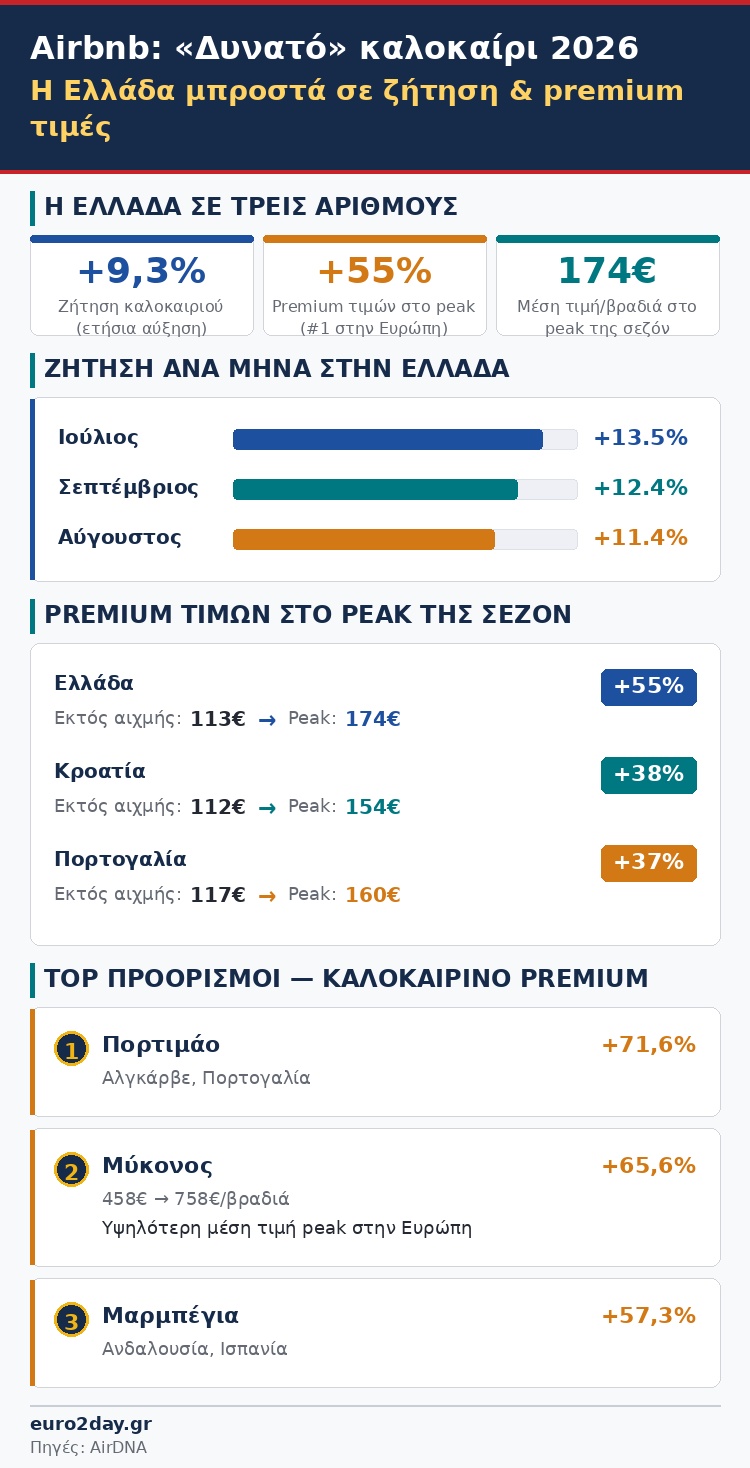
According to AirDNA data, demand for Airbnb-style accommodations in Greece has increased by 9.3% for the summer season on a year-over-year basis, with Portugal recording a 5.7% annual increase and Croatia lagging by 6.4% and being the weakest market among the top 20, a fact that suggests a slowdown after several years of exceptional post-pandemic growth.
It should be noted that Greece, Portugal, and Croatia belong to the same group, that of medium-sized markets.
The picture in Greece
More specifically, regarding the domestic market, July recorded the highest growth at 13.5%, with September following with a 12.4% increase, effectively contributing to the extension of the tourist season, and August at 11.4% year-on-year.
The growth of the short-term rental market in Greece is outpacing the European average of 8.2%. Indicative of the momentum characterizing this market is the fact that Greece has the highest premium rate among major European markets, reaching 55%.
Specifically, the average daily rate during the off-peak season is 113 euros, a figure that rises to 174 euros in the summer, at the peak of the season.
Croatia follows in second place with a price ranging from €112 to €154 at the peak of the season, representing a 38% increase, and Portugal comes in third with a 37% increase, rising to €160 from €117 during the off-season.
Rounding out the list are the Netherlands with a 4.9% increase and Belgium with a 4.6% increase, while Norway recorded a marginal increase of 0.5%.
The picture is similar when it comes to destinations. This time, however, Portimão (+71.6%) on the Algarve coast in Portugal recorded the highest summer premium among all major European markets, while Mykonos (+65.6%) and Marbella (+57.3%) are not far behind.
Of course, as for the Island of the Winds, according to AirDNA data, the average daily rate during the peak season reaches €758, up from €458 during the rest of the year, and is the highest among the countries under review.
April Performance
The domestic short-term rental market showed resilience in April. The number of available listings decreased by 3.6% year-over-year, which helped mitigate the decline in occupancy.
Despite lower occupancy, Greek owners managed to improve their performance in terms of pricing. The average daily rate (ADR) rose by 7.8%, reaching €107.1. Furthermore, revenue per available room (RevPAR) increased by 2.1%, reaching €58.7, despite the overall slowdown in occupancy.
Overall, in April, supply increased by 3.6%, while demand decreased by 5.7% year-over-year. This imbalance led to an 8.2% drop in occupancy, which stood at 55.3%.
Despite the overall decline in demand, the outlook for the summer remains positive, as demand for the June-August period is up 8.2%, indicating that the market expects stronger travel activity during the summer months.
Demand for the upcoming summer in Europe’s 20 largest markets remains strong, despite geopolitical uncertainty. Overall, these markets are growing at a rate of 7.8% year-over-year. The picture shows positive momentum, as 17 of the 20 markets are already above last year’s levels of bookings and demand.
Denmark recorded the largest increase at +50.9%, with Germany (-0.5%), Croatia (-6.4%), and Austria (-0.6%) being the three countries with negative growth.
It should be noted that the 20 countries under review are: Denmark, Finland, Norway, Hungary, the Czech Republic, Spain, Poland, Austria, Sweden, Italy, Sweden, the Netherlands, Ireland, Belgium, Germany, France, Greece, Portugal, the United Kingdom, and Croatia.