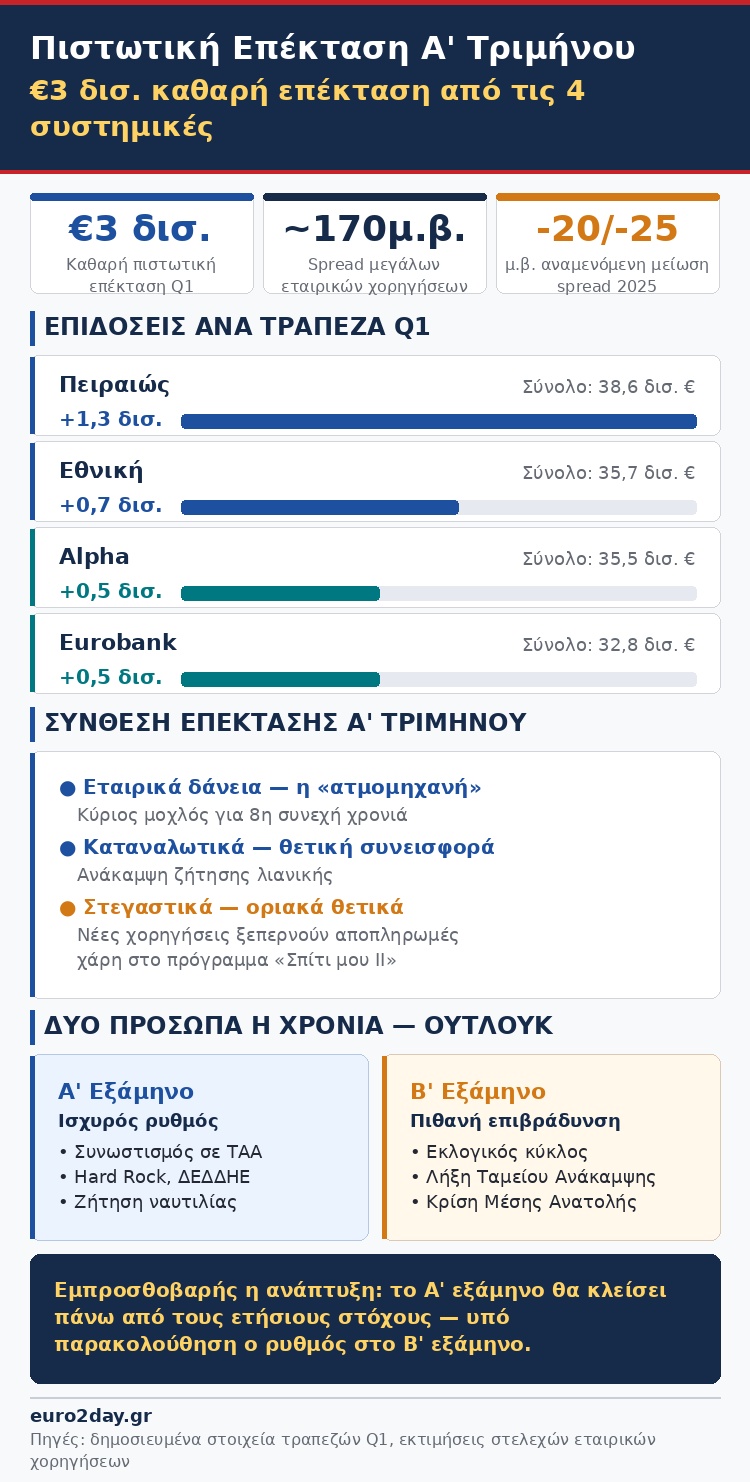
The four systemic banks recorded a net credit expansion of €3 billion in the first quarter of the current fiscal year, confirming that for this year, the growth of the performing loan portfolio continues to be thecornerstone of their investment narrative.
For the eighth consecutive year, corporate lending served as the “driving force,” while retail loans made a positive contribution, thanks mainly to consumer loans. On the other hand, new mortgage loan disbursements marginally exceed repayments thanks to the “My Home II” program .
This one-dimensional growth of the loan portfolio fuels investors’ questions about how sustainable given the impact the election cycle, the expiration of the Recovery and Resilience Facility, and the oil and natural gas supply crisis caused by the conflict in the Middle East will have on the economy.
This environment is likely to result in a year of two halves regarding domestic credit expansion. Specifically, strong growth is expected in the first half of the year, followed by a slowdown in the final months. It is no coincidence that the two systemic banks, whose performance is based almost exclusively on the trajectory of the domestic economy (Piraeus Bank, National Bank of Greece), posted the highest credit expansion in the first quarter.
Piraeus increased its performing loans by €1.3 billion to €38.6 billion, and National Bank by €0.7 billion to €35.7 billion. It should be noted that the first quarter has historically been the “weakest” in terms of performance for National Bank of Greece. Eurobank and Alpha each increased their performing loan portfolios in Greece by €0.5 billion. As of March 31, Alpha had performing loans totaling €35.5 billion, while Eurobank had €32.8 billion.
According to management statements, “April and the first days of May were“strong”in terms of credit expansion,” a development that was expected, partly due to the… rush observed in the low-interest loan segment of the TAA, in order to secure the remaining funds. Barring any unexpected developments, the first half of the year will close, according to corporate lending executives, above the targets for the full year.
The front-loaded growth of the portfolio contributes to the goal of recovering net interest income, which will be aided by a potential 25-basis-point interest rate hike by the ECB.
This year began with two “buffers.” Some of last year’s major loan agreements are being disbursed, in part, this year (HEDNO, Hard Rock Athens, etc.). At the same time, according to corporate lending executives, there is strong demand from deep-sea shipping companies, which, combined with participation in international syndicated issuances, will serve as a “buffer” in case domestic demand “stalls.”
Margins narrowing at a “moderate” pace
Importantly for banks and investors, the average loan spread remained at the previous quarter’s levels or declined more modestly than banks had guided, with the margin on large corporate loans holding steady around 170 bps.
Banks have guided the market toward a reduction in the corporate loan spread this year of around 20 to 25 bps. If these estimates are confirmed, the impact will be offset by the increase in the “pie” of performing loans.
The net interest income lost due to a 25-basis-point reduction in the spread is offset by credit expansion of approximately €1.5 billion.