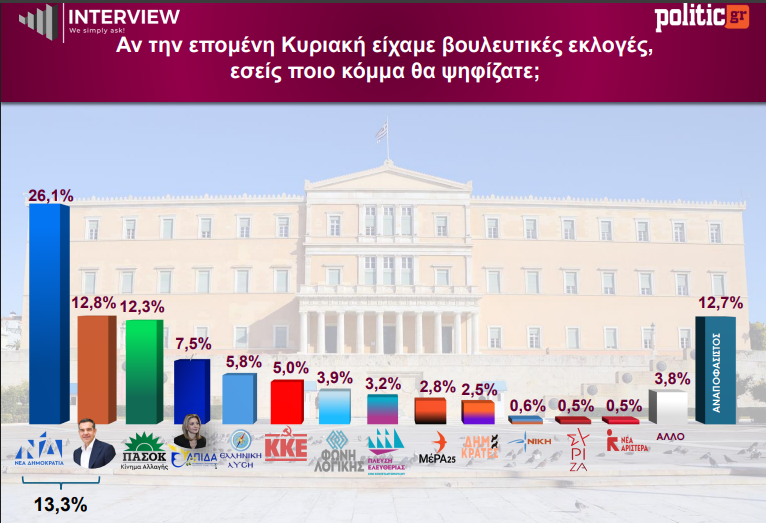
The latest Interview poll for POLITIC shows New Democracy with a clear lead at 26.1%, but the real focus of the survey is on the battle for second place. Alexis Tsipras ’s fledgling party stands at 12.8% and narrowly leads PASOK, reigniting the debate over dominance in the center-left. PASOK has fallen from 13.5% in April to 12.3% in May, losing its advantage as the “obvious” second-place contender.
At the same time, Maria Karistianou’s party ranks fourth with 7.5%, down from 7.9% in April, indicating that it maintains an independent voter base despite the entry of the Tsipras factor into the polling equation. In contrast, SYRIZA drops from 3.1% to 0.5%, marking one of the poll’s most striking findings. In the scenario of a new Tsipras party entering the race, it appears to lose almost all of its polling ground.
The right-wing bloc remains active as Greek Solution rises to 5.8%, while Voice of Reason reaches 3.9%, clearly surpassing the 3% threshold.
The undecided have dropped from 14.8% in April to 12.7%, an indication that a portion of the public is beginning to make up their minds.
Here are the parties’ detailed percentages:
- New Democracy 26.1%
- Tsipras’ Party 12.8%
- PASOK 12.3%
- Hope for Democracy 7.5%
- Greek Solution 5.8%
- KKE 5.0%
- Voice of Reason 3.9%
- Freedom Course 3.2%
- MERA25 2.8%
- Democrats 2.5%
- Niki 0.6%
- SYRIZA 0.5%
- New Left 0.5%
- Other party 3.8%
- Undecided 12.7%
Despite New Democracy’s clear lead in voting intentions, the public’s assessment of the party’s political resilience is not equally solid. When asked whether New Democracy can win another term in the upcoming elections, 44% answer “yes/probably yes,” while 45% believe it will not manage to prevail again.
At the same time, in the event of a second round of elections, the vast majority of respondents state that they would be unlikely to change their initial choice. Specifically, 82% consider it “somewhat unlikely/not at all likely” that they would vote for a different party, while only 15% say it is “very likely/quite likely” that they would switch.
Karystianou moves toward the center, skepticism toward Tsipras, “no” to a new role for Samaras
On the Right-Left axis, where 1 corresponds to the far Right and 10 to the far Left, Maria Karistianou’s party is positioned at 4. The finding shows that citizens do not place her in a purely left-wing or anti-establishment space, but see her closer to the political center, with a slight tilt toward the right of the spectrum.
At the same time, although Tsipras’s party, currently in the process of formation, is showing significant momentum in the polls, his personal political image continues to carry strong reservations from his time in government. When asked whether, compared to his 2015–2019 term in office, he appears better, the same, or worse, 45% say he is worse, 32% consider him the same, while 20% believe he is better.
The message regarding Antonis Samaras is even clearer. When asked what he should do, 62% say he should retire from politics, 27% believe he should form his own party, while just 7% favor his return to New Democracy.
Who will answer the crisis phone? Citizens say Mitsotakis
In a hypothetical scenario where the country comes under attack at 3 a.m. and the “red phone” rings in the Prime Minister’s office, Kyriakos Mitsotakis garners 34% of citizens’ spontaneous positive responses.
In second place is the “other” option with 23%, indicating that many citizens cannot find anyone they trust in a critical moment. Alexis Tsipras follows with 14%, while 13% answer “none.” Nikos Androulakis garners 10%, while Maria Karistianou stands at 6%.
The picture is similar when asked which political leader citizens trust most to govern the country. Kyriakos Mitsotakis leads with 29.9%, followed by the “none” option at 15.2%. Alexis Tsipras registers 14.2%, Nikos Androulakis 10.1%, Kyriakos Velopoulos 5.6%, and Maria Karistianou 5.5%.
One in two sees parties supported by Russia
When asked whether there are parties in Greece, inside or outside Parliament, that receive favorable treatment or support from Russia, 50% of respondents answer “yes/probably.”
In contrast, 33% believe that there are no such parties or that there are probably no such parties, while a significant 17% did not express an opinion.