Many countries have used various means to achieve their geopolitical goals from antiquity to the present day. In 2020, Turkey attempted to use migrants who had gathered with the help of Turkish authorities at the Greek-Turkish border and were trying to enter our country as a tool to exert political pressure on Greece and the EU.
In the 1970s, Arab countries used oil as a lever of pressure, imposing an embargo through OPEC to achieve their geopolitical goal.
U.S. President Trump has also recently used trade tariffs, sanctions, and restrictions on exports of advanced chips to reduce the U.S. trade deficit and achieve geopolitical goals.
China has also used rare earths as a bargaining chip with the U.S.
Today, Iran is using the closure of the Strait of Hormuz and rising oil prices as a bargaining chip in discussions with the U.S. to reach an agreement.
Historically, food has been used as a means to achieve geopolitical goals during sieges. From Constantinople to Messolonghi and the 21-year siege of Chandakas in Crete. Control of the food supply chain can lead to sharp price increases and shortages, resulting in military victories. Control of food has been part of political and military strategy for centuries.
The issue of food security came to the forefront following Russia’s invasion of Ukraine in 2022. This is because the two countries are major grain suppliers to various parts of the world, including Africa. However, the worst fears—including those of famine—did not materialize.
Today, food is not a clear-cut means of achieving geopolitical goals. However, it can be used as a lever of pressure and is more deeply embedded in the existing system. It is well known that the closure of the Strait of Hormuz led to significant price increases for urea and sulfuric acid, which affect the price of fertilizers and, by extension, food.
Some countries, such as China, appear to have realized the importance of food as a geopolitical weapon and are taking their own measures. China is stockpiling grain and purchasing large tracts of land abroad.
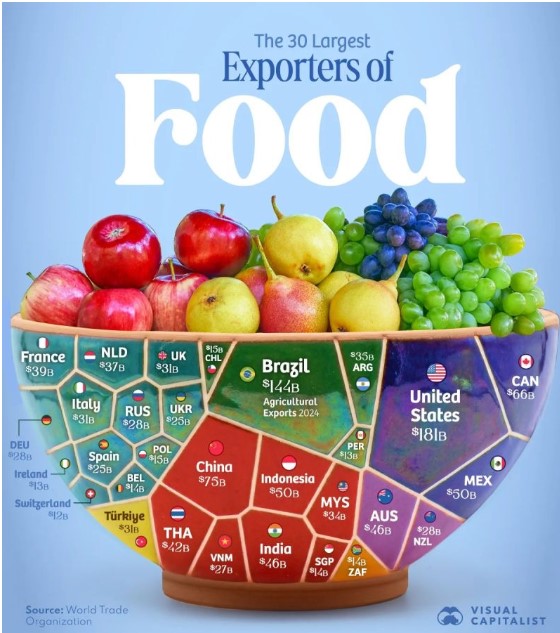
The answer to why it is doing this is provided by data on global food exports. As it turns out, food production is concentrated in a few countries, making it vulnerable. Half of global food exports come from 10 countries, led by Brazil, the U.S., Canada, and Australia. It is worth noting that even Turkey exports agricultural products worth $31 billion, as much as Italy.
Furthermore, it doesn’t take much to put pressure on prices. War in a key region, drought, transportation disruptions, or higher fuel costs can drive up global food prices. Furthermore, export restrictions aimed at ensuring domestic supply can drive up international prices.
Consequently, food could become the next flashpoint. Some countries, such as those in the Persian Gulf and China, take food security seriously as they recognize its geopolitical dimension. Others do not, assuming that the supermarket shelves in their countries will always be full.
Sooner or later, it will become clear which countries are right.