A look at our bank card statements reveals a bitter truth about our wallets. A few euros for a movie streaming service, a little something for music in the car, a small fee for extra mobile data, and a monthly pass for free food delivery can add up to a full year’s salary, depending on the mix of subscription services and how much we use them.
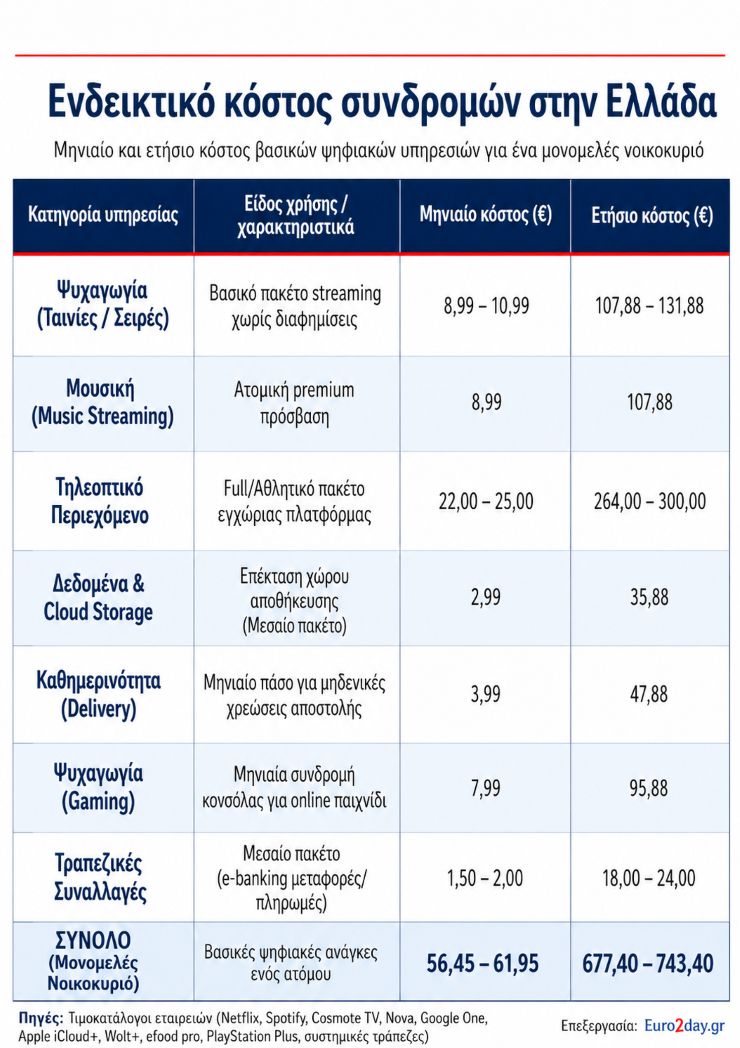
Individually, these amounts seem negligible. At the end of the month, however, their sum brings the consumer back down to a completely different reality. According to the price lists of the most popular subscription services and packages, these fixed costs can reach 55–60 euros per month for an adult. This amount nearly doubles and can reach 1,450 euros a year for a family with two children.
The “few euros” trap
Subscriptions offer perks and discounts for heavy use of a service for just a few euros. The problem for Greek consumers lies in how these expenses relate to their salary. With the net minimum wage at 772 euros and the average net wage in the private sector close to 1,149 euros, the “digital subscription basket” absorbs a disproportionately large portion of earnings compared to other EU countries.
When half of the country’s wage earners are paid less than €1,000 net, monthly “fixed costs” rob them of valuable flexibility. Especially at a time when income for the majority of households runs out before the month is over.
Price increases
Over the past three years, platforms have implemented successive price hikes to cover production costs. At the same time, the ban on sharing access codes among friends has forced thousands of users to pay for individual, more expensive subscriptions.
Prices in Greece, excluding gym memberships or other activities, as well as AI, are as follows:
- Video streaming platforms: Basic ad-free access starts at €8.99, while standard HD packages go up to €10.99. For 4K resolution, the cost rises to €13.99 per month. Even platforms that launched with low introductory prices (at €8.99) have now aligned their premium pricing at €13.99.
- Music services: The most popular music platform in Greece, which for years cost €6.99, has gradually risen to €8.99 for the individual plan (a 28% increase). Similarly, the family plan now costs €14.99.
- Cloud storage: High-resolution mobile photos have made backing up photos almost mandatory. Small packages (50GB–100GB) remain affordable, ranging from €0.99 to €1.99. However, expanded or combined ecosystem packages now cost €14.95 for the individual plan and up to €22.95 for the family plan.
- Pay TV and sports: Following recent domestic agreements on simultaneous broadcasts of matches, full sports packages range from €22 to €25 per month.
- Banking packages: The latest addition to monthly expenses. Major banks have introduced fees for account maintenance and e-banking. Basic packages start at 0.60 euros per month, mid-tier packages (with 4–5 free payments) range from 1.50 to 2 euros, while premium packages reach 5 euros per month, offering a certain number of free transactions and services.
Children and scooters
While a freelancer might keep costs under 62 euros, for a family with children the picture changes dramatically. Teenagers’ needs are completely tied to the digital environment: online gaming, passes for game upgrades, separate accounts for music and photo storage.
Using electric scooters to get to school or tutoring is no longer charged by the minute, but through monthly passes. These provide free rides and a set amount of usage time, costing about 10 euros a month per child.
In total, the fixed subscription cost for each school-age child is around 75 euros per month. Let’s look at an example of a four-member Greek family with two children who wants to meet everyone’s needs:
Cloud-based entertainment
This requires a premium movie package (€13.99), a second content platform (€9.99), a family music package (€14.99), and expanded cloud backup (€9.99). Add pay-TV for the home (€25), two gaming subscriptions for the kids (€15.98), a delivery service (€3.99), a banking package (€2), an app for the child’s online allowance (€1.99), and two monthly passes for electric scooters (€20). This example does not include subscriptions for mobile phone service, data, internet, gym memberships, or other activities.
This means that for the household:
- The cost comes to €120.91 per month.
- The annual cost amounts to €1,450.92.
The relationship to the salary
This amount far exceeds the net base salary (772 euros) and is higher than the country’s average monthly net salary (1,149 euros). Essentially, an average family in Greece works about 1.3 months a yearto pay for its members’ subscriptions.
Double the cost
A subscription of 10 or 15 euros has the same nominal cost in Athens, Paris, or Munich. Its impact on disposable income, however, differs radically.
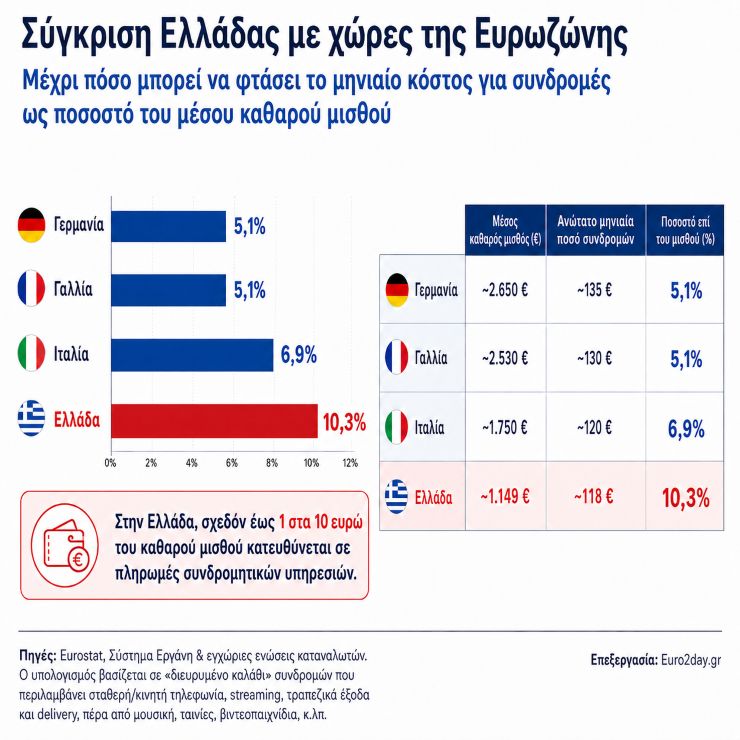
To capture the true burden at the European level, analysts typically examine a broad range of subscription costs. In addition to traditional subscriptions, this includes fixed and mobile internet, as telecommunications form the foundation for every digital service. In Greece, these costs are traditionally higher than the European average, pushing the total expenditure to 118 euros.
A comparison of four Eurozone countries reveals a huge disparity:
- In Germany, with an average net salary of €2,650, the expanded basket of €135 accounts for just 5.1% of income.
- In France, with an average net salary of €2,530, the corresponding cost of €130 also represents 5.1% of monthly earnings.
- In Italy, where the average net salary drops to €1,750, the cost of €120 accounts for 6.9% of the salary.
- In Greece, however, with the average net salary at €1,149, the cost of the basket (€118) accounts for 10.3% of the salary.
The financial burden on Greek workers is exactly double that of their French or German counterparts.
Proper use
Recognizing the high cost does not mean we should do away with everything. These services offer utility, entertainment, and discounts. However, a plan and careful calculation are needed to identify the point where small amounts add up to a sum greater than what our budget can handle. This plan includes:
- “On-Off” Strategy for Streaming Platforms: There’s no reason to pay for three different streaming services at the same time. Consumers can activate one service, watch the shows they’re interested in, and cancel it the following month, switching to a competitor.
- Take advantage of family plans: Shared family plans for music, cloud storage, or banking services can reduce the cost per user by as much as 40%.
- Seasonal control for scooters: Subscriptions for electric scooters make sense during months with good weather. They can be deactivated during the winter.