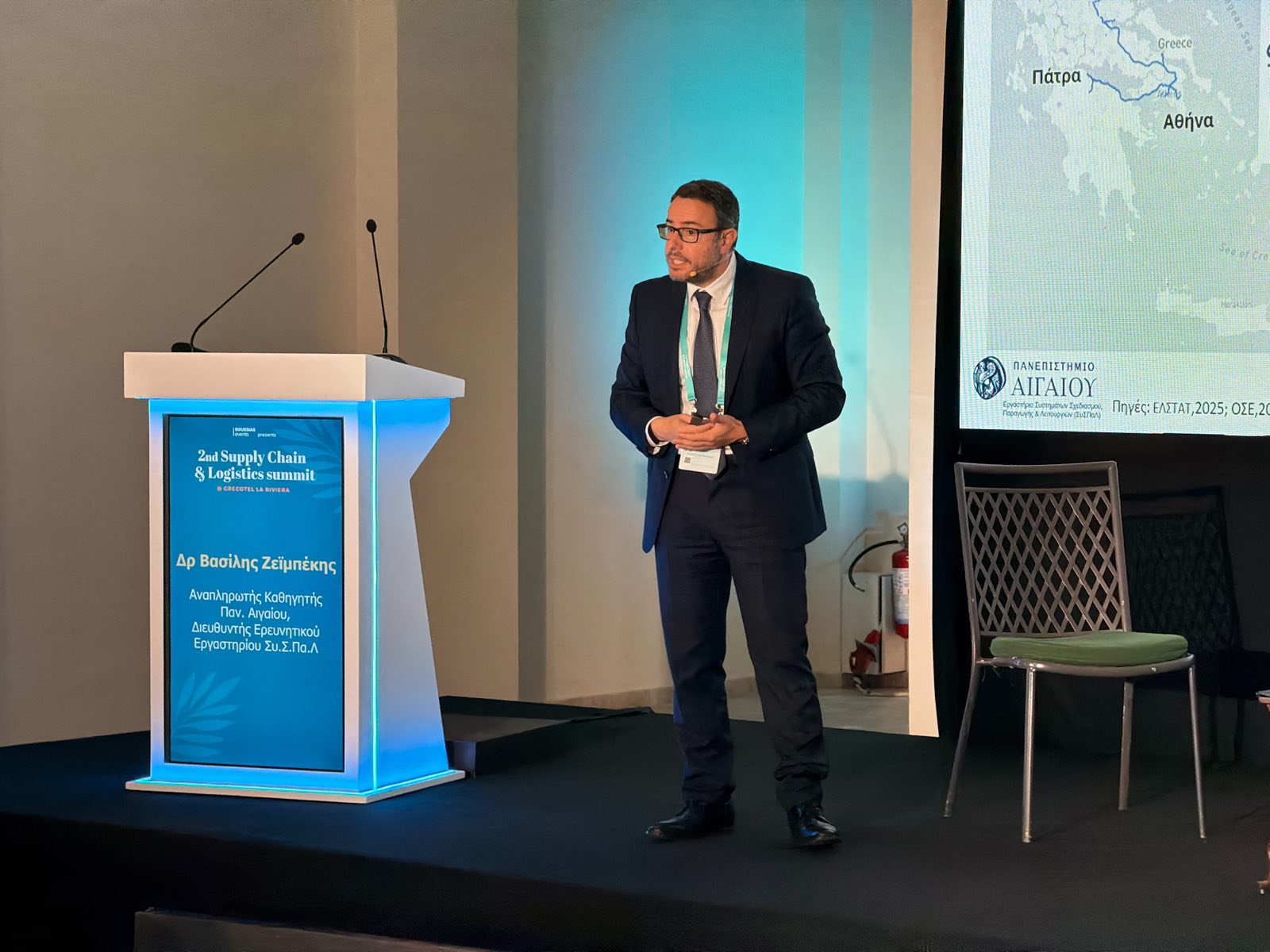
The logistics sector contributes €25.5 billion (10.8%) to Greek GDP and €11.8 billion (5.75%) to Gross Value Added, noted, among other things, Dr. Vasilis Zeibekis, associate professor at the University of the Aegean, Director of the Sy.S.Pa.L Research Laboratory, speaking at the 2nd Supply Chain & Logistics Summit @ Grecotel La Riviera organized by Boussias events.
According to the relevant press release, one of the most significant new figures presented by the professor concerns the increase in the logistics sector’s contribution to the country’s GDP by 2 billion euros compared to previously available data. “We’ve gone from 23.5 billion to 25.5 billion. This is the true picture of the sector’s growth,” he told the summit audience.
At the same time, according to the data presented by the professor, the net contribution to Gross Value Added now stands at 11.8 billion euros (5.75%), a figure that—according to Dr. Zeibekis—"demonstrates the sector’s dynamism and significant prospects."
According to the presentation by the professor at the University of the Aegean, Greece ranks 19th (LPI Index) based on World Bank data for 2023, showing significant improvement in infrastructure and competitiveness. “The challenge is for Greece to climb into the Top 10 of the ranking,” he commented.
Regarding the workforce, according to the data presented by the professor, 5.4% of Greece’s total workforce is employed in the transportation and warehousing sector. This translates to 236,000 employees. “The need for personnel is particularly acute (high demand for truck drivers and supply chain executives).
The sector is facing a severe staff shortage, particularly for Class C and D drivers. There is a need for reskilling and upskilling of workers, in both digital and technical skills," he noted, adding that “demand for logistics executives at all levels is rising, while productivity is being constrained by the lack of sufficient and properly trained personnel,” he explained.
Mr. Zeibekis made a special reference to freight transport.“Road transport dominates the sector with a 64% share. However, the fleet is significantly outdated, as it is aging and has limited capacity, with the average age of heavy trucks reaching 23 years compared to 13.9 years in Europe. “This highlights the need to develop intermodal transport by increasing rail usage,”he noted.
Reference was also made to the country’s ports.“Piraeus is the 5th largest port in Europe, although it has been affected by geopolitical turmoil in the Red Sea. It remains one of the most important in Europe, ranking 37th globally. Thessaloniki serves as a key gateway to the Balkans, already boasting two dry ports and implementing significant upgrade investments. Finally, Alexandroupoli has emerged as a key hub with a threefold role: an energy hub for Europe, a geostrategic pillar for the U.S. and NATO, and a major transportation and logistics hub,” he commented.
Other key findings from the survey include:
- There has been significant growth in 3PL companies, although outsourcing to third parties still has significant room for expansion. 3PL companies offer a wide range of services; however, they need to invest more in automation and staff training to reduce costs and improve the quality of their services.
- In Attica, 800,000 square meters of new modern warehouses are expected within two years, with most already pre-leased.
- Similarly, in Thessaloniki, although the market is less developed, investments are projected to exceed 800 million euros.
- Significant obstacles to businesses’ logistics processes include the lack of specialized personnel, the training level of the existing workforce, the low adoption of information systems by small businesses, and the absence of medium- to long-term strategic planning.
- To boost growth and attract international freight, critical measures include modernizing the regulatory framework, creating organized national-scale logistics business parks (such as Thriassio and Gonos), the development of the railway, the promotion of Greek logistics abroad, and the implementation of new road infrastructure.
- At the governance level, it is deemed necessary to establish a Special or General Secretariat for Logistics, which will coordinate and support the sector’s development and serve as the coordinating authority for all necessary actions to be implemented.
- Significant progress has been made in the adoption of cutting-edge technologies, such as automation, robotic systems, and artificial intelligence, with the largest companies leading the way in digital transformation, while company size has a decisive influence on the pace of adoption of cutting-edge technologies.
- Sustainable development is emerging as a key priority for large companies in the sector, through practices such as the use of LEED-certified buildings, the use of green vehicles, recycling, installing solar panels in storage facilities, and calculating carbon footprints. These practices not only reduce operating costs but also enhance companies’ appeal to new customers and improve their overall financial valuation.