In creating a single, large-scale survey area in the western and southern parts of the Peloponnese, covering nearly 14,000 square kilometers, where the statistical probability of identifying exploitable targets increases, Chevron aims to enter “Block 10” of the Gulf of Kyparissia by acquiring 70% from Helleniq Energy.
Essentially, with this move—namely, entering this specific block (its fifth in Greece), something it had been discussing for some time with Helleniq Energy—the American giant is bringing together the pieces it has held to date: “A2” (826 sq. km), “Block 10” (2,736 sq. km), and “South Peloponnese” (10,211 sq. km) into a single area of 13,800 sq. km, comparable to that south of Crete.
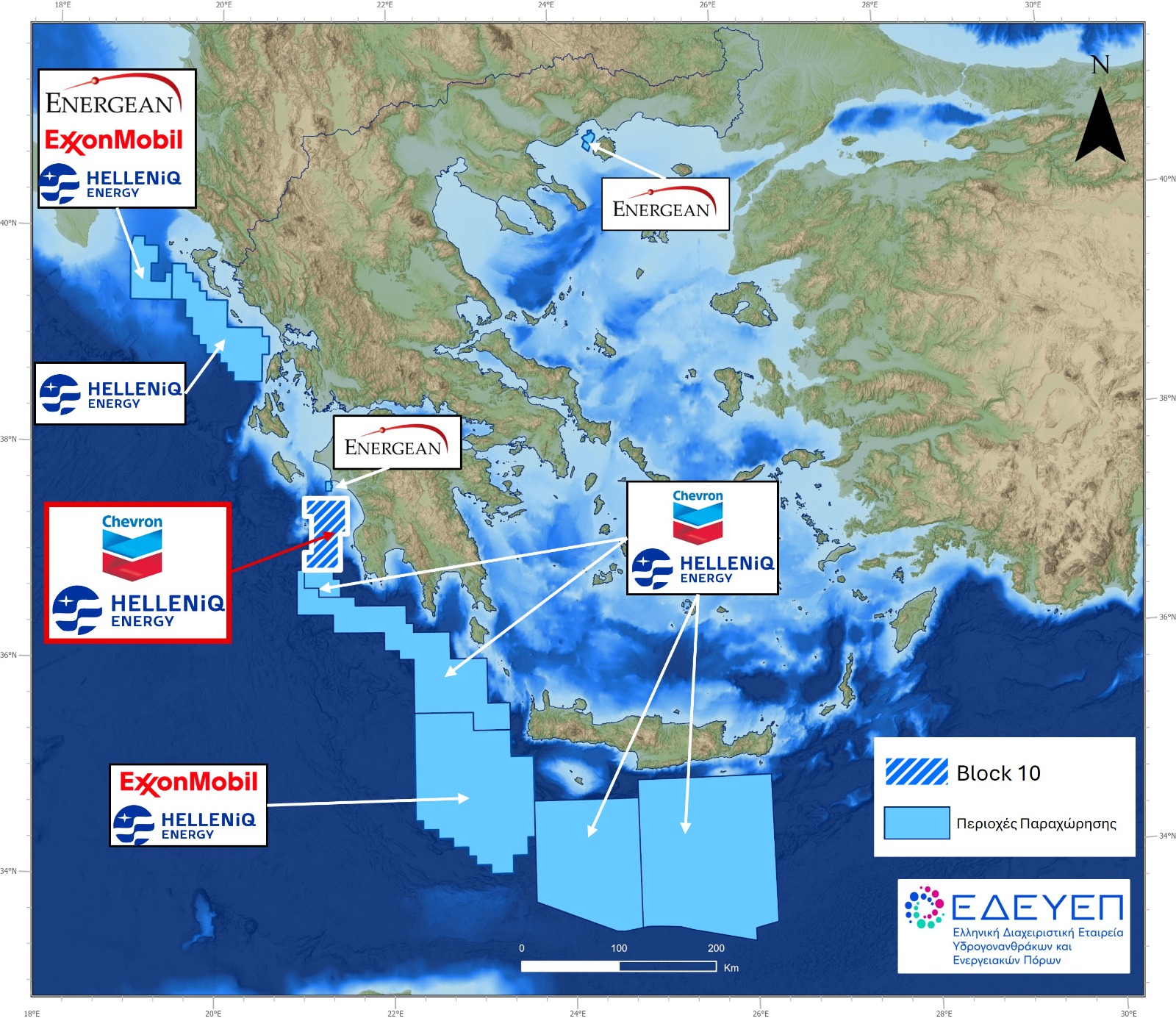
This means that not only are the prospects for discovery increasing, but so is the flexibility in identifying potential targets for drilling in the West and South of the Peloponnese, since an oil system, if it exists, is not limited to the “administrative boundaries” of a single plot but extends to and characterizes a broader area.
This is also indicated by the announcement from the Ministry of Environment and Energy itself, according to which the Hellenic Hydrocarbon Exploration Management Company (EDEYEP) is evaluating a request for an 18-month extension of the second exploration phase, so that the consortium currently being formed can jointly evaluate the data obtained from the two-dimensional (2D) and three-dimensional (3D) seismic surveys.
This is so that the remaining data to be acquired from neighboring concession areas can also be taken into account, as the companies’ decisions are always made with the overall management of their portfolio in mind.
In other words, if the 3D seismic data from plot “A2,” which borders “Block 10” to the south, has also been evaluated during the same period ,then a joint evaluationwill be conducted ,with all that this may imply for the potential selection of drilling sites.
In international practice, after all, an operator’s evaluation of neighboring areas is conducted as simultaneously as possible, so that the decision to drill may cover a broader area.
Why “Block 10” is considered an area of interest
As for whether “Block 10” is of interest, the answer is provided by the website of the Hellenic Hydrocarbon and Energy Resources Management Company (EDEYEP) itself, according to which this specific plot is adjacent“with the proven oil system in the neighboring licensed area of Western Katakolo (note: it has now been returned to the State), in combination with the large number of surface natural oil and natural gas seeps in the wider area.”
Furthermore, “several oil and natural gas fields have been discovered in Albania, which belong to the same fold and thrust zone and share the same geological characteristics.”
3D seismic surveys have also been conducted on this specific plot; that is, both the first and second phases have been completed. Therefore, once Chevron receives the data from Helleniq Energy, it will be able to decide whether or not to proceed with drilling.
In the case of Helleniq Energy, which has held the plot for years, no further decisions had been made to date, as the great depths of the area —500 meters to 2,500 meters—and consequently the higher risk, entail not only high costs but also the need for a partner with the appropriate expertise.
By analogy with the approach taken in the case of “Block 2” in the northwestern Ionian Sea, where ExxonMobil entered months ago by purchasing stakes from the existing licensees (a “farm-in,” as it is known in the industry), so now Chevron’s entry means that the major oil company has the “know-how” to operate in the field and take on the associated risk of carrying out an exploratory well that could cost up to 100 million euros, without any certainty that anything will be found.
It was no coincidence that in February, during the presentation of the concession to the consortium led by Chevron, the head of EDEYEP, Aris Stefatos, mentioned that the consortium is considering skipping the first phase in the case of “A2” and proceeding directly to the second phase, namely 3D seismic surveys, bypassing the first phase involving 2D seismic surveys.
As for the 3D marine surveys, covering an area of 2,400 square kilometers in “Block 10,” these were conducted between December 2022 and January 2023 by the Norwegian company PGS (now TGS), with numerous companies having since reviewed the data in the relevant data room.
Upon completion of the relevant process and subject to the required approvals, the ownership stakes in the concession will be 70% for Chevron and 30% for Helleniq Energy, while Chevron will also assume the role of operator.