FLASH presented an ALCO poll that reveals a completely new landscape, one that may reflect not only the new bipolarity but also a different expression of the anti-establishment vote.
This is the first nationwide poll to gauge voting intentions for the newly formed parties led by Maria Karistianou and Alexis Tsipras.
The poll began on Tuesday evening immediately after Alexis Tsipras presented his new party at the event in Thiseio.
The Coalition is the second-largest party, with Karystianou’s party just a “hair’s breadth” behind PASOK
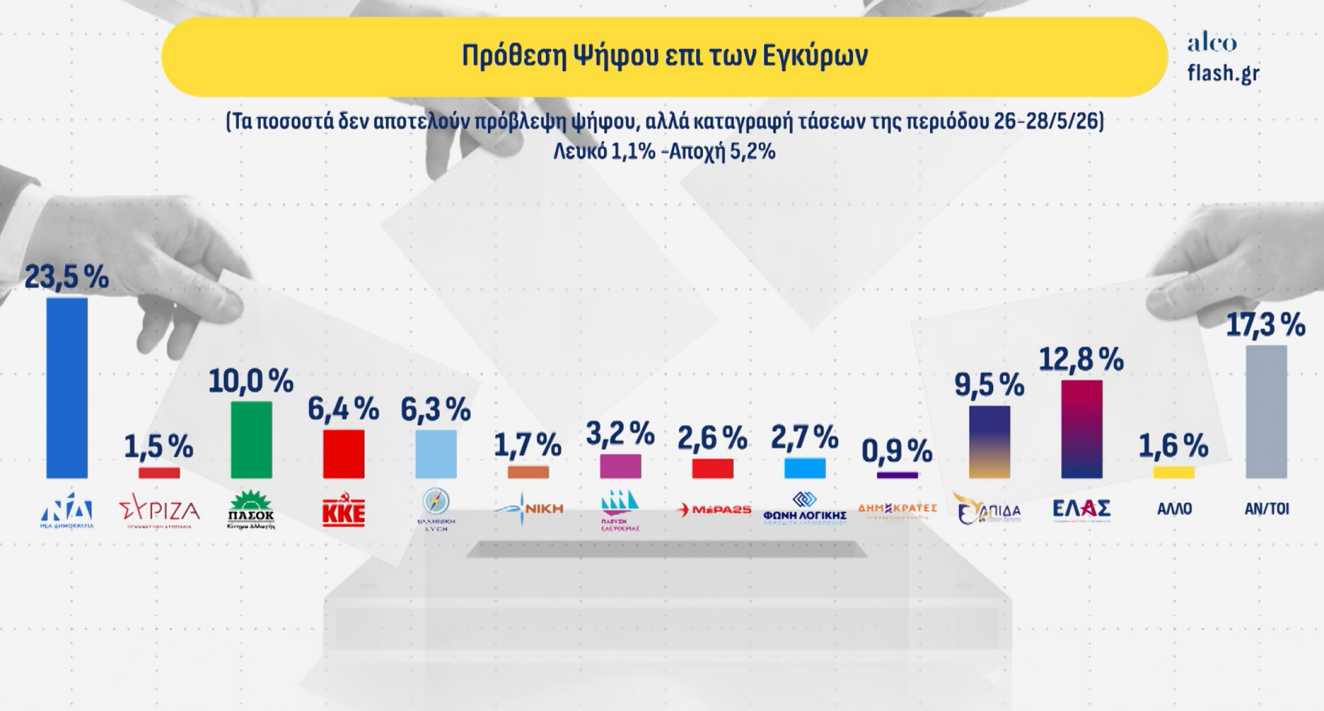
In the poll presented for FLASH by Spiros Mourelatos, with analysis by ALCO CEO Kostas Panagopoulos regarding voting intentions, New Democracy remains in first place, followed by Alexis Tsipras’s Greek Left Coalition. PASOK is in third place but feels the “breath” of Maria Karistianou on its neck. Notably, there has been a complete collapse of SYRIZA as well as the New Left, which, with a share of nearly 0.2%, is classified among the “other parties.”
Specifically, regarding voting intentions: New Democracy (ND) garners 23.5%. Next is Alexis Tsipras’s “Coalition” with 12.8%.
PASOK is third with 10%, while “Hope for Democracy” follows with 9.5% in fourth place. The percentage of undecided voters remains high, exceeding 17%.
Tsipras: SYRIZA’s “fall,” significant gains from Zoe
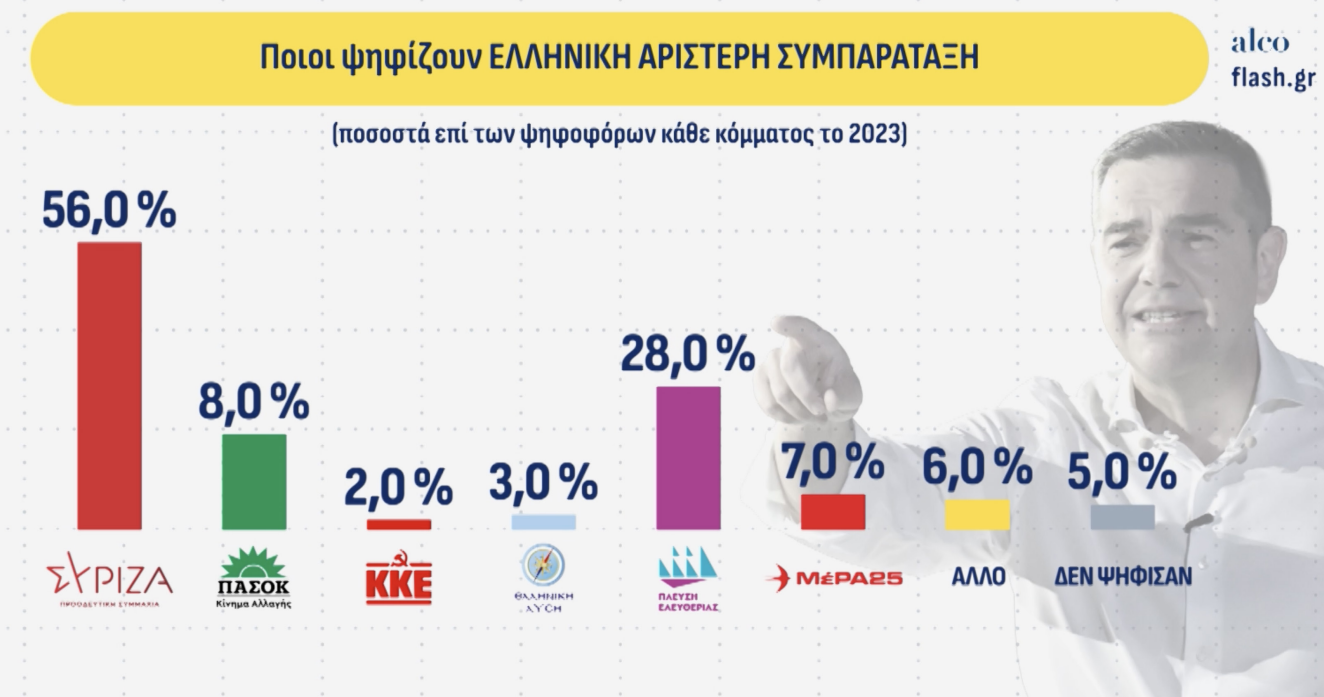
An analysis of the “vote” for Alexis Tsipras’s new party shows that the former prime minister is “sweeping” both SYRIZA (56%) and the Freedom Course (28%).
The “honesty card” appears to be one of Alexis Tsipras’s strongest “weapons” in the election campaign.
Thirty-nine percent say they choose him because he is honest, 33% because of trust, 20% because he supports the working class, while a low 8% because they agree with the party’s positions. This finding is understandable given that it is too early to have a clear picture of the “Coalition’s” policy platform.
A total of 23% express hope, confidence, and enthusiasm regarding the founding of the new party by Alexis Tsipras. Disappointment, according to 28%. Uncertainty, 24%, while fear, 11%. A 14% share did not express an opinion.
Karystianou: Gains from all parties, with “cleansing” as the rallying cry
Conversely, votes for Ms. Karistianou appear to come from all parties—even New Democracy.
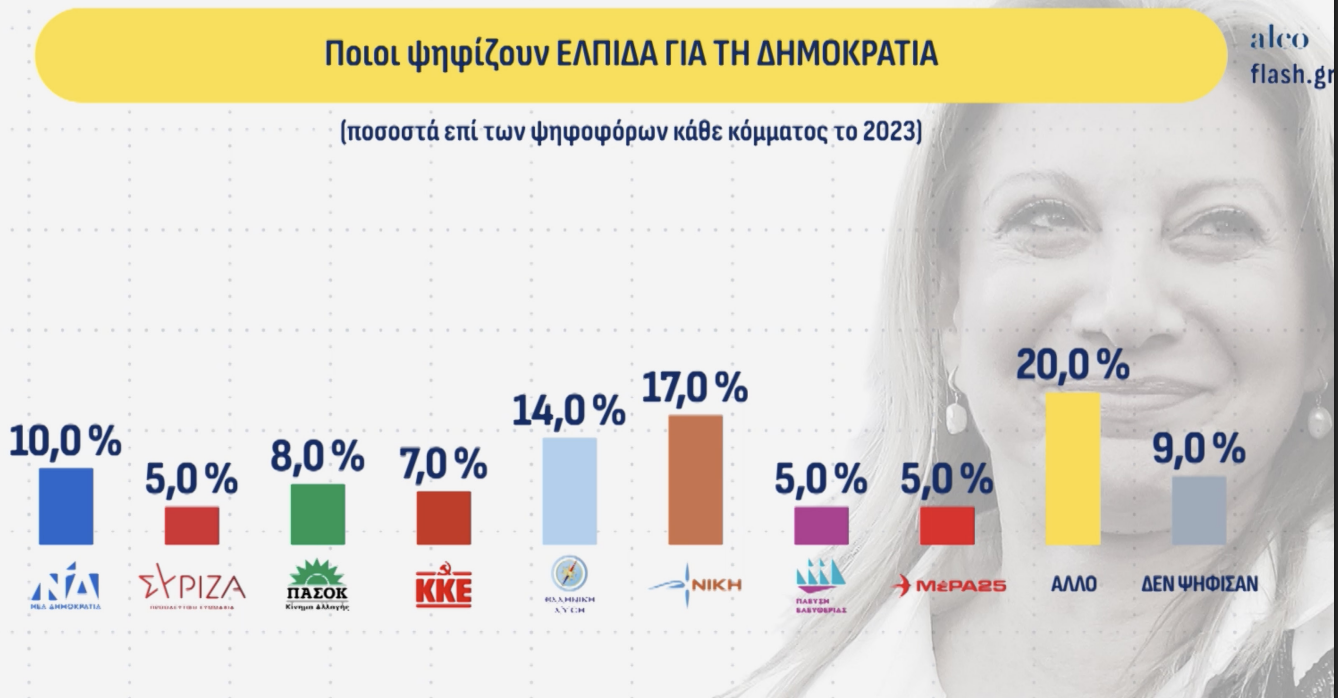
“Hope for Democracy” is gaining a significant portion of its votes from NIKI as well as the Greek Solution. Thelargest segment of voters, however, comes from the“other party” category, while 9% are citizens who did not vote in the previous elections.
According to the poll, the “banner” for Maria Karistianou’s party is the call for a clean slate and the demand for justice regarding the Tempi incident. Among Ms. Karistianou’s strengths is that she is a “new and untarnished face.”
A total of 27% express hope, confidence, and enthusiasm regarding the founding of Maria Karistianou’s new party. Thirty-two percent express disappointment, 18% express uncertainty, and 5% express fear. Eighteen percent have no opinion.
The “battle” for the undecided
One of the most significant findings of the ALCO poll concerns the direction of undecided voters in the 2023 elections. In the 2015 election, New Democracy had won over nearly one in two undecided voters (48%). Twenty-one percent had voted for SYRIZA, which now stands below the parliamentary threshold, while the “Spartans” received 6% of the undecided vote.
Who can defeat Mitsotakis?
Kyriakos Mitsotakis’s remark at the New Democracy conference about who would answer the phone if it rang in the early hours of the morning to manage a crisis sparked debate and numerous reactions from the opposition.
For New Democracy, however, the “bet” on governability remains one of the key government narratives upon which the pre-election “line” is already being built. When asked which politician will be Kyriakos Mitsotakis’s toughest opponent on the road to the polls—and with spontaneous answers—the response “none” remains the majority choice at 29%, however, Alexis Tsipras now ranks second with a high percentage (25%).
Nikos Androulakis garners 15% and is in third place, while Maria Karistianou follows with 7%.
The picture is different, however, when it comes to the popularity of political leaders, where Maria Karystianou, with 32% positive opinions, leads Kyriakos Mitsotakis, who garners 28%.
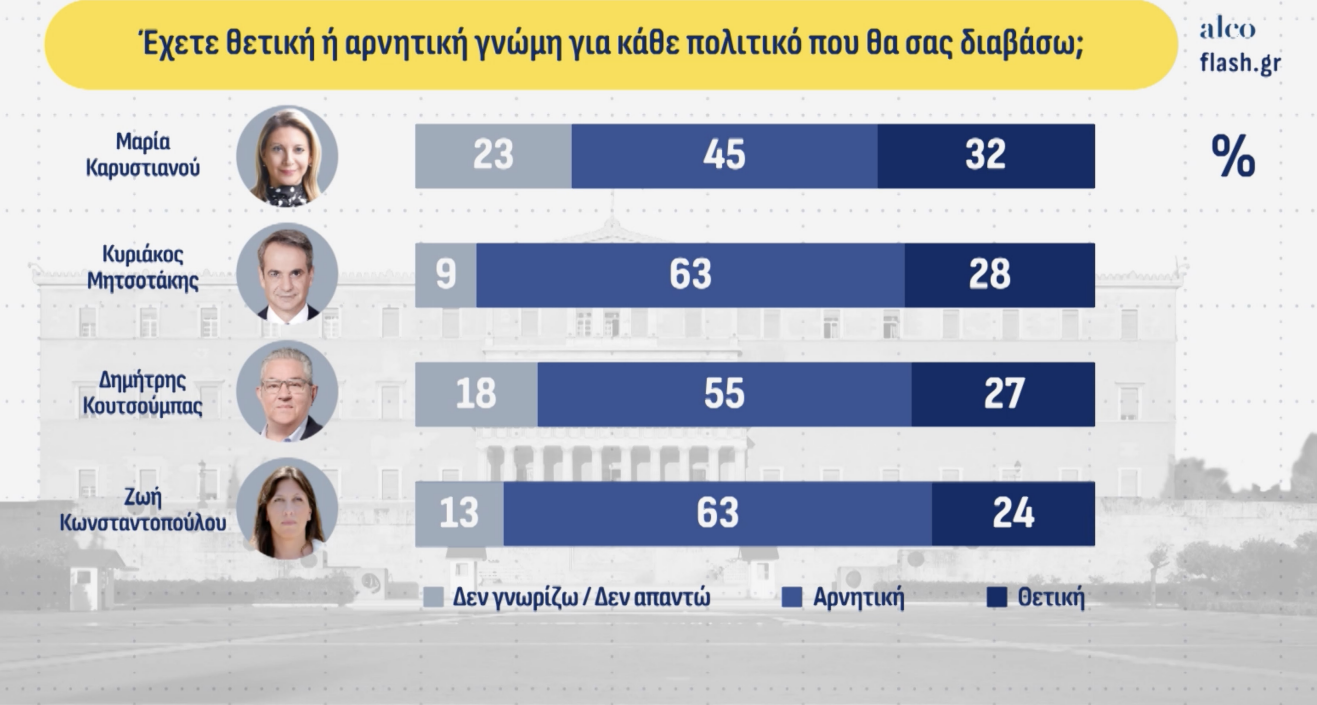
It is worth noting that on this specific question, Mr. Tsipras ranks fourth with 24%, alongside Zoi Konstantopoulou and behind Dimitris Koutsoubas, who ranks third with 27%. Nikos Androulakis ranks fifth with 20%.
As for the government, 52% say they are not at all satisfied and 24% say they are somewhat satisfied. Twenty percent say they are fairly satisfied, and just 2% say they are very satisfied.