Increased tax revenues and the digitization of the public sector are supporting the Greek economy’s continued strong fiscal performance, according to Alpha Bank’s Economic Developments Bulletin.
In the first quarter of 2026, the general government budget surplus rose to €2.4 billion, up from €1.6 billion in the corresponding period of 2025. This development is attributed to both increased revenue and reduced spending, while the 25% rise in VAT revenue stands out among the individual figures.
For the full year 2026, based on the European Commission’s spring forecasts, Greece, along with Cyprus, Ireland, and Denmark, is among the only EU member states expected to post general government surpluses. The Greek surplus is projected at 0.8% of GDP in 2026 and 0.6% in 2027.
The rise in tax revenues
The bank attributes the positive fiscal outlook to a prolonged period of improving tax revenues, which began following the recovery in economic activity starting in 2017. Despite tax rate cuts since 2019, tax revenues as a percentage of nominal GDP rose from 24.7% in 2013 to 27% in 2019 and, following the temporary decline during the pandemic, stabilized in the 27%-28% range for the four-year period 2022-2025.
The main tax categories also showed an upward trend. In 2025, VAT revenue stood at 9.2% of GDP, personal income tax revenue at 6.4%, and corporate income tax revenue at 2.7%.
According to the analysis, this improvement cannot be explained solely by growth, rising employment, higher nominal wages, and the impact of inflation. Structural changes in tax administration also played a role, as they strengthened tax compliance and the state’s ability to collect its due revenues.
The role of the AADE and digital tools
Key initiatives include the establishment of the AADE, the implementation of myDATA, the expansion of mandatory POS usage, their integration with cash registers, as well as pre-filled VAT and income tax returns. These measures improve the monitoring of economic activity and reduce the administrative burden on businesses, professionals, and taxpayers.
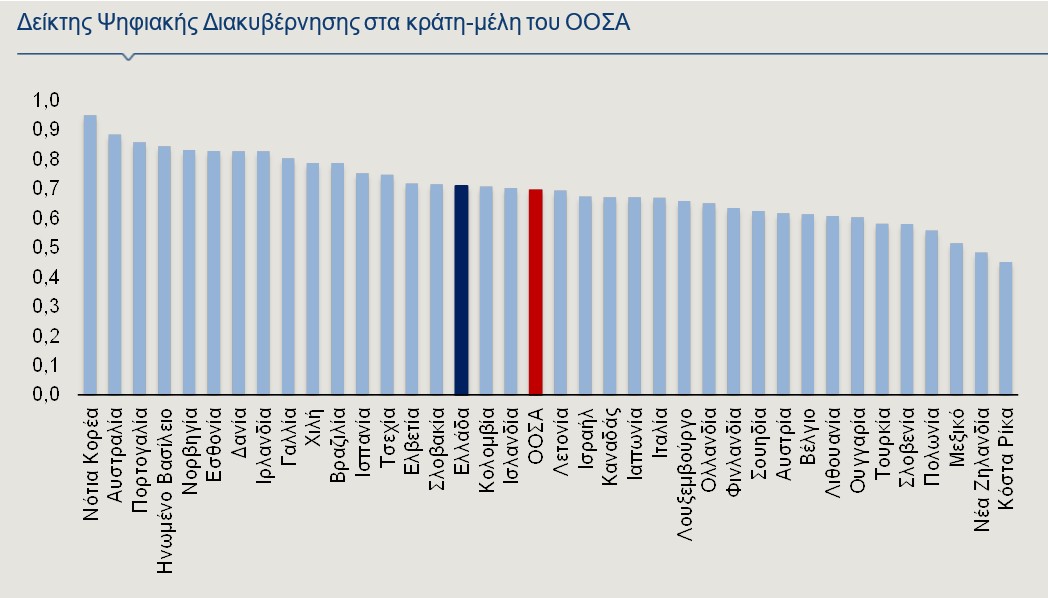
Greece’s progress is also reflected in the OECD Digital Governance Index. Based on data collected during the 2023–2024 period, the country recorded a score of 0.71, marginally higher than the OECD average of 0.70. The score is also higher than that of countries such as Italy, the Netherlands, and Sweden.
The improvement is particularly significant compared to the previous measurement in 2019, when Greece was among the lowest-ranked countries in that year’s ranking. Although the two assessments are not fully comparable due to methodological differences, the country’s higher ranking in the recent survey indicates a substantial improvement in the state’s digital maturity.
Next steps
The next areas for action include the expansion of mandatory electronic invoicing, electronic rent payments, and the new digital registry for property ownership and management.
As Alpha Bank points out, the continuation of reforms in tax administration remains critical for fiscal credibility and the further strengthening of public revenues.