To understand what is happening today, the reader must start with 2020. The pandemic was not merely a health crisis. It was an economic collapse that threatened to set Europe back decades. Investment vanished, businesses ground to a halt, and governments found themselves facing a recession reminiscent of wartime.
The European Union decided to do something it had never done before: borrow collectively and distribute the money to member states.
Thus was born NextGenerationEU, an €806 billion package. At its core was the Recovery and Resilience Facility (RRF), worth €723.8 billion.
Each country had to submit a national plan. Greece submitted Greece 2.0.
And here is something the average reader may not know: Greece received one of the highest amounts in Europe —proportionally the highest per capita.
The reason is simple: Greece had the largest investment gap in the EU, suffered the most damage from the debt crisis, and had the lowest investment levels in Europe for over a decade.
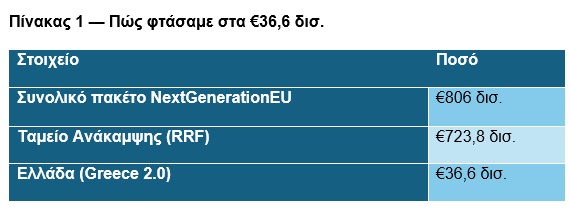
What is Greece 2.0 — and why is it so large
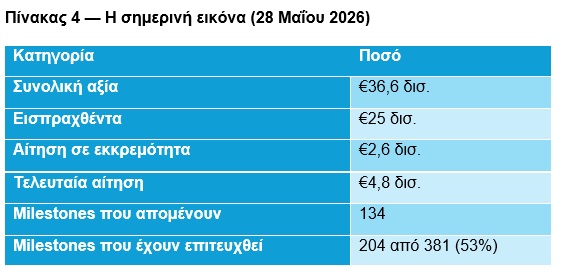
As the table below shows, the Greek program is €36.6 billion and is divided into two parts:
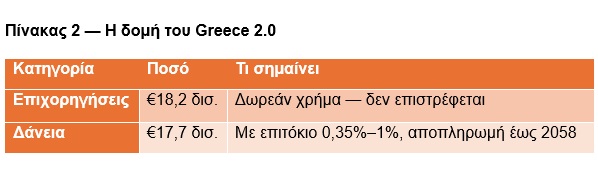
To put the size into perspective: this amount corresponds to 15% of the Greek economy. It’s like adding a whole year’s worth of investment into two years.
3. Where the money is going — and what has been done so far
Greece 2.0 is not a program. It consists of 381 commitments (milestones & targets). Each one must be completed for the next tranche to be disbursed.
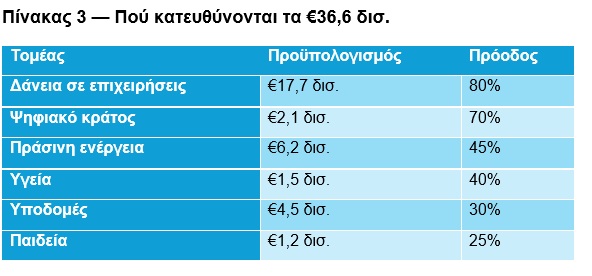
The picture is clear: where banks and businesses are involved, progress is fast. Where the government is involved, progress is slow.
4. What has been received to date — and what remains
To date, Greece has received:
• €12.9 billion in grants
• €11.7 billion in loans
Total: ~€25 billion (68.5%)
A new request for €2.6 billion was submitted this week . If approved, the total will reach €27.6 billion.
One final request remains: €4.8 billion (€3.8 billion in grants + €1 billion in loans)
But this will only be submitted if 134 commitments are completed by August 31.
5. What happens if the 134 milestones are not completed
If they are not completed:
• the final application will not be submitted,
• €3.8 billion in grants will be permanently lost,
• €1 billion in loans will not be disbursed.
There is no extension. There is no negotiation. There is no “we’ll see.”
And there is one more thing: the European Commission is already considering the possibility of redirecting the unspent funds to the new European defense program, ReArm Europe.
6. Can Greece return funds it has already received?
Yes—but only in three cases.
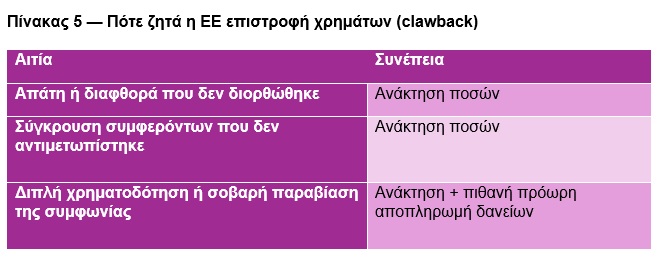
Project delays do not lead to a refund. Failure to meet milestones also does not lead to a refund.
These simply block the next installment.
For a clawback to occur, there must be:
• systematic fraud,
• corruption,
• double funding,
• or a serious breach of the agreement.
This is not Greece’s biggest problem today.
The current problem is the speed of implementation.
7. Why we are falling behind — the structural truth
Greece operates at two speeds:
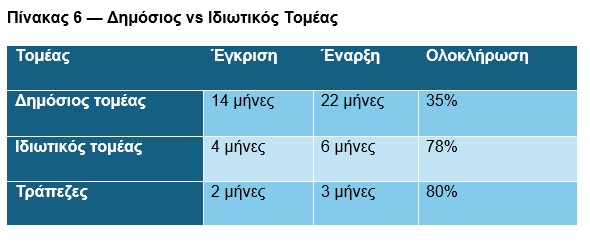
The reason is simple:
• Banks have an incentive to lend.
• Businesses have an incentive to invest.
• The government has procedures, permits, tenders, committees, and approvals.
The result:
The private sector is moving forward. The public sector is stuck.
8. What does this mean for citizens
If Greece succeeds:
• energy bills go down,
• hospitals will be improved,
• schools will be modernized,
• businesses will be strengthened,
• jobs will be created,
• productivity increases,
• growth is being boosted.
If not:
• €3.8 billion in grants are lost,
• projects are delayed,
• investment declines,
• growth slows down,
• the country’s credibility is undermined.
9. What does this mean for the future
Starting in September 2026:
• Greece 2.0 ends,
• the National Development Program 2026–2030 (€16.6 billion) begins,
• the Hellenic Development Bank is bolstered with €2 billion,
• the new NSRF 2028–2034 is being planned.
But there is one critical detail:
The less you collect now, the lower the baseline from which you start later.
10. The final question—and the answer that will define the decade
In September 2026, Greece will find out if it can submit its final application for disbursement from the Recovery Fund. This application has a total value of €4.8 billion. Of this amount, €3.8 billion consists of grants—pure, non-repayable funds that are permanently lost if not claimed in time. The remaining €1 billion consists of very low-interest loans, which simply will not be disbursed if the application is not submitted.
If Greece completes the 134 milestones by August 31, then it receives the full amount of €4.8 billion and the program concludes without losses. In this case, the country demonstrates that it can deliver on its commitments, on time—a sign of credibility that is more valuable than any credit rating upgrade.
However, if the milestones are not met, the application cannot be submitted. And then the €3.8 billion in grants is lost for good. They are not transferred, postponed, or subject to negotiation. It is money that Greece is entitled to but will never receive. The €1 billion in loans will also not be disbursed, but the loss of that amount is secondary.
The real damage is not just economic. It is institutional. If the country fails to act in time, it will be confirmed once again that there is a deep gap between what it announces and what it ultimately delivers—a gap that does not appear in any budget, but costs more than any lost billion.
And this gap has a cost that does not appear in any budget.
Sources: Athens Times (May 26, 2026, May 19, 2026, March 16, 2026), ProtoThema (March 26, 2026, May 26, 2026), Greek Reporter (February 22, 2026), European Parliament Think Tank (June 2025), Coface (January 2026), European Data Journalism Network (December 2025), EUR-Lex Regulation (EU) 2021/241, European Court of Auditors SR-2023-07, OLAF & EPPO documentation
* Nicholas Havoutis has many years of experience leading strategic financial units, having served as an executive at JPMorgan (New York), Chase Manhattan Bank (London), and Eurobank (Athens). At the same time, he has a significant presence in the media sector. Today, as head of SoZone Limited, he advises companies and investors on international expansion, organic optimization, and M&A strategies.