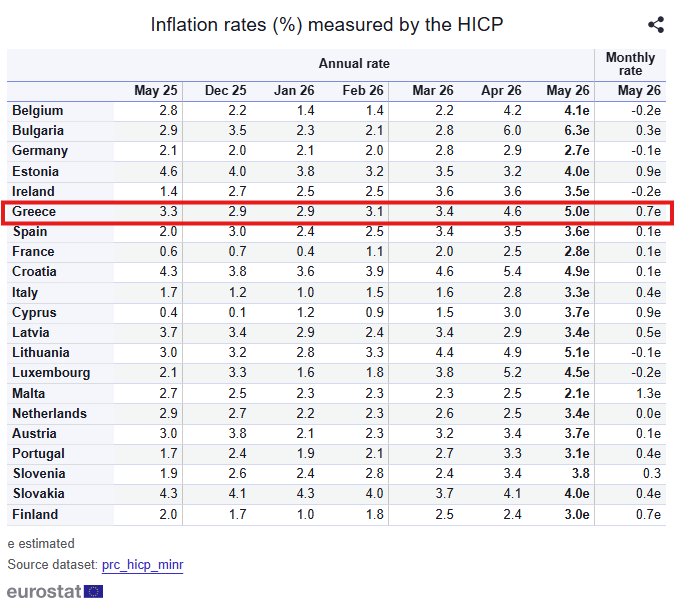
Annual inflation in Greece rose to 5.0% in May, according to Eurostat’s preliminary estimate. A month earlier, it stood at 4.6%.
In the eurozone, it accelerated to 3.2% from 3.0% in April. This is the highest rate since September 2023, remaining significantly above the European Central Bank’s 2.0% target.
Eurozone core inflation from 2.1%, eurozone core inflation—which excludes volatile energy and unprocessed food prices—accelerated, strengthening the case for an interest rate hike by the ECB at its June 11 meeting.
Looking at the main components of eurozone inflation, energy had the highest annual rate in May (10.9%, compared with 10.8% in April), followed by services (3.5%, compared with 3.0% in April), food, alcoholic beverages, and tobacco (2.0%, compared with 2.4% in April), and non-energy industrial goods (0.9%, compared with 0.8% in April).
Inflation surges in France and Spain, slight decline in Germany
Inflation in France and Spain accelerated in May to its highest levels since 2024.
The rise in prices was mainly driven by higher energy costs due to the conflict in the Middle East. In France, consumer prices rose by 2.8% year-over-year, while in Spain, harmonized inflation stood at 3.6%, the highest level since June 2024.
In Germany, inflation slowed slightly, coming in at 2.7%, down from 2.9% a month earlier.
Borrowing costs are expected to rise for the first time since 2023
Three months after the start of Donald Trump’s military campaign against Iran, European Central Bank officials—from the so-called “hardliner” Isabelle Schnabel tothe more moderate chief economistPhilip Lane, are hinting that borrowing costs will likely rise for the first time since 2023.
Markets consider it almost certain that the first hike will come on June 11, with the deposit rate rising to 2.25% from 2%, while another hike is priced in by the end of the year.