AKTIOGLOU: Regarding Efi Aktioğlu’s resignation and the handover of her seat, we had reported this information to you ten days ago, and it has now been confirmed.
The message she wants to send—that she does not view politics as a profession —combined with the “opening” of a law firm in early May, sent the first signal that she is following Alexis Tsipras’s recommendation: first, relinquishing her seat, and then joining the Hellenic Police.
Regarding this, however, the information from Amalia is equally persistent: the current MPs who resign will not automatically join the new party, but will do so gradually and under certain conditions. “There will be a…purge ,” as one of Alexis’s associates humorously puts it.
Between us, though, no one can believe that resigning from parliament comes with the risk that whoever resigns will set sail into the unknown, clinging to the hope that they will find a new home in ELAS.
Everyone understands that the agreements have been reached and that the timing of the move will simply be worked out…
The same applies to those SYRIZA MPs who decide (or are persuaded to…) to resign immediately from their parliamentary seats, with reports indicating “two or three” are considering it.
DRAGASAKIS: Yannis Dragasakis will inevitably be sworn in as a SYRIZA MP, taking Ms. Achtsioglou’s seat, as he is the first alternate in the Western Athens constituency.
As has been reported, immediately afterward he will declare to the Presidium of the Parliament that he is becoming an independent and will thus become… the 40th independent MP.
Staying with SYRIZA… is out of the question: he resigned from the party’s leadership (due to Kasselakis’s election) in December 2023, and six months later he left the party altogether. Whether he too will turn to Tsipras’s ELAS remains to be seen—and he likely will, since he is among the supporters of the new venture.
The question is whether it will be beneficial for Alexis to welcome into his party, starting this fall, those who chose to remain in Parliament as independent MPs, even though he himself called on his would-be allies to do what he did in October:
To give up their seats.
PARLIAMENT: Not five, not ten, but… there are now 40 independent MPs in Parliament. That is, those who were elected with a party and then either were expelled from the parliamentary groups to which they belonged (such as Pavlos Polakis) or—most of them—became independents after disagreeing with their party leaderships.
If they shared an ideological affinity and decided to form a “parliamentary group of independents,” they would be… the second-largest force in Parliament, after New Democracy.
But they aren’t, since the chamber of independents is “cohabited” by former members of SYRIZA, New Democracy, PASOK, Freedom Course, Victory, Greek Solution, and the Spartans.
In other words, there’s a bit of everything.
The Parliament, however, has become a seven-party body, since the New Left parliamentary group disbanded yesterday following the departure of its seven MPs. Losing privileges (regarding travel, the chamber, etc.) and ending its 2.5-year parliamentary life, with polls now showing it at 0.5–1%.
To understand, however, what has happened to the once-ruling party of the “first-time Left, ” of the 40 independents, 21 come from SYRIZA—including those who left the New Left yesterday.
They could earn a spot in the Guinness Book of World Records since: they were elected with SYRIZA in June 2023, became independents in November of the same year in protest of the Kasselakis presidential election, co-founded NE.AR. and yesterday… they became independent again, with most of them hoping for a spot in Alexis Tsipras’s ELAS .
What is interesting is that although, as mentioned above, Mr. Tsipras has set as a condition for any current MP wishing to follow him that they must resign from their parliamentary seat and hand over their seat, all those who left yesterday (except for Effie Achtsioglou) chose… to become independents.
Most likely, they were “scared off” by the possibility that there won’t be early elections this fall, so even if they’ve secured a spot on the… ELAS ballots, they’ll have to stay out of Parliament for 9–10 months…
PROKOPIOU: George Prokopiou is moving forward with one of the year’s largest shipbuilding deals, as Dynacom Tankers Management signed an agreement for the construction of 12 VLCC supertankers at the Chinese shipyards Hudong-Zhonghua Shipbuilding, a subsidiary of China State Shipbuilding (CSSC).
The value of the agreement is estimated at 10 billion yuan, or approximately $1.48 billion, which translates to a cost of about $123 million per vessel.
Deliveries of the 307,000-dwt tankers are expected to begin in late 2028, and the ships will be equipped with scrubbers.
The order marks Hudong-Zhonghua’s entry into the VLCC market, as until now the shipyard was known primarily for building LNG carriers and container ships.
According to market sources, the agreement was made possible following approval from Chinese authorities for the construction of a new large dry dock, which will increase the group’s shipbuilding capacity.
With this new order, Dynacom’s order book for VLCCs now stands at 30 vessels. Of these, 18 are already under construction at Chinese shipyards, while the company is expected to take delivery of five VLCCs in 2026 and another four in 2027.
MARINAKIS: Evangelos Marinakis reaffirms his confidence in Capital Tankers’ prospects by proceeding with a new purchase of shares in the newly listed shipping company on the Oslo Stock Exchange.
According to a related announcement, Capital Maritime & Trading, a company affiliated with the Greek shipowner, acquired 1.07 million shares at 133 Norwegian kroner per share, investing a total of approximately $14.4 million.
Following the transaction, the controlling shareholder’s stake increased to 75.6% from 74.8%, with the value of his stake approaching $1.38 billion.
Capital Tankers was listed on the Oslo Stock Exchange in March, following a $500 million private placement, marking the largest public offering by a shipping company in the past two decades.
The company is also continuing to expand its fleet, securing $235 million in new financing for four newly built vessels. It currently has 12 tankers in operation and another 18 under construction, while 23 vessels in its fleet are capable of using LNG as fuel.
In the first quarter, it reported net profits of $23.1 million and daily revenue of $97,309 per ship.
MARTINOS: Nikolaos Martinos’ Thenamaris is entering a new phase of fleet expansion, strengthening its presence in the product tanker market through a series of new shipbuilding orders in China.
According to TradeWinds, the Greek shipping company has signed an agreement for four LR2 Aframax/product tankers at the DSIC Shanhaiguan shipyards, with deliveries scheduled for 2029.
This marks the first collaboration between the two parties in three decades, as Thenamaris’s last order at the Chinese shipyard was placed in 1996.
The move is part of a broader investment program, as the company has already placed orders for LR2 tankers with Hengli Shipbuilding, while it is reported to have commissioned Cosco Heavy Industry Guangdong to build up to four MR2 tankers.
With these new agreements, Thenamaris’s portfolio of LR2 and MR2 vessels under construction now approaches a dozen. The fleet renewal follows extensive sales of older vessels.
Since early 2023, the company has divested 17 tankers, securing proceeds estimated to be close to $800 million. At the same time, it has already ordered two 158,000 dwt Suezmaxes from Shanghai Waigaoqiao Shipbuilding, with delivery scheduled for 2027.
FAFALIS: Haris Fafalis, chairman of the Greek Committee for Maritime Cooperation in London, while strongly criticizing proposals for the use of alternative fuels, such as ammonia.
Speaking on the sidelines of the Posidonia exhibition, the Greek shipowner defended the strategy of Greek shipping groups, arguing that they are investing in the most modern and reliable technologies currently available.
“Choosing inadequate, impractical, or even dangerous fuels is not a solution, ” he stated emphatically, warning of the risks involved in using ammonia on ships. As he noted, a serious leak could put the lives of seafarers in immediate danger.
Mr. Fafalios also expressed reservations about the decarbonization initiatives being promoted at the international level, arguing that they are often formulated without sufficient input from the shipping industry.
At the same time, he emphasized that the limited availability of alternative fuels in ports around the world makes their implementation difficult, particularly in ocean-going shipping. According to him, the industry needs practical solutions and mature technologies, rather than “theoretical approaches” that do not correspond to the actual operating conditions of ships.
ANGELICUSSIS: The Angelicoussis Group revealed its strategy for further fleet development and renewal through Maria Angelicoussis, who stated at Posidonia that the company remains open to new ship orders in four key sectors of activity: large bulk carriers, conventional crude oil tankers, shuttle tankers (i.e., specialized tankers that transport crude oil from offshore platforms to refineries), and LNG carriers.
Speaking at the Capital Link Forum, the head of Greece’s largest shipping group emphasized that the investments concern both the renewal and expansion of the fleet, typically supported by long-term charter agreements with strategic clients.
At the same time, she expressed confidence regarding the significant increase in tanker orders globally in recent months, noting that the market remains balanced. As he noted, the current VLCC order book stands at approximately 258 vessels, a number comparable to that of the so-called “shadow fleet”, which he described as an environmental hazard that should be gradually phased out through safe scrapping or recycling.
MARKETS: Despite the crisis in the Persian Gulf,Wall Street indices continue to hit record highs. However, anyone looking only at the indices is largely seeing a magical picture, in which stocks completely ignore high oil prices and their economic consequences.
Because that is onlyhalfthe story.
As the following chart shows, if we exclude technology stocks linked to artificial intelligence, the picture that emerges ceases to be so “magical”.
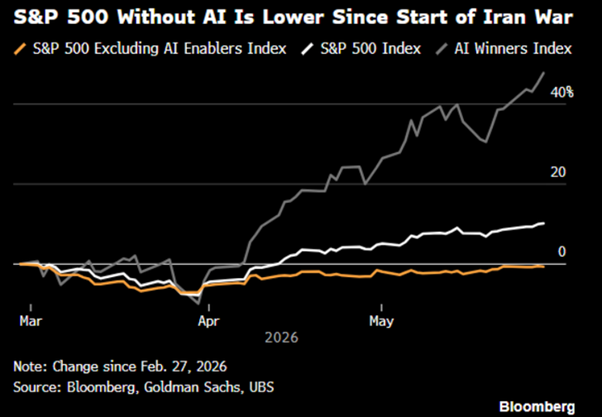
Without the AI-related stocks (some 40 in number, which have skyrocketed), the rest of the S&P 500—the most representative index of the U.S. market— has NOT recorded gains since the start of the crisis, nor has it suffered significant losses.
Essentially, we have... two markets. One for... regular stocks and one for those that are "bets" on artificial intelligence.
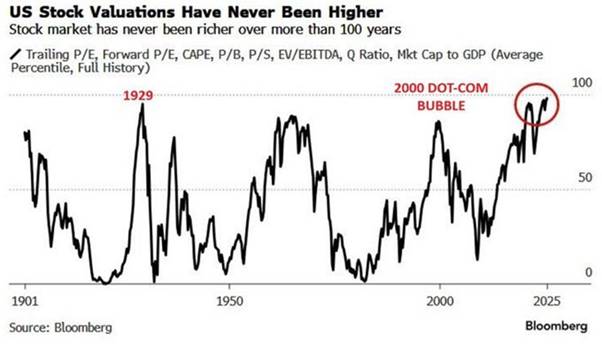
MARKETS II: The influence of AI stocks on the overall market is now so significant—and their rise so steep—that it inspires genuine awe.
As shown in the chart below, the U.S. market has now surpassed all previous records in terms of valuations.
No one knows when a significant correction will come. However, these valuations, combined with record-high levels ofmargin loans, suggest that when it does come, it will likely be very severe!