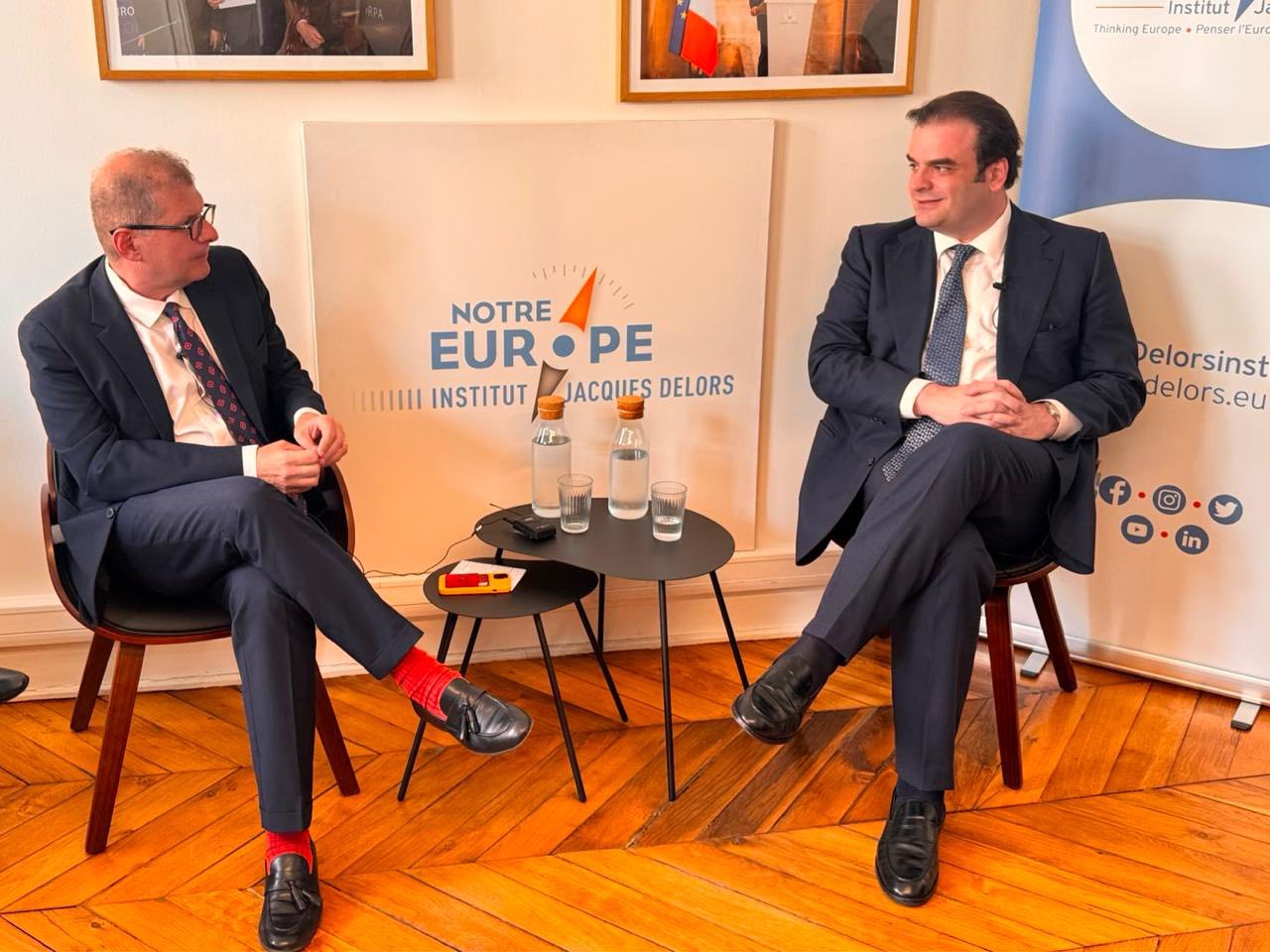
In light of recent geopolitical developments, the challenges facing the European economy, the strengthening of Europe’s competitiveness, and the future of the eurozone in an environment of growing international uncertainty were the focus of the discussion led by the Minister of National Economy and Finance and President of the Eurogroup, Kyriakos Pierrakakis, with Fabrizio Pagani, treasurer and member of the board of directors of the Jacques Delors Institute.
Mr. Pierrakakis referred, among other things, to the need for Europe to invest more in competitiveness, innovation, technology, and security, while emphasizing the importance of economic resilience and fiscal stability in a period of multiple challenges.
Special mention was made of the trajectory of the Greek economy, which was presented as an example of reform progress, fiscal responsibility, and resilience following a long period of crises and adjustments.
The discussion included journalists, banking executives, economists, and policymakers, who had the opportunity to ask questions and exchange views with the Minister on the prospects for the European and Greek economies.
Fabrizio Pagani: At the moment, we are seeing significant fragmentation in the global economy, and we have several reports from international organizations, such as the IMF and the OECD, on this issue. We have also seen what has been written in the press regarding the OECD’s recent report on trade. We would therefore like to hear your views on the global outlook and the role played by the European Union. Based on the first year of your term, what direction should we steer our economic policies toward in the coming months?
Kyriakos Pierrakakis: First of all, thank you for having me. I am particularly pleased to be here with you in Paris. And, needless to say, we are living through an extremely interesting period, in the broadest sense. As the well-known saying goes, we live in interesting times. Unfortunately, some weeks we get the feeling that times are changing even faster.
Given this context, in most of the meetings we attend—and especially in Eurogroup meetings—attention inevitably turns to the crises and challenges ahead of us.
At recent meetings, we discussed at length the implications of a potential closure of the Strait of Hormuz and the broader crisis in the Middle East, both directly in terms of energy prices and indirectly in relation to the broader economic outlook. The trend toward stagflation persists. We are not in a state of stagflation, but we are on a trajectory toward stagflation. And this is obviously a cause for concern.
The European Commission and the relevant European authorities are revising their forecasts for the year’s economic outlook: upward for inflation and downward for growth. We are closely monitoring the situation.
Other issues, of course, are equally or even more important when viewed from a macroeconomic perspective. The implications of artificial intelligence, specifically Anthropic’s new LLM model, are also a major area of concern regarding its proper governance and the regulatory framework that will govern it.
And overall, I believe that the era of geopolitical innocence for Europe is now over. From this perspective, we are facing an obvious dividend. The “dividend of the obvious” is a term I use often, because I consider it very accurate.
Greece experienced this as it emerged from its own crisis in recent years. It is very useful to have something obvious that you haven’t done for a long time. And if you do it, it can offer you a growth dividend.
For Greece, this was a series of long-overdue reforms—accumulated reforms that had not been implemented across all policy sectors and industries, built on the foundation of political and fiscal stability.
For Europe, the equivalent is the Capital Markets Union. Along with the Digital Euro project, the Savings and Investment Union.
This is an area that European finance ministers discuss at length. It is not a single issue. It is a portfolio that encompasses a range of individual policy issues: from banking union and the integration of stock markets, to the development of start-ups in Europe and a range of other policy issues.
There is currently momentum to bring these initiatives to fruition. The Letta and Draghi reports have played a very important role in defining the policies needed to strengthen Europe’s competitiveness.
At the moment, for example, we are discussing at length the market supervision package and how we can strengthen the role of ESMA at the European level. In a recent discussion at ECOFIN, I had the opportunity to say that, in my view, it is obvious that we should not do the same thing 27 times.
We need to strengthen ESMA’s role at the European level as a whole, because as technological innovation accelerates more and more, we also need to strengthen our supervisory authorities so that they can effectively monitor the markets and fulfill their role. And it clearly makes more sense to do this centrally rather than 27 times at the local level. This is one of the areas where we need to take action.
Beyond strengthening Europe’s central role, I would say that we also need better coordination among Member States. At the recent Eurogroup meeting in Nicosia and the informal ECOFIN, we had the opportunity to discuss the housing issue.
In many European countries—and I see this every day in my conversations with colleagues—we are facing a housing challenge. In some countries, I would say it amounts to a housing crisis. Obviously, this is not within the European Commission’s remit at the central level; it falls more within the purview of the Member States.
However, on issues such as this, the least we can do as Finance Ministers is to discuss the issues that concern citizens, address them, and learn from one another. To learn from successes, failures, mistakes, and challenges, so that we can implement these policies immediately, on a large scale, and with the best possible results.
All of this together, I would say, forms a framework within which European policy can move faster than in the past. And at a similar meeting, one of the participants told me that it seems we have to do all these things at the same time.
That is, things that haven’t happened in Europe for generations. It seems there is a need to implement multiple solutions simultaneously. And the answer is yes.
This is the burden that falls on the shoulders of this generation of policymakers. In the wake of the energy crisis, the Russian invasion of Ukraine, and a series of external events, the European Union must substantially strengthen European sovereignty.
And I am quite optimistic. This is not a “yes or no” question. It is not a black-and-white issue. It is more a question of how much ground we can cover.
And I am optimistic that this distance can be covered. Right now, there is momentum among European Union leaders to cover as much of this distance as possible.
Fabrizio Pagani: Thank you. That is very encouraging. I think it is also very appropriate from our perspective here. We are working precisely on this: linking the Savings and Investment Union with the idea of Europe’s strategic autonomy, the European strategic autonomy.
It is truly encouraging that you say there is momentum and progress. Do you see any specific area of the Savings and Investment Union where tangible results could be achieved in the coming months?
Kyriakos Pierrakakis: The goal here is to move forward on many fronts simultaneously. Because there are areas where there will be obvious progress.
We are discussing the supplementary pensions package, the market supervision package, and in these areas, the incoming Irish presidency is expressing optimism and a willingness to significantly advance both these two initiatives and the overall Savings and Investment Union agenda.
I would say, however, that our goal is to incorporate all elements of the discussion, all the discussions, and all the items on the Eurogroup’s agenda. We have already discussed the Kukies–Noyer report since the beginning of the year.
You mentioned earlier the channelling of savings into investments within Europe rather than in the United States. If one examines the startup ecosystems in Europe and across the various member states—I continue to use the term “ecosystems” in the plural, whereas we should be talking about a single European startup ecosystem—
Today, we have limited experience regarding how startups develop and expand in Europe.
Even so, every startup in Europe knows that, after a certain point in its growth, it may need U.S. funding to continue growing. This should be an option. It should be an option for a startup to incorporate as a Delaware company. It shouldn’t be a necessity. It should be able to find that financing option in Europe.
Could the “28th regime” play a role in this? Yes, it could.
This is an area where I believe progress can be made.
Banking union is also an area where more progress is needed. And, in a sense, I am a strong advocate of the advice William Faulkner gave to young writers: “show, don’t tell.”
I am the finance minister of a country where Unicredit recently acquired a significant stake in one of our systemic banks. And Euronext acquired the Athens Stock Exchange. We need European champions. We do not need national champions.
This is the natural consequence, the natural extension, of both the Letta report and the Draghi report. And of course we need this particularly in sectors where more innovation is required.
I recently had the opportunity to present some slides to my colleagues in the Eurogroup regarding banks and banking integration. I believe two points stand out from this presentation.
The first concerns the level of technological investment by European banks compared to American and Chinese banks, which is lower. Therefore, we clearly need more technological investment from European banks so that they can compete on a global level.
The second point concerns cross-border mergers and acquisitions in the banking sector in Europe following 2008, 2009, and 2010—that is, after the sovereign debt crisis. There have been some, but we need even more.
All of this together involves part of a regulatory framework, part regulatory policy, and part policy-making at the European level.
Another, equally important part concerns political will at the national level.
It also involves speaking the same language when we describe things, when we understand the facts, when we process them, and when we formulate policy.
And that is why I began my response by saying that, in the case of Greece—speaking as a Greek citizen rather than a European official—this understanding exists, because we believe there is still an additional growth dividend to be reaped.
Greece is currently growing at a rate of about 2%, according to current forecasts, which is roughly double the European average.
However, we recognize that there is room for even greater growth, both at the national and European levels.
We need more productivity.
Europe also faces an overall productivity problem. And we cannot address it unless we collaborate with larger European players and unless we manage to promote more mergers.
This will be part of that agenda. And of course, we need to develop and establish a common vocabulary.
To conclude on an optimistic note: this mindset is becoming increasingly evident and stronger at the leadership level.
That was also the conclusion of their recent informal meeting, where they asked the finance ministers to deliver results very quickly regarding the implementation of the Savings and Investment Union.
But the same applies at the level of finance ministers. This will require compromises, which is a very European approach. However, I see countries moving toward a consensual direction so that we can deliver the results that are being asked of us.
Fabrizio Pagani: This is indeed good news, because in recent months—and indeed in recent years—we have seen a great deal of resistance, even when it comes to banking consolidation. In Italy, my home country, we have seen significant banking consolidation at the national level, but we have encountered resistance abroad. Not in Greece, of course. You mentioned technology, and I know you’re following developments very closely regarding the digitization of financial services, the tokenization of financial transactions, and the creation of the digital euro, which may see the light of day in the next two years.
For the average citizen, what is the purpose of all this? Because that is the question we are asked most often. How will the digital euro function, and what will be the benefit for the general population and the economy?
Kyriakos Pierrakakis: The digitization of payments, even before we get to the digitization of the currency itself, can play a huge role in terms of transparency and how the economy functions in the world we live in.
Before we talk about the currency itself, I can tell you that part of the digitization we implemented in Greece was that we managed to curb tax evasion, partly because we created an independent authority and partly because we digitized the tax collection process.
You don’t need to do anything extremely complex or technologically advanced to achieve results. What’s needed are practical solutions. And simply connecting POS systems with small and medium-sized businesses in Greece proved particularly effective in terms of tax collection.
Reducing tax evasion has created a social dividend. I believe this was particularly important and is widely recognized. This pertains to payments and the digitization of payments. The digitization of the currency itself is a much broader undertaking.
There are several countries that are not considering digitizing their currency. China is doing so. The United States has chosen not to follow this path.
Their core strategy is to rely on private-sector innovation developing around the financial system, rather than on the digitization of the currency itself. That is why the focus is on stablecoins.
In this context, the Genius Act is a key tool for integrating stablecoins into the broader strategy of the United States and its overall macroeconomic management.
In our case, competition surrounding stablecoins is an area where Europe currently has a very limited presence. 95% of stablecoins are pegged to the dollar. However, where we have the opportunity to move quickly is in creating the public infrastructure that will allow us to strengthen the euro’s international role.
And that infrastructure is none other than the digital euro. The matter is now in the hands of the European Parliament. There will be a vote in the relevant committees on the amendments within the year.
I hope we will soon have a clear timeline. A pilot program for the digital euro could start relatively quickly, and we could then move on to its full implementation.
The faster we move forward, as the overall functioning of the economy becomes increasingly digital, the better it will be to have a digital version of our currency as well.
This is important both for the sovereignty of our currency and for the overall resilience of the European economic system. That is why it is preferable to move forward with a strong and reliable public infrastructure. We need a strategy.
And when it comes to the dilemma between private innovation and a strong public infrastructure, the answer is that we must do both.
Fabrizio Pagani: So you see complementarity between euro-backed stablecoins and the digital euro?
Kyriakos Pierrakakis: Absolutely. In my view, there is no other option.
If we look at what is happening globally and compare the United States with China, the United States invests primarily in private innovation, while China focuses mainly on public infrastructure.
In our case, we need to combine the best elements of both approaches.
This means we need to have a strong public infrastructure that enhances the transparency and credibility of our currency, while at the same time allowing private innovation to flourish on top of that infrastructure. The MiCA regulation is already contributing to this goal.
However, we must continue to adapt and move quickly, because this is a sector where innovation is constantly accelerating.
I am quite optimistic that this is an area where we will see tangible results, in line with the timeline I mentioned earlier.
Responding to a question regarding the impact of the war between Israel and Iran on energy markets, Europe’s energy security, and the green transition, Mr. Pierrakakis stated:
“First of all, we have already begun discussing energy policy at the level of finance ministers. And this is not only linked to the implications of developments in the Middle East. We had already included the issue of energy on the agenda of the previous Eurogroup meeting, even before the events in the Middle East. And we did so deliberately, because we recognize the strategic importance of energy policy for the competitiveness of the European Union as a whole and the Eurozone in particular. That is my first point.
My second observation is that, if one examines the data recently presented by the IMF, the impact of the crisis in the Middle East is 12% less severe than it would have been had we not taken a series of measures following the Russian invasion of Ukraine. Therefore, taking short-term measures that are consistent with long-term strategic goals pays off. That is why the impact of the current crisis is 12% smaller than what we would have faced under different circumstances.
My third observation is that the response to such crises has long-term consequences. Let us recall the 1970s. The response to the oil crisis of that period had significant repercussions that lasted for decades: from the creation of the International Energy Agency (IEA), to the intensification of oil exploration in the North Sea, the development of nuclear energy in countries such as France—nearly 40% of its nuclear capacity was developed after the 1970s—but also, unfortunately, increased dependence on Soviet energy sources.
If we take all of the above into account, what is now clear in Europe is that we need a single European energy market.
What should we do in the short term? We must support our citizens, especially the most vulnerable. The European Commission has already set out the conditions that support measures must meet: they must be targeted, tailored to needs, and, above all, temporary. Because certain measures tend to become permanent, and when that happens, fiscal policy can conflict with monetary policy.
Therefore, we must support the most vulnerable in a targeted manner and with interventions that respond to real needs and priorities.
It is equally clear that Europe needs more interconnections, more energy storage capacity, and significant investments in energy networks. Hundreds of billions of euros in investments are needed for the networks.
All of this is absolutely necessary in order to achieve our medium-term strategic goals. And that is why finance ministers must have a clear picture of the roadmap required to achieve them.
At the same time, we are also facing significant technological developments in the energy sector, which are of crucial importance for the future of our energy system.”
Responding to a question regarding whether the integration of European markets and financial infrastructures is sufficient to direct European savings toward investments within Europe or whether additional incentives, such as tax policies, are required, Mr. Pierrakakis pointed out:
“Do we need to change our policies and try to keep a larger portion of our savings in Europe? Yes.
But we need to change many things. And I consider it particularly appropriate that the European Commission has taken initiatives in this direction.
We need to change the way we invest. We need to change the way we understand financial concepts and financial terminology in every Member State of the European Union.
This in itself is extremely important, because it will influence the way we manage our personal and family savings and the way we channel them into investments.
In the United States, there is a different risk appetite compared to Europe. And these differences, obviously, play a role.
But if we look at the other side of the coin, doing something you don’t usually do can offer you a clear growth dividend.
And I believe this could prove particularly beneficial. Because, again, this is not a “yes or no” issue. The more we manage to implement the Savings and Investment Union agenda, the greater the growth dividend we will reap, both collectively as Europe and at the level of individual Member States.”
Finally, in response to a question regarding the fiscal flexibility applied during the pandemic and subsequent crises, as well as the long-term fiscal challenges that European economies continue to face, Mr. Pierrakakis replied:
This is a delicate balancing act. Especially in light of the impact the crisis is already having in the Middle East. All finance ministers and all governments in Europe are called upon to support their citizens, particularly those most in need, the most vulnerable. This is due to the inflationary pressures that continue to exist.
The issue, however, lies in how this support is provided. Effectiveness is determined by the details. As I mentioned earlier, when fiscal policy conflicts with monetary policy, the result is not merely ineffective but may also become counterproductive.
What do the IMF and the European Commission propose? Policies that target the most vulnerable. The measures implemented during the pandemic or the exemptions granted following Russia’s invasion of Ukraine fall within this framework.
What does the escape clause mean? It means that states are allowed to spend more and temporarily deviate from the new European fiscal framework.
What is the rationale behind this framework? To agree on a specific level of spending for each year and then, whether a country is in deficit or surplus, to operate within a predetermined framework. In this way, it can spend more during times of crisis and reduce its debt during periods of stronger growth.
Deviating from this framework should be the exception, not the rule. The Russian invasion of Ukraine has made it necessary to increase defense spending across all European member states.
I come from a country that already maintained a high level of defense spending due to the specific geopolitical conditions and challenges it faces. Other countries were not at the same level, which is why this additional flexibility was granted.
Today, there is a European debate regarding the extent of fiscal flexibility that should exist. Some countries support one approach, while others support a different one.
Where there is clear agreement at the European level is on the type of policies that should be implemented, regardless of the degree of fiscal flexibility.
If we look at the overall picture in Europe, the fiscal position of many countries is weaker today than it was in 2022. This must also be taken into account in our assessments.
Greece is in a strong fiscal position and has one of the fastest public debt reduction trajectories internationally. However, the overall European picture does not indicate that fiscal deficits are a thing of the past.
All of this requires highly targeted and carefully designed interventions. For this reason, we are in constant dialogue with the European Commission regarding the scope of acceptable measures and, depending on external conditions, we adjust how the rules are applied.