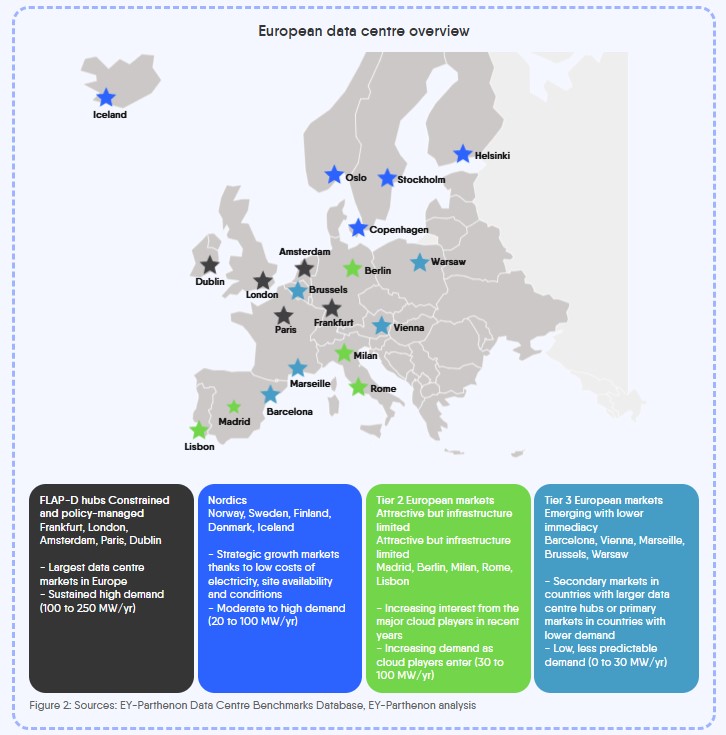
The very strong investment interest from U.S. and other funds in new large data centers in Europe is compelling countries across the continent to move forward with new investments in energy production and networks, in order to avoid repeating the U.S. experience.The challenge is not only related to the risks posed by the geographical concentration of these investments—as in Ireland, where 87% of this infrastructure is located in Dublin, placing enormous strain on the local grid—but also to the fact that they are becoming increasingly larger.
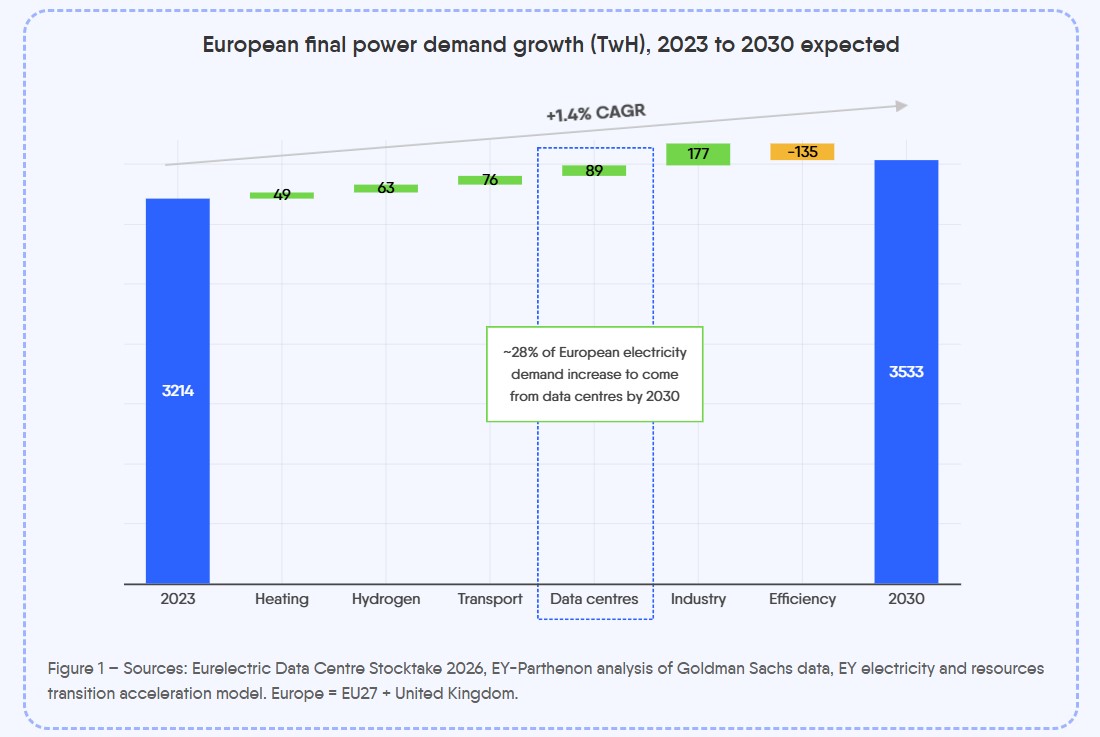
In essence, the figures show that by 2030, data centers will account for 28% of the increase in total electricity demand in Europe by that time, according to a report by Eurelectric presented yesterday at the industry’s annual conference in Helsinki.
The message is that data center consumption in Europe in 2030 will range from 149 to 287 terawatt-hours, which means that additional capacity must be added to the grid to handle these new “gigantic” loads without causing side effects and to prevent a repeat of the incidents that occurred in Virginia.
The state on the U.S. East Coast is the global capital of data centers. However, repeated design flaws and the lack of new facilities to meet demand from data centers have resulted in consumers themselves paying, through their bills, a significant portion of the investments in the networks required to “handle” all this energy, sparking strong public backlash.
The issue is a serious concern for the European market and was discussed during yesterday’s press conference by Eurelectric’s leadership in Helsinki, where the annual conference of the European association of energy companies is being held.
At a time when the sector is preparing to shift gears, “marrying” electricity with the digital age, it recognizes that “if they are not designed properly (i.e., data centers), there is a risk they will become cost drivers, which means they will face opposition from local communities and governments,” as noted in the relevant Eurelectric study.
“The mistakes made in Virginia must not be repeated,” noted PPC CEO George Stassis, who is also vice president of Eurelectric, adding that “the additional energy demand from the expansion of data centers must not come from existing generation capacity, but from new investments in power plants in line with the company’s design standards in Western Macedonia.”
In the case of this specific PPC project, the “behind the meter” , meaning that the adjacent renewable energy sources will supply power directly to the infrastructure, without the energy being transmitted through the grid, thus avoiding a burden on local networks.
The Eurelectric-Google Agreement
How ready is the European electricity system to accommodate the new data centers, what investments need to be made in the grids, what are the most cost-effective approaches without burdening the system and consumers, and the overall development of a unified strategy—these were the reasons behind yesterday’s agreement in Helsinki between Eurelectric and Google.
The “Twin Transition Commitments” is a commitment between the energy and digital sectors, signed by Eurelectric Vice President George Stassis and the head of Google’s Data Center Investment and Development Department , Diane Hodnett, formalizing the collaboration between the two sectors toward shaping a unified strategy for this challenging endeavor.
The study’s findings are expected to be published in 2027 and aim to serve as a European “roadmap” for the development of data centers in Europe.
Everything points to the view that Europe must not miss this opportunity, especially now that all the American tech giants have set their sights on it.
However, when it comes to how quickly the EU-27 can move, the answer cannot be the 7–10 years it currently takes on average to connect a data center to the network. Especially when the time required for its construction does not exceed 18 to 24 months.
Long-term investment signals are needed, with an emphasis on “delivery”—that is, the implementation of policies, faster permitting, and the acceleration of network construction—which currently represents the most fundamental challenge, as noted by the President of Eurelectric, Markus Raumaro.
The undertaking is by no means straightforward, with Eurelectric’s leadership summarizing the challenge as follows:
- Accelerating grid connections for large loads is required through flexible connection frameworks, as well as through structural reforms.
- Ensuring that data centers contribute to system stability and reliability.
- Maximizing the use of existing networkcapacity through advanced operational and digital technologies.
- Market incentives, such as securing and promoting Power Purchase Agreements (PPAs) and measures that facilitate the integration of data centers into energy systems.
- Faster permitting for new generation, grid infrastructure, and technologies.
- Strengthening long-term coordination of siting and planning with data centers, hybrid grid interconnection, and cooperation among system operators.