Labor Inspectorate inspections in 2025 set a four-year record; with the results revealing widespread non-compliance across many sectors of the economy and confirming that strengthening enforcement mechanisms brings to light chronic problems in the labor market.
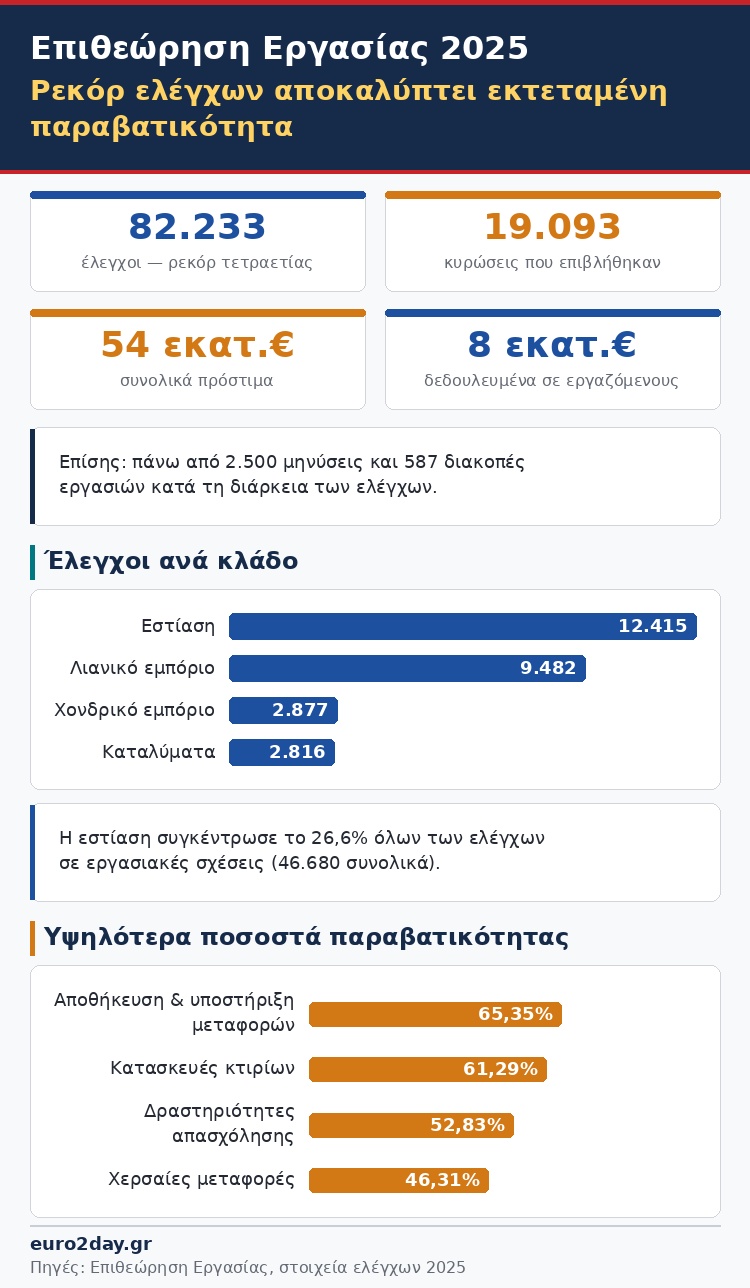
A total of 82,233 inspections were conducted—the highest number in the last four years—while 19,093 penalties were imposed, along with more than 2,500 criminal complaints and 587 work stoppages. Total fines amounted to nearly 54 million euros, while through the Inspectorate’s intervention, approximately 8 million euros in accrued wages were paid to employees.
Specifically regarding labor relations, 46,680 inspections were conducted. The highest concentration of inspections was in the food service sector, where 12,415 inspections were carried out, representing 26.6% of the total. The same sector also ranked first in terms of fines, with 4,279 penalties imposed, while it also recorded the highest frequency of violations at 33.18%.
Retail trade ranked second in terms of inspections with 9,482, followed by wholesale trade with 2,877 and accommodations with 2,816 inspections. The picture was similar for penalties, with retail trade recording 1,649 fines, land transport 898, and accommodations 708.
However, in terms of the violation rate, the storage and transport support services sector took the dubious lead, with 65.35% of inspections resulting in the detection of violations. This was followed by building construction at 61.29%, employment services at 52.83%, and land transport at 46.31%.
The most frequent violations concerned the implementation of the Digital Work Card, with 2,994 recorded cases. These were followed by violations of working hours (2,332), failure to pay accrued wages (1,410), and undeclared work (1,372). A significant number of violations were also recorded in cases of refusal to allow entry or provide information to labor inspectors.
In 2025, particular emphasis was placed on inspections related to the Digital Work Card. Through the Risk Analysis system, 12,244 targeted inspections were conducted, and a total of 95,958 employee cases were examined.
Fines totaling 7.2 million euros were imposed on 1,586 businesses for violations related to work on rest days, failure to pay wages for hours worked beyond the declared schedule, failure to report working hours, and improper operation of time-recording systems. Meanwhile, 74 companies complied following the Labor Inspectorate’s intervention, paying wages to 518 employees.
At the same time, flexible forms of employment remain particularly widespread. In 2025, 1,572,294 part-time or shift work contracts were recorded, with nearly one in two new hires involving a flexible form of employment. At the same time, conversions of full-time contracts to flexible forms increased by nearly 19%, exceeding 55,600 cases.
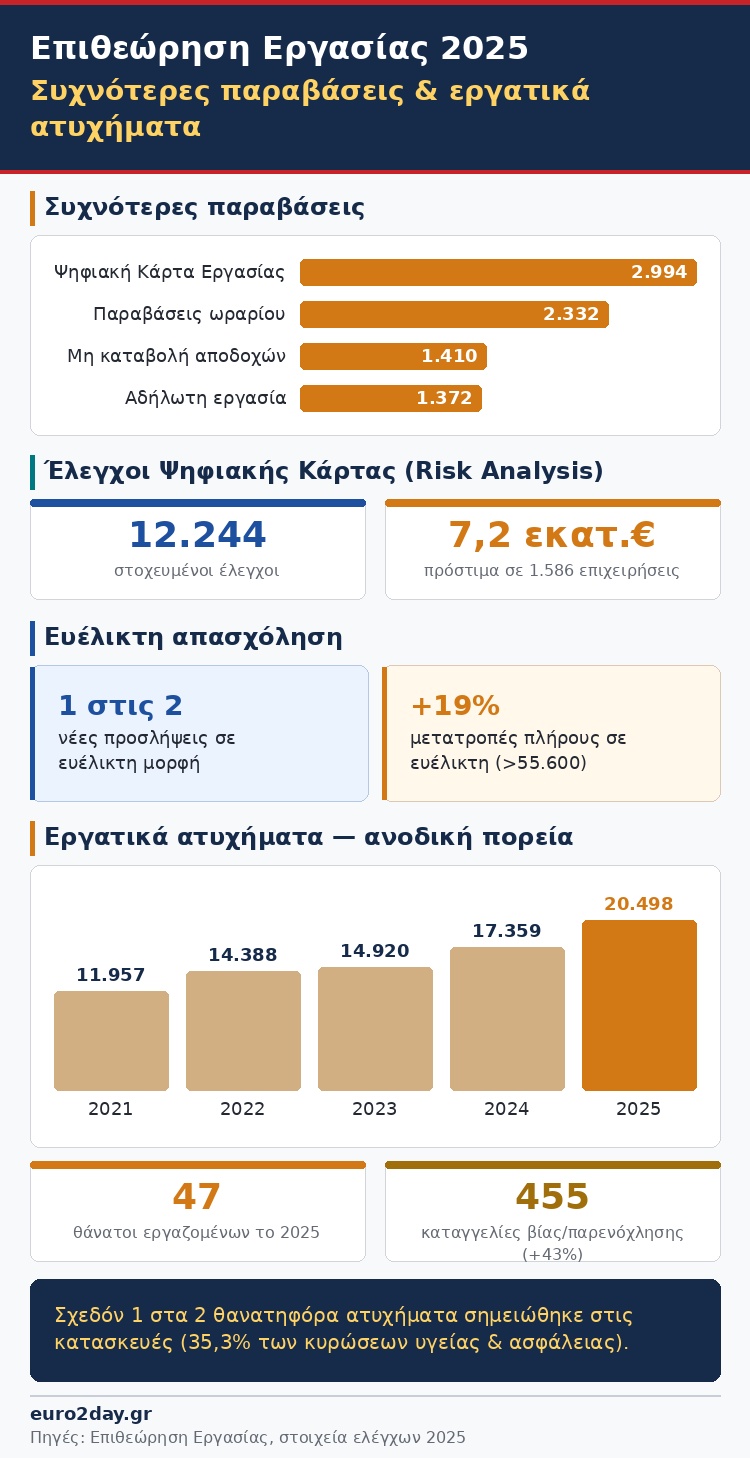
The situation in the field of occupational health and safety is also concerning. In 2025, 20,498 workplace accidents were reported, an increase of 3,139 compared to 2024 and 8,541 compared to 2021.
This marks a continuation of a steady upward trend, as the corresponding figures stood at 11,957 in 2021, 14,388 in 2022, 14,920 in 2023, and 17,359 in 2024. Worker fatalities reached 47, while nearly one in two fatal accidents occurred in the construction sector, which also accounted for the highest percentage of health and safety penalties, at 35.3%.
An increase was also recorded in complaints regarding incidents of violence and harassment in the workplace. The number of related complaints reached 455, a 43% increase compared to the previous year. Most cases involved the tourism sector, while of the total complaints, 70 were related to physical violence and 28 to sexual harassment.