Randstad, the global leader in the human resources services sector, has published, for the ninth consecutive year, the results of its global Employer Brand Survey, which measures the attractiveness of companies in Greece and provides valuable insights into the factors influencing candidates’ choices when seeking a new work environment.
This year’s survey clearly highlights a new reality in the Greek job market: employees are no longer looking solely for an employer that offers competitive compensation, but for a comprehensive work environment that combines job satisfaction, meaningful career development, and a balance between professional and personal life.
At a time when companies are called upon to attract and retain talent in an ever-changing environment, Randstad’s 2026 survey highlights the true priorities of employees in Greece. A pleasant work environment is the most important factor in choosing an employer, while an attractive salary and benefits remain the top priority when employees are asked to rank their needs.
A total of 3,571 people participated in the survey on the Greek labor market, including Greek students, employees, and unemployed individuals aged 18 to 67. The interviews were conducted online in January 2026, and the detailed results will be presented at the webinar, which will take place on Thursday, June 25, at 11:00 a.m., featuring Leda Sgouraki, Director, Professionals & Enterprise HR Services, Randstad Greece, and Eleni Galopoulou, Strategic Business Development Manager, Randstad Greece. You can view the detailed findings of the Randstad Employer Brand 2025 survey here
The 10 Most Attractive Employers in Greece for 2026
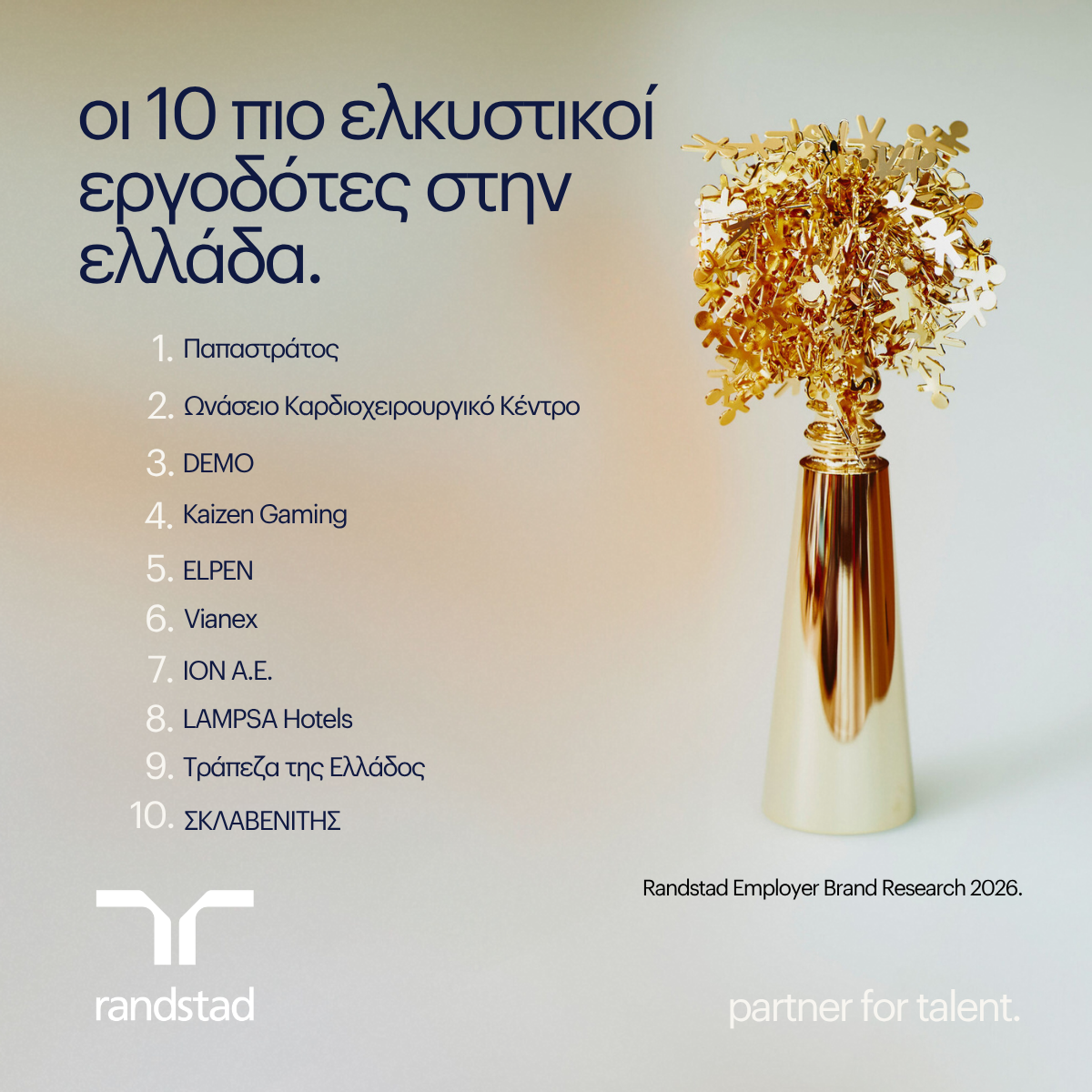
This year’s ranking highlights companies that have successfully linked their business trajectory with a strong employer reputation, creating work environments that inspire trust, stability, and growth prospects. Papastratos was named, for the sixth consecutive year, the most attractive employer in Greece for 2026, according to Randstad’s annual Employer Brand survey.
In second place is the Onassis Cardiac Surgery Center, while third place goes to the pharmaceutical company DEMO, which has consistently maintained its position among the top employers in recent years. Rounding out the top five are Kaizen Gaming, which enters the list for the first time at number four, and the pharmaceutical company ELPEN, which ranks fifth.
The top employers stand out for their financial strength, strong corporate reputation, job security, and the sense of trust and stability they offer their employees. The top ten also includes the pharmaceutical company VIANEX, ION S.A., Lampsa Hotels, the Bank of Greece, and Sklavenitis, which has consistently ranked among the most attractive employers in every year the Randstad Employer Brand survey has been conducted.
Employees’ priorities
The profile of the ideal employer in Greece is shaped by a consistent set of factors that combine the quality of the daily work experience with financial compensation and growth prospects.
According to the findings of the Randstad Employer Brand survey, a pleasant work environment (70%) emerges as the most important criterion for choosing an employer, followed by competitive pay and benefits (67%). At the same time, career development opportunities (61%), work-life balance (57%), and equal opportunities (56%) are established as key pillars of a strong employer brand, rounding out the five decisive factors in employer selection.
The gap between expectations and reality
A comparison between the ideal employer and the evaluation of current employers reveals a significant gap in expectations. Employees rate the companies where they currently work positively, particularly regarding job security, interesting work, equal opportunities, and corporate reputation. However, the greatest discrepancies are found in the areas that most influence the attraction and retention of talent: a pleasant work environment, attractive salary and benefits, and career development—a finding that clearly highlights where employers need to focus their efforts to enhance their appeal.
Job security as a talent retention factor
In an environment of increased challenges and changing work conditions, job security remains a top priority for employees. Reliable pay and benefits are the strongest factor in a sense of security, confirming the importance of financial stability.
This is followed by recognition of performance and opportunities for advancement, with generational differences: Millennials and Gen X place greater emphasis on recognition (approximately 59%), compared to Gen Z (48%), while older generations rank reliable pay and benefits higher (approximately 83% versus 75%). Organizational and financial stability, as well as fair and consistent employment practices, rank similarly in importance (about 45%). Financial stability is particularly important to Gen X (49% versus approximately 43% among younger generations), while expectations regarding fair and consistent practices are distributed more evenly across age groups.
The importance of additional benefits
Fringe benefits also play a significant role, with employees placing particular value on leave and time-off policies, as well as benefits related to retirement planning and financial security. When it comes to different generations of employees, Gen X consistently places a higher value on core benefits, while Gen Z rates them as less important overall, and women generally consider them more important than men.
Work-life balance: a timeless priority
Work-life balance remains an important criterion for employees in Greece. As the survey shows, a pleasant work environment is the most important factor contributing to achieving this balance, with about two in three highlighting it as a key factor, while a manageable workload, free time, and opportunities for personal development and fulfillment also play a decisive role.
Why employees are considering leaving
Although labor market mobility has declined slightly compared to the previous year, the intention to change employers remains high. Twenty-one percent of employees say they plan to change jobs within the first half of 2026, while 13% have already switched employers in the last six months.
The main reasons for leaving are linked to unsatisfactory pay (63%), a negative work environment (47%), and the perception of unequal pay (43%). Limited career advancement and the difficulty of achieving a work-life balance, as well as a lack of interest in the job itself, also significantly influence the decision to leave.
Thanasis Paltadakis, Managing Director of Randstad Greece, stated, “The findings of Randstad’s Employer Brand survey show that an employer’s attractiveness is a dynamic relationship of trust with its people. This year, that has become even clearer—employees in Greece are looking for companies that combine a meaningful work experience, fair compensation, and real opportunities for growth. This is precisely where the future of the job market will be decided, and where a major opportunity will emerge for all companies that truly want to stand out.”