At a time when Greece is breaking one record after another in terms of tourist arrivals, accompanied by a rise in revenue, a significant portion of tourist spending is shifting: It is gradually shifting from restaurants and taverns to supermarket shelves.
This trend is reshaping the landscape of Greek tourism and the sectors that depend heavily on it. Tourists continue to choose Greece as their travel destination and spend considerable amounts during their vacations; however, the way they allocate their available budget has changed significantly, with a greater emphasis on controlling daily expenses.
The data shows that travelers are becoming more selective about how they spend their money. Accommodations, transportation, and activities remain top priorities at a time when travelers are prioritizing the experience, while daily dining out is one of the areas where there is a greater willingness to… cut back.
This is illustrated by data from the Hellenic Statistical Authority, which show that the turnover of businesses in the lodging sector for the first quarter of this year was positive, in contrast to that recorded by businesses operating in the food service sector for the same period.
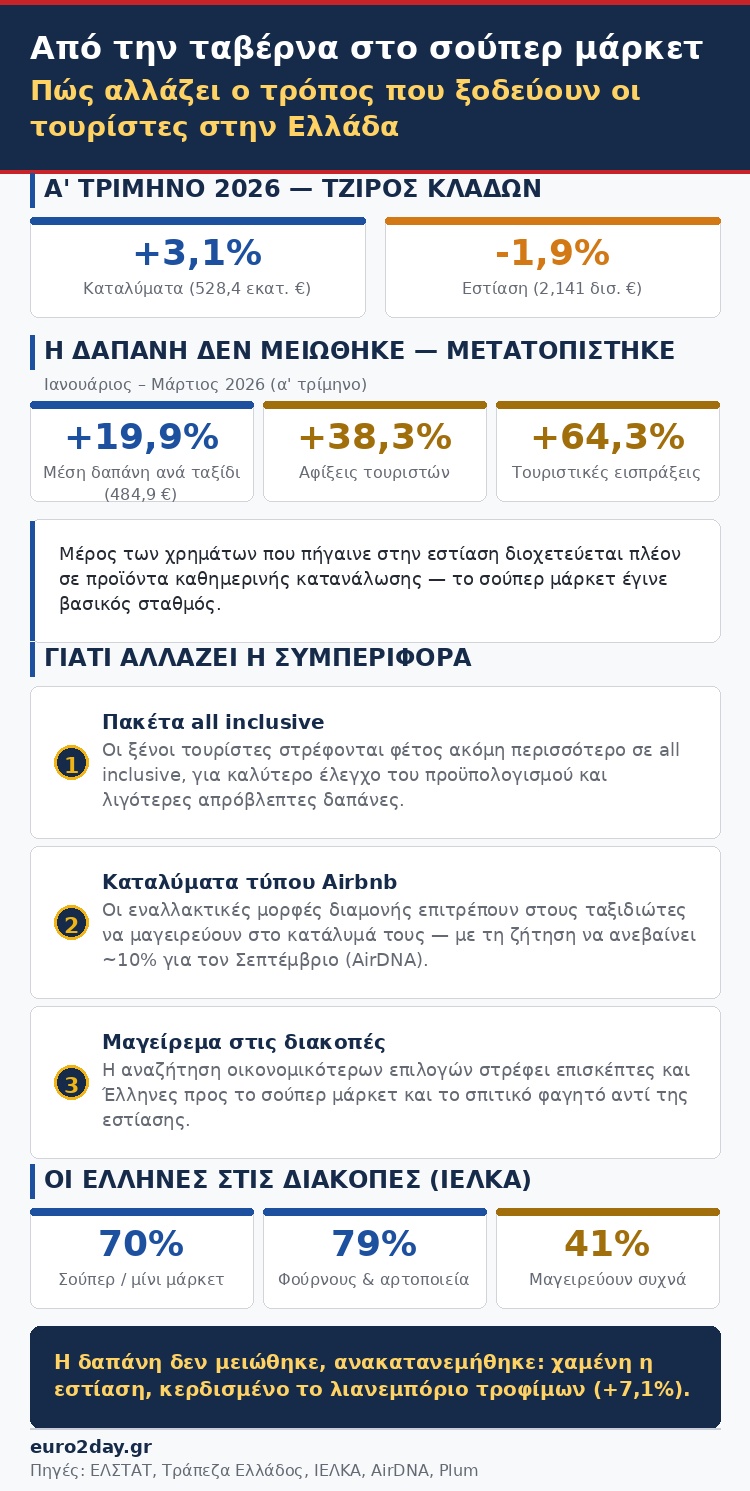
Specifically, as shown by the available data, the turnover of accommodation businesses for the period from January through March amounted to 528.4 million euros, marking a 3.1% increase year-over-year. In contrast, revenue for businesses in the food service sector stood at 2.141 billion euros, marking a 1.9% decrease compared to the same period in 2025.
This shift in habits is also confirmed by the fact that the total amount of money spent by tourists did not decrease. On the contrary, according to data from the Bank of Greece (BoG), the average expenditure per trip during the January–March period rose by 19.9% to 484.9 euros, compared to 404.6 euros during the same period last year.
It should be noted that during the same period, both tourist arrivals and revenue recorded increases of 38.3% and 64.3%, respectively.
In other words, tourism spending did not decline, but shifted. A portion that in the past was directed almost exclusively toward dining is now being channeled toward everyday consumer goods, with supermarkets becoming a key stop… for travelers during their stay at a destination.
In fact, in an effort to better control their travel budget and limit unexpected expenses during their vacations, foreign tourists are turning even more to all-inclusive packages this year.
It is worth noting that the trend of declining spending on dining out is not a phenomenon unique to this year. The same trend was observed last year at the peak of the season. Specifically, in the third quarter of 2025, revenue from accommodations rose by 3.2% (6.6 billion euros) compared to the same period in 2024, while revenue from dining fell by 1.7% (3.977 billion euros).
Changing Habits
NielsenIQ had already highlighted this shift in visitors’ travel behavior in its research last year. According to the findings, 94% of foreign visitors purchased grocery items, with bottled water topping the list (82%), followed by beer (41%), soft drinks, and snacks.
Hypermarkets and supermarkets accounted for the largest share of planned purchases, absorbing approximately 40% of travelers’ total spending, while mini-markets and kiosks served as options for immediate or small purchases.
This shift in habits is reinforced by the expansion of alternative forms of accommodation, as Airbnb-style accommodations allow travelers to cook in their lodgings.
This is a market that is gaining momentum, with demand for Airbnb-style accommodations gradually increasing. Of course, the restrictions imposed in terms of standards have reduced the number of listings to some extent in recent months. In any case, however, the latest data from AirDNA show an increase in demand for the July–September quarter, with the first month of fall recording a double-digit growth rate of around 10%.
The picture of limited spending on dining out is further reinforced by the latest available data from the Plum money management app. According to the monthly report “Money Unwrapped,” which tracks changes in average spending per user based on actual transactions in selected categories, spending on dining out fell by 50% on a month-over-month basis in June 2025, marking five consecutive months of decline. This trend demonstrates that eating out is one of the first categories of spending that consumers cut back on when financial pressure intensifies.
However, based on the same findings, total spending per trip increased by 10%, reaching 622.7 euros, suggesting that tourists did not reduce their budget but rather reallocated it, with dining out bearing the brunt of the cuts.
This shift is also reflected in the performance of the organized food retail sector. Total sales in the first five months of 2026 exceeded 6.625 billion euros, an increase of 7.1%. Crete and the islands, however, recorded the highest growth rate nationwide, at +8.9%, significantly exceeding the national average.
What Are Greeks Doing?
This new behavior is not limited to foreign visitors. A similar trend is now evident in the vacations of Greek travelers, who appear to be more careful in managing their expenses.
For example, according to a survey by IELKA (Institute for Retail and Consumer Goods Research), 41% of respondents say they often cook while on vacation, and 70% say they regularly visit supermarkets or convenience stores, most likely in an effort to save money on dining out.
At the same time, 79% of consumers visit bakeries and pastry shops during their vacations, indicating that the search for more economical options extends beyond just the main meal to their overall daily diet.
Finally, according to the findings, only 28% say they never cook while on vacation.