The Independent Authority for Public Revenue (IAPR) is creating the “tax office of the future” and is gradually moving toward the full digitization of all tax procedures, the use of artificial intelligence, the automation of operations, and ultimately the elimination of the traditional way of serving taxpayers.
Traditional tax offices are being closed or merged, and in their place, new, modern facilities are being created where taxpayers, within a digital environment and under the guidance of trained staff, will be able to submit their requests, ask questions, and find solutions to their problems.
One such center is opening to the public today in Holargos, marking the beginning of a new era.
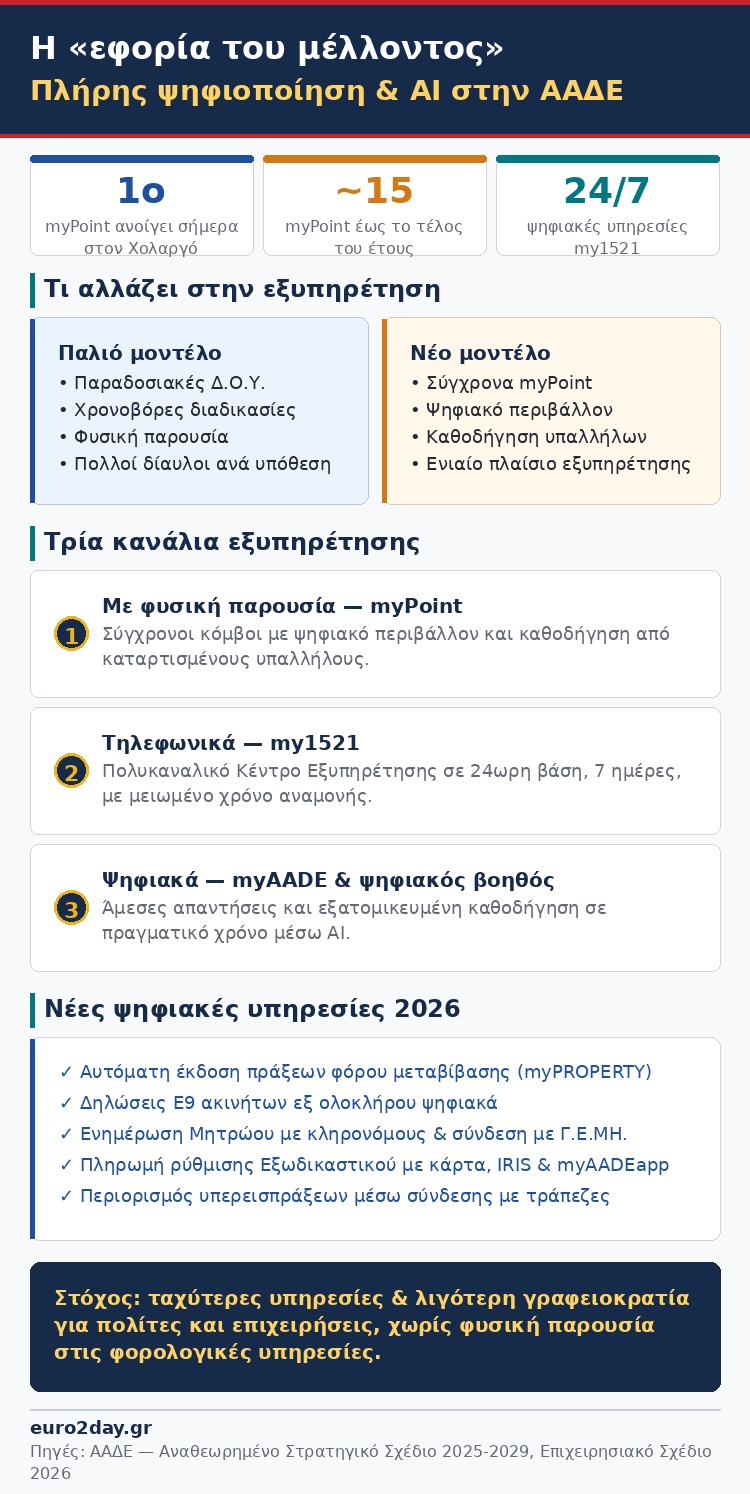
This is the AADE’s first “service point” (myPoint), where taxpayers will be able to receive guidance, information, and support in a simpler and more organized manner, without being burdened by time-consuming procedures and without having to seek out different channels of communication for each of their matters.
With the launch of the first myPoint (approximately 15 will be established by the end of the year), the Tax Administration aims to substantially upgrade its day-to-day services for citizens and businesses.
Existing Tax Service Centers are gradually being transformed into modern hubs, which will operate according to uniform standards, with better organization and increased use of digital tools.
my1521 Service
myPoint will operate in conjunction with the my1521 Multichannel Taxpayer Service Center and the digital services of the Independent Authority for Public Revenue (AADE). This creates a unified service framework, within which citizens can choose to be served digitally, by phone, or in person, depending on the nature of their case.
Modern Tools
In accordance with the Revised Strategic Plan 2025–2029 and the 2026 Operational Plan, the AADE, through modern e-tools, will proceed in 2026 with a broad program to modernize tax services, offering faster services and less bureaucracy for citizens and businesses.
To this end, the following are expected to be implemented:
- An integrated digital information environment that will centralize tax and customs legislation. Users will have access to up-to-date information, codified laws, and administrative decisions to help them understand their obligations and rights.
- The Taxpayer Service Center is being upgraded with new digital tools, while the integration of telephone and online communication channels is expected to significantly improve service. The digital assistant will also play a key role, providing immediate answers and personalized guidance in real time.
- The operation of the new my1521 Taxpayer Service Center is being improved and expanded. These digital services, available 24 hours a day, 7 days a week, will reduce wait times, while a smart management system tracks all inquiries, ensuring comprehensive and accurate responses from the Tax Administration.
Digital Services
Among the tax authority’s new digital services are:
- Automation of the process for issuing and notifying tax assessment notices for capital transfer taxes for those returns that are not automatically processed by the myPROPERTY application.
- Automatic updating of the Registry with the heirs of deceased persons through interoperability.
- Changes to business information for individuals and legal entities, such as registered office, etc.
- Automatic updating of the Taxpayer Registry database through an interface with the General Commercial Registry.
- Digitization of the authorization process for natural persons within the Registry’s operational scope.
- Development of an online service with credit institutions to limit overcollection.
- Development and support of a comprehensive system for the purchase of motor vehicle fuel exempt from the Special Consumption Tax and VAT, as well as the purchase of goods and services exempt from VAT for persons eligible for exemption, namely foreign diplomatic missions, consular authorities, and their staff, as well as international organizations and their staff.
- Development of an electronic application for the process of granting direct or indirect VAT exemption on the supply of goods by a taxable person established within the country to a traveler-purchaser, who is not established within the European Union and who is departing from Greece for a third country.
- Digitization of the process for submitting applications for approval or rejection regarding the VAT exemption procedure for the purchase and import of goods intended for export or intra-Community supply, as well as services directly related to these transactions.
- Option to pay for the Out-of-Court Settlement Mechanism via credit card, IRIS, and the myAADEapp.
Interconnection
At the same time, the integration of the AADE’s information systems with other public databases allows for the immediate updating of taxpayer information. Changes related to real estate, inheritance matters, or business data will be recorded electronically, without requiring citizens to physically visit tax offices.
Real Estate
E9 property tax returns will be able to be filed and amended entirely digitally, and provisions are in place for the electronic management of cases involving deceased taxpayers. In addition, notaries and other authorized professionals will gain new capabilities for handling procedures electronically, contributing to the faster completion of property transfers and inheritance matters.