The workshop organized by the Hellenic Association of Information Technology & Communications Enterprises (SEPE) on the topic “Greece in the New Digital Era: AI, Cybersecurity, and the New Innovation Ecosystem,” on Thursday, June 18, 2026. The event took place as part of the international exhibition “Beyond 2026” at the Metropolitan Exhibition Center in Spata, Attica.
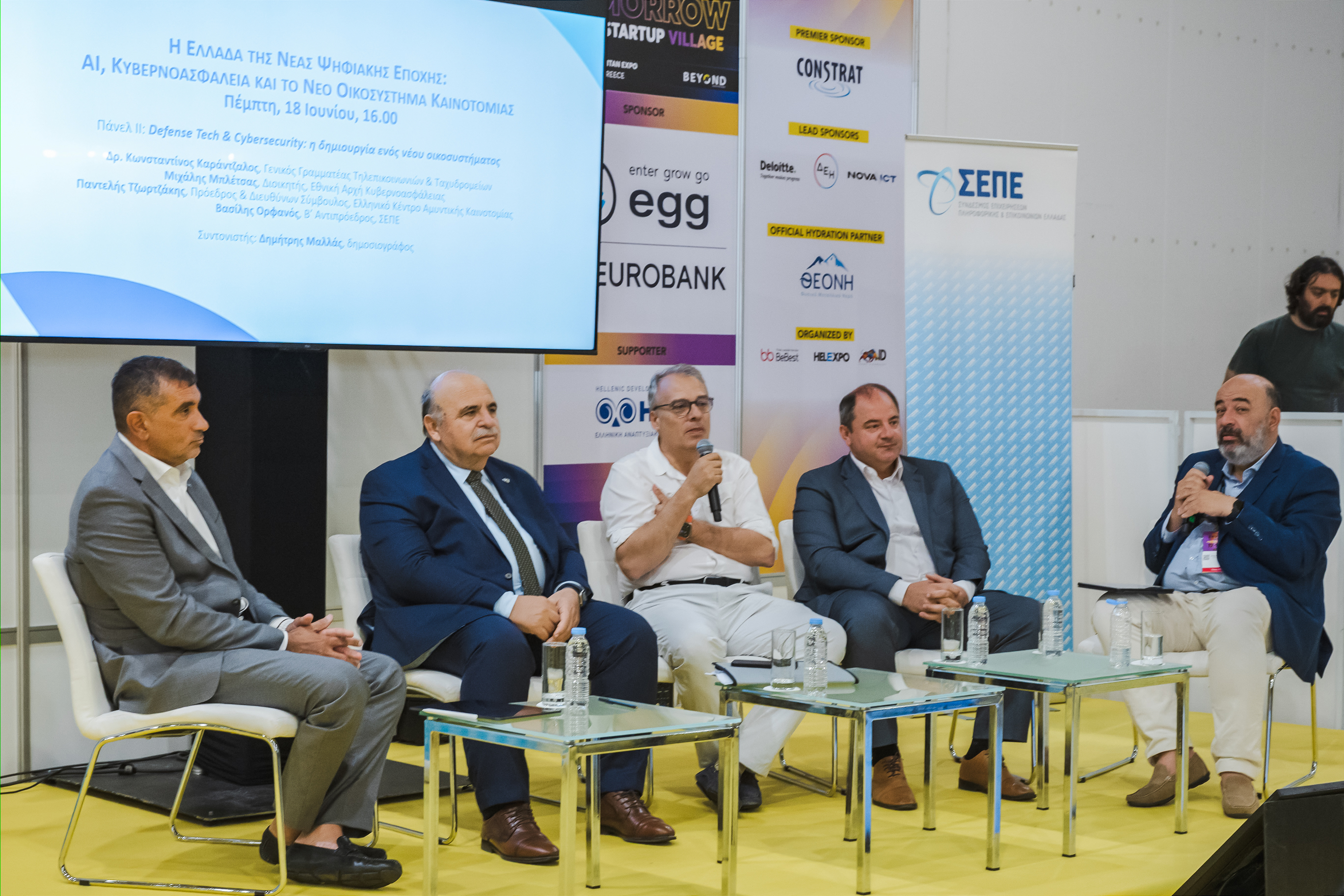
With the participation of leading institutional representatives, academics, and industry executives from the digital technology sector, SEPE, as an institutional interlocutor and partner of the government, took the initiative to launch a discussion on the future of the country’s digital strategy by organizing two specialized panel discussions titled: “DigitalGreece 2030: The Next Steps and Challenges for the Country’s Digital Transformation” and “Defense Tech & Cybersecurity: Creating a New Ecosystem,” where participants focused on the obstacles that must be overcome to achieve the country’s digital transformation by 2030, securing infrastructure, and cutting-edge investments that will ensure national digital resilience.
At the same time, a memorandum of cooperation was signed between the National Center for Documentation and Digital Content (EKT) and the Hellenic Association of Information Technology & Communications Enterprises, with the aim of joining forces on the critical issues of digital transformation, data usage, research, and science. The Memorandum of Cooperation was signed on behalf of EKT by its Director, Dr. Kyriakos Tolias, and on behalf of SEPE by the Chair of the Board of Directors, Ms. Giota Paparidou. This marks the beginning of a collaboration between two institutions whose goal is to foster innovation and disseminate it throughout society and the economy.
More specifically, the Memorandum of Cooperation covers the following actions:
- Communication and the exchange of know-how, data, information, and best practices on topics of mutual interest;
- cooperation on business information, networking, and consulting initiatives,
- cooperation on education/training and skills development,
- cooperation on research and development/innovation and digital transformation,
- support for the promotion of projects and the dissemination of results of common interest,
- the conduct of research/studies and/or the collection, compilation, and dissemination of statistical data and indicators on topics of heightened interest,
- the implementation of joint initiatives such as workshops, seminars, and events,
- seeking funding to carry out joint activities that advance the objectives of this agreement,
- exploring new areas of cooperation and opportunities for joint participation in national and European programs or cooperation networks.
In the first panel, titled “DigitalGreece 2030: The Next Steps and Challenges for the Country’s Digital Transformation,” the Secretary General for Information Systems & Digital Governance, Mr. Demosthenes Anagnostopoulos, emphasized that “Greece has made tremendous strides in digital transformation. And what’s important is that it has changed all of our mindsets. We now expect everything to be digital. We are establishing best practices. In academia, in the public sector, and in the creation of new businesses. The next step, in addition to new services, is to make the government function as a unified system—with reliable and interoperable data, shared and improved infrastructure, and greater security. Interoperability continues to be the foundation of this transition. On this foundation, we can responsibly leverage artificial intelligence, offer more proactive services, and strengthen trust.”
Taking the floor, the CEO of the Information Society MAE, Mr. Stavros Asthenidis, noted that “Greece is now entering a new phase of digital maturity, where the challenge lies not only in implementing projects, but primarily in their operation, integration, and utilization in the daily lives of citizens and businesses. In this transition, the Information Society plays a decisive role, focusing on the creation of a unified digital operating framework, with an emphasis on interoperability, common standards, and the operational continuity of projects. The future of Digital Greece 2030 requires continuity in planning, stability in the funding framework, and strengthening of administrative capacity so that projects can evolve and deliver real value. Success will ultimately be judged by the extent to which digital services become genuinely useful and transparent for citizens, consistently and reliably integrated into their daily lives.”
Continuing the discussion, the Chairman of the Board of Directors of the National Technology and Research Infrastructure Network (EDYTE S.A. – GRNET), Professor Emeritus at the National Technical University of Athens (NTUA) and Coordinator of the PHAROS AI Factory, Mr. Stefanos Kollias, stated that “EDYTE’s goal is to support, through supercomputing infrastructure, the development of a reliable, sustainable AI ecosystem on the path toward 2030, for the public sector, researchers, startups, and small and medium-sized enterprises in our country. This development, coupled with the simultaneous building of AI skills, prioritizes key thematic areas such as the preservation of the Greek language, digital support for and dissemination of culture, personalized healthcare, addressing the climate crisis, and further improving the efficiency of public administration. Continuous collaboration and the complementary nature of public and private sector activities are of particular importance to the success of this development.”
The Governor of the Independent Authority for Public Revenue, Mr. George Pitsilis, also commented on the matter, stating that “The IAPR’s presence at BEYOND is linked to the present and future of the digital economy, public administration, and society. The transition of technology from innovation to practical application was the first major step. Today, we have already moved beyond that: in a phase of continuous, mature, and pioneering digital evolution. The Independent Authority for Public Revenue (AADE), having adopted a comprehensive digital operating model years ago, has made the public sector a leader in digital progress. We did not merely expand digital services; we gave them depth, quality, and real value, for the benefit of the economy, entrepreneurship, citizens, and society. Through artificial intelligence, advanced analytical tools, secure connections, and the continuous simplification of procedures, we are making compliance easier, service faster, and audits more targeted, fair, and effective.”
For her part, IDYKA S.A. CEO Niki Tsouma noted that “in recent years, Greece has taken significant steps toward the digital transformation of the healthcare sector, with services that have fundamentally changed citizens’ daily lives. The challenge for the coming period is to build on this momentum by investing in new, innovative digital services, as well as in infrastructure and interconnections that enable systems to work together effectively. The value of digital transformation lies in technology’s ability to transform data into digital services, faster processes, and evidence-based decisions. In this context, interoperability, data quality, and the responsible use of artificial intelligence are essential prerequisites for the future. At the same time, strengthening public trust, developing robust digital infrastructure, and fostering ongoing collaboration between the public and private sectors will largely determine the success of Digital Greece 2030.”
Finally, the Chair of the SEPE Board of Directors, Ms. Giota Paparidou, commented that “technology leaders are not created by chance. They emerge when there is talent, access to markets, sustainable financing, a stable institutional environment, and national self-confidence. And today, Greece has the opportunity to shift from being seen as a country that merely follows developments to one that produces technology, exports innovation, and claims a role in global digital competition. The digital technology sector in Greece has matured significantly in recent years and has now evolved from the role of a technology provider to that of a strategic partner for the country. The public sector’s digital transformation, progress in connectivity infrastructure, extensive 5G coverage, as well as the growing demand for solutions in artificial intelligence, cybersecurity, cloud computing, and data analytics, demonstrate that the market possesses the expertise, outward-looking approach, and capacity to implement large-scale projects and initiatives.”
In the second panel, titled “Defense Tech & Cybersecurity: Creating a New Ecosystem,” the discussion was opened by the Secretary General of Telecommunications and Post, Dr. Konstantinos Karantzalos, who noted that “Our participation in BEYOND 2026 reflects the Ministry of Digital Governance’s strategic approach to the sectors of critical infrastructure and digital security. Through our contribution to the event’s thematic discussions, we highlight both the progress made in the digital modernization of the country’s critical infrastructure networks and the efforts to strengthen the resilience of communications networks and foster a national ecosystem of innovation in cybersecurity. Our goal is to develop resilient, secure, and interoperable infrastructure capable of meeting the modern challenges of the digital age. The development and implementation of national strategies in critical technologies, such as Artificial Intelligence, Space, Connectivity, and Autonomous Robotic Systems, set both short-term and optimistic long-term goals for the country. Greek companies have already developed significant capabilities in these sectors and are able to offer solutions for both the public sector and citizens.”
“For us at EAK, regulatory compliance with the European Artificial Intelligence Directive is our top priority. We have already begun efforts in this direction, as the development of technological tools beyond human resources is also required. One of the first sectors in which our plan will be implemented is healthcare. “We have passed laws, so now we are taking the step toward implementation,” emphasized the Director of the National Cybersecurity Authority, Mr. Michalis Bletsas, adding that “A Greek presence in the cybersecurity sector in foreign markets requires a marketable product. The real challenge is selling abroad, not developing the solution itself.”
For his part, the President and CEO of the Hellenic Center for Defense Innovation, Mr. Pantelis Tzortzakis, noted that “The greatest challenge today is not the production of innovation but a state’s ability to absorb and scale it. This is the gap that ELKAK aims to fill. In a world where deterrent power depends increasingly on software, data, artificial intelligence, autonomous systems, and advanced sensor networks, national security cannot rely exclusively on traditional defense industries. It requires a dynamic ecosystem that is constantly renewing itself and generating a technological edge. ELKAK acts as the catalyst for this transition: not merely by connecting different entities, but by establishing—for the first time in Greece—a mechanism for generating defense innovation that simultaneously strengthens operational readiness, the country’s technological sovereignty and competitiveness, thereby serving as a driver of security and economic growth.”
The Second Vice President of SEPE, Mr. Vasilis Orfanos, also commented on the matter, emphasizing that “BEYOND 2026 highlights precisely what the country needs most: for Greece to shift from simply implementing projects to producing cutting-edge technology. It must become outward-looking and achieve strategic autonomy. Civil protection, cybersecurity, and the protection of critical infrastructure will no longer be determined solely by heavy industry, but by the “heart” of these systems: software, Artificial Intelligence, Computer Vision, data, autonomy, and cyber resilience. This is where Greek companies—which have innovation in their DNA and develop dual-use technologies applicable to both society and defense—can make a difference. True success in the coming years will be seeing Greek technologies protect networks, infrastructure, borders, energy systems, and critical infrastructure worldwide. We must not merely be buyers of advanced solutions, but also producers and exporters of technology. This is the challenge for Greece, and this is the message that BEYOND must convey.”
In connection with the signing of the memorandum of understanding between the National Center for Documentation and Digital Content (EKT) and the Hellenic Association of Information Technology & Communications Enterprises, EKT Director Dr. Kyriakos Tolias stated: “The Memorandum of Cooperation between EKT and SEPE establishes a substantive framework for joint actions aimed at strengthening innovation, outward orientation, and the digital transformation of businesses. By leveraging the link between research and entrepreneurship, reliable data, and the EKT’s participation in international networks such as the Enterprise Europe Network, we aim to develop targeted initiatives for networking, consulting support, and skills development, and to contribute to a more dynamic and competitive ICT ecosystem.”
Subsequently, the Chair of the SEPE Board of Directors, Ms. Giota Paparidou, emphasized: “At a time when innovation, knowledge, and digital technologies are shaping the future of the economy and society, SEPE’s collaboration with the National Center for Documentation and Digital Content represents a significant step toward further strengthening the Greek technology and innovation ecosystem. Through this Memorandum of Cooperation, we are joining forces to promote research, leverage knowledge and data, and create new growth opportunities for companies in the sector. At the same time, we are strengthening the connection between the research community and the market, helping to accelerate digital transformation, develop modern skills, and create greater added value for the Greek economy and society.”
SEPE, by supporting dialogue and the exchange of views among institutions, stakeholders, and the market, reaffirms its strategic role as the government’s institutional advisor in shaping the country’s digital strategy, serving as a lever for growth and progress.