The title of the article that caught our attention was “Poland Ranks Highest on the EU Household Well-Being Index, Surpassing Four Member States.”It reminded us of the Poles who came to our country to work in the 1990s and in the early 2000s. Most of them returned to their homeland before and after 2004, when Poland joined the EU.
The celebratory headline referred to Poland’s position in the EU’s 2025 ranking based on real individual consumption (AIC), adjusted for differences in price levels. The latter calculates the value of all goods and services consumed directly by households, as well as those provided by the government—such as education and healthcare—and by NGOs.
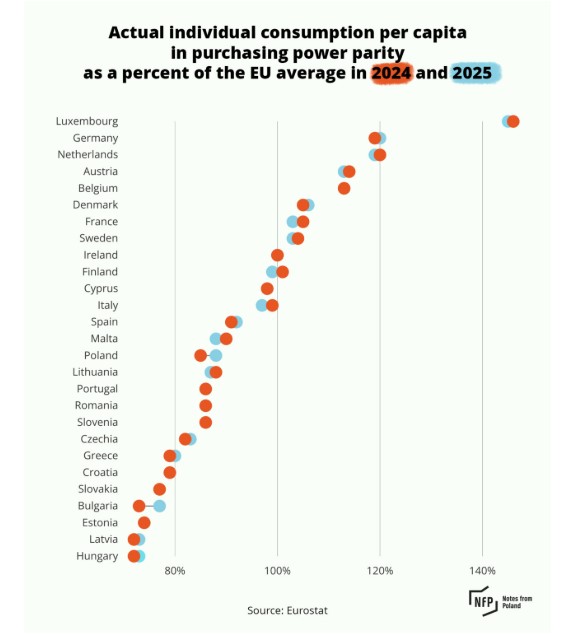
Poles were celebrating because they went from 85% in 2024 to 88% of the EU average in 2025, ranking 14th among the EU-28 and surpassing Portugal, Romania, Slovenia, and Lithuania. In 1995, Poland’s AIC stood at 45% of the EU average. Our neighbor Bulgaria made the biggest leap, up 4 percentage points, but remains below 80%. The relevant graph is shown below.
It was impossible not to notice that Greece’s AIC rose slightly last year and stands at 80% of the EU average, compared to 68% based on per capita GDP. Looking back, we found that real per capita consumption in terms of purchasing power stood at 80% again in 2012. Some 13 years later, Greece is 20 percentage points below the EU average. Of course, Greece does not stand alone, as its position also depends on the performance of other EU member states.
In fact, if we go even further back in time, we see that the real per capita consumer spending of Greek households stood at 100%, i.e., the EU average, from 2004 to 2007, and in fact rose to 104% in 2008, driven by all kinds of consumer loans. In 2008, Poland stood at 63% of the EU average.Greece slipped to 103% in 2009 and began to plummet from there, reaching 93% in 2010, to 86% in 2011 and to 80% in 2012, before reaching an all-time low of 75% in 2020, the year of the coronavirus.
The question that arises is a reasonable one. Why has Poland fared so much better than Greece during this entire period? Obviously, there are various reasons, such as culture and the political landscape. But if we focus on the economic sphere, certain factors stand out.
Greece continued to rely primarily on consumption and, to a lesser extent, on exports—with an emphasis on tourism—and even less on private investment.
In contrast, Poland expanded its industrial base by attracting large amounts of foreign direct investment and integrated itself into global supply chains, benefiting from its interconnection with German industry. Furthermore, unlike Greece, the crisis in the eurozone found Poland with low public debt, below 50% of GDP.
Tax evasion exists in both countries, but in Greece it is estimated to be significantly higher. As is well known, many people here declare themselves as poor to the tax authorities but have much higher incomes, which fuel consumption. This is why, after all, total consumption exceeds declared incomes by several tens of billions of euros every year.
The purchasing power of Greek households is not the lowest in the EU, as those who emphasize per capita income like to say, but the improvement relative to the EU average is insufficient, as Poland demonstrates. At least, we have more fun here.