PPC is considering further expanding its presence abroad, with Moldova now on its “radar”—a country located along the critical energy corridor of Southeast Europe and bordering the large Ukrainian market.
On the strategic South-North electricity transmission corridor, which begins in Greece, passes through Bulgaria, and continues through Romania, Moldova serves as the eastern terminus. Until recently, the country was not included in the group’s investment plans; however, it is now being considered as a potential new destination.
The other prong of PPC’s westward expansion strategy calls for strengthening its presence in markets such as Hungary and Slovakia, with Poland—which also borders Ukraine—as the ultimate destination.
PPC CEO George Stassis spoke yesterday during the company’s annual general meeting of shareholders about the group’s prospects for entering new markets and opportunities for international expansion on a larger scale.
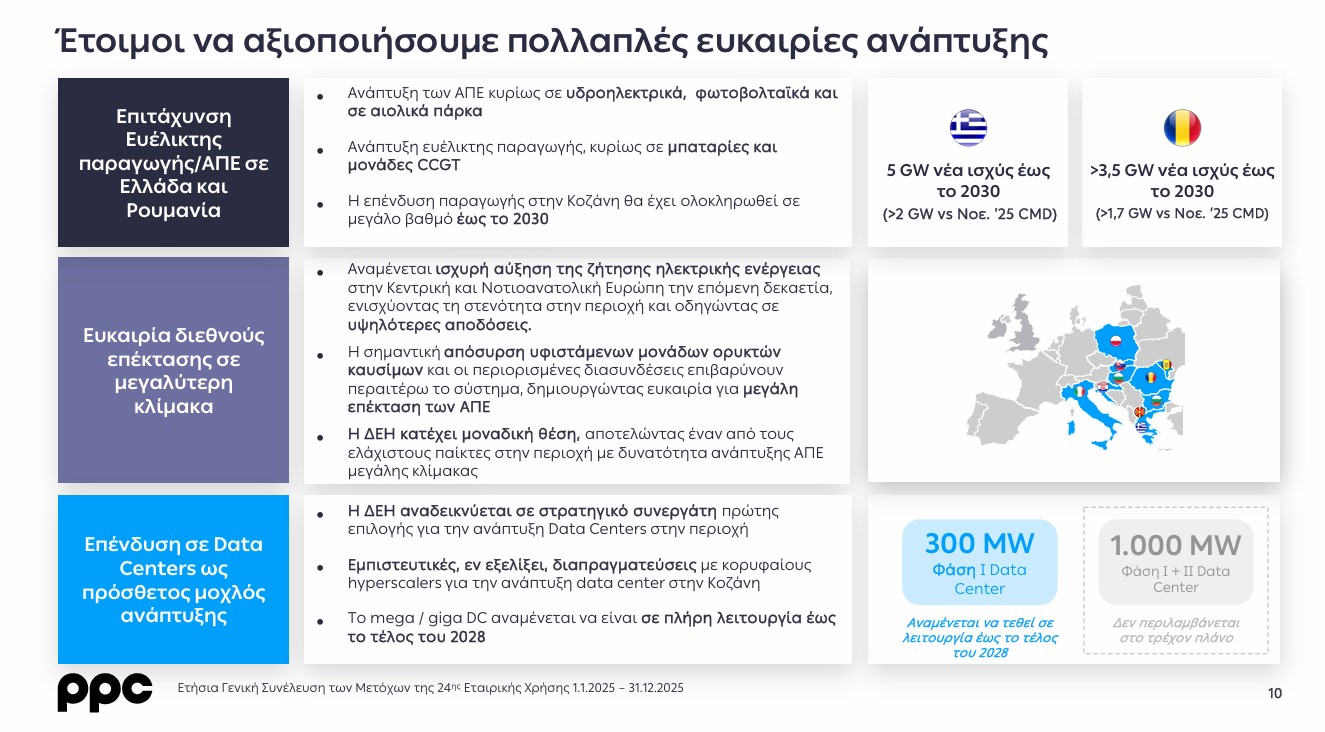
In the relevant slide of the presentation, the number of countries where the company aims to establish a presence in the coming years has increased from nine to ten.
Strong Wind Energy Potential
According to reports, the opportunities the company is exploring in Moldova involve investments in wind turbines, as the country possesses significant wind energy potential, comparable to that of Romania. This technology is considered particularly important for grid stability and technological diversification—beyond mere geographic diversification—which PPC has been systematically pursuing in recent years.
According to people familiar with the situation, the similarities between Moldova and Romania—such as their similar geography and shared advantages—make the two countries, in a sense, a single market.
Furthermore, the renewable energy market in Moldova shows no signs of the saturation observed elsewhere and has made impressive progress in recent years. Data show that installed renewable energy capacity stands at just over 1 GW, up from a mere 76 MW in 2020, ranking it among the fastest-growing markets in the region.
Another sign of this growing interest is the recent tender issued by the Moldovan Ministry of Energy for the development of 170 MW of wind farms and at least 44 MWh of battery storage systems. According to the same sources, PPC did not participate in this specific process; it is operating independently and “scouting” other investment opportunities.
George Stassis also addressed the emerging prospects in Southeastern and Central Europe during his remarks at the Superfund forum, emphasizing the importance of the concept of geographic and technological diversification that PPC has been systematically pursuing in recent years in order to achieve 24-hour green power generation while minimizing any risks.
Vertical Electricity Export Corridor
The diversified footprint stretching from Poland to Greece and from Italy to Moldova provides a natural hedge between the wind energy of the North and the solar energy of the South.
Just as the expansion into photovoltaics was based on the logic that when there is no sun in Greece, there will be, for example, in Romania, the same principle applies to wind power. The logic is that when the wind isn’t blowing in Greece, it will be blowing, for example, in Bulgaria, Italy, Moldova, or some other country in the region where it wants to establish a presence.
“We’re talking about the Vertical Corridor for natural gas and how it can supply the north. But we can also, as a country, supply it with electricity, so this is an opportunity to press Brussels for more and more interconnections, which are of crucial importance,” said the head of PPC, noting that the company currently operates in six countries (Greece, North Macedonia, Bulgaria, Romania, Italy, and Croatia) and will soon expand into more.
Among the reasons driving “Phase 2” of PPC’s European expansion—which involves the sale of ever-increasing quantities of energy from renewable sources—is not only the well-known “Greece-Bulgaria -Romania” axis, but also to Hungary, to Slovenia—which is interconnected with it—and from there to Croatia and Italy—Mr. Stassis made a special mention of this during the company’s annual general meeting.
The scope of this opportunity is summarized by estimates that installed renewable energy capacity in the region is expected to more than double by 2035, reaching 180 GW, as well as the fact that over the next decade, obsolete coal and gas-fired power plants (69 GW) are set to be decommissioned. The gap created by this phase-out will be filled by investments in renewable energy, batteries, and flexible natural gas plants. In other words, significant investment opportunities are emerging.
Essentially, the group views the region as a large, unified market, which—as its CEO noted during last month’s presentation of PPC’s investment plan—has traditionally had some of the highest wholesale prices in Europe, with the causes being primarily structural in nature (old power plants, few interconnections, etc.). However, higher prices also translate into higher returns.