The latest Interview poll for POLITIC reveals a new balance of power, with New Democracy gaining ground to 28.1%, ELAS consolidates its second-place position, PASOK remains stuck at 12.3%, and Maria Karystianou’s “Elpida” party suffers the biggest drop in the poll.
In terms of voting intention, New Democracy garners 28.1%, increasing its share by two points compared to the previous month, when it stood at 26.1%. ELAS remains in second place with 14.5%, and has actually gained 1.7 percentage points. PASOK stands at 12.3%, exactly the same as last month, while at the same time it sees Tsipras’s party pulling ahead and turning May’s narrow margin into a clear lead.
Maria Karystianou’s “Elpida” party recorded the biggest drop in the poll. It fell from 7.5% in May to 5.4% in June, losing 2.1 percentage points in a single month. SYRIZA has not rebounded, remaining at 0.5%.
The decline in the number of undecided voters is also significant. They fell from 12.7% in May to 9.5% in June, a drop of 3.2 percentage points. The findings suggest that new voter alignments are not concentrated in a single party but are primarily bolstering New Democracy, ELAS, and the Greek Solution.
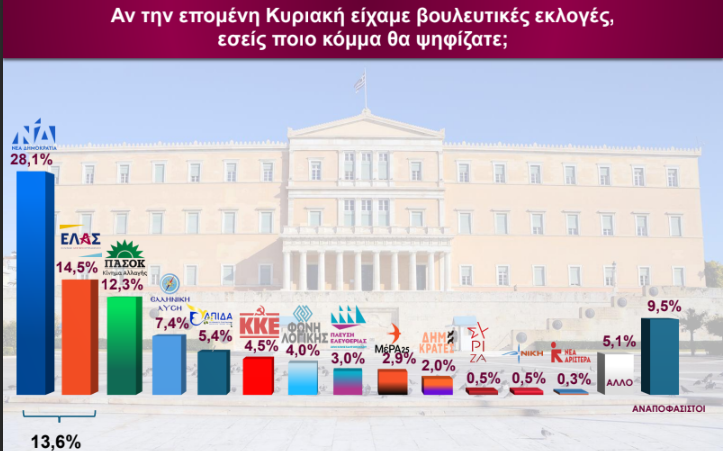
Here are the detailed percentages:
New Democracy: 28.1%
ELAS: 14.5%
PASOK: 12.3%
Greek Solution: 7.4%
Hope: 5.4%
KKE: 4.5%
Voice of Reason: 4.0%
Freedom Course: 3.0%
MERA25: 2.9%
Democrats: 2.0%
SYRIZA: 0.5%
Niki: 0.5%
New Left: 0.3%
Other party: 5.1%
Undecided: 9.5%
Skepticism toward ELAS and “Elpida” leaders
Citizens see new parties, old faces, and a lack of credibility behind the new political formations.
Regarding EL.A.S., 42% believe it features figures lacking a convincing political presence, while 29% see a recycling of old political figures. Only 15% view its members as competent and serious.
Reservations are even more pronounced regarding Maria Karystianou’s “Elpida” party. Sixty-seven percent of citizens believe that the party’s leaders lack a convincing political presence, while just 6% see them as competent and serious. Seventeen percent recognize them as having good intentions but limited experience.
78% Reject the Idea of a Samaras Party
The prospect of Antonis Samaras forming a new party has generated little political traction, as 78% of citizens say they would “definitely not” vote for such a party.
Only 12% are in favor, responding “very much” or “somewhat,” while another 8% say “a little.”
Mitsotakis Leads in Suitability for Governing
When asked which political leader citizens trust most to govern the country, Kyriakos Mitsotakis maintains a clear lead with 32%. This is followed by the response “none” at 16.3%, a figure that reflects the lack of trust in the political system, while Alexis Tsipras garners 15.4% and Nikos Androulakis 10%. Further down the list are Kyriakos Velopoulos with 6.7% and Maria Karystianou with 5.1%.
Wages, employment, and housing top the list of needs for the younger generation
When asked where additional resources to support young people should be directed as a priority, the responses clearly reflect the pressures of daily life. Fifty percent choose wages and employment, while housing follows with 26%, confirming that financial independence is the primary goal for the younger generation. Education accounts for 14%, entrepreneurship for 8%, while transportation and other options are limited to 1%.
Public opinion appears even more cautious toward proposals for free or significantly discounted public transportation for young people. Fifty-six percent view these proposals primarily as campaign slogans, while 28% consider them a necessary social measure. Another 16% view them positively but do not see them as a priority, indicating that citizens are calling for measures with an immediate impact on employment, wages, and housing.
Chalki School: 48% see geopolitical expediency
The reopening of the Halki Theological School is viewed by citizens primarily through the lens of international relations. Forty-eight percent believe that the most important factor behind Erdogan’s decision is an effort to improve Turkey’s international image, while 22% attribute a role to Trump’s intervention. In contrast, only 8% consider the Ecumenical Patriarchate’s long-standing demand to be a decisive factor.