The debate over the relationship between wages and competitiveness is once again taking center stage, as the Greek economy is called upon to navigate an environment of heightened geopolitical uncertainty, trade realignments, and a slowdown in global economic activity.
In its Monetary Policy Report for 2025–2026, the Bank of Greece notes that external risks make maintaining competitiveness even more critical, particularly for an economy that relies on exports, tourism, and investment.
This concern is not unfounded. The rapid decline in unemployment has limited the availability of labor in several sectors, such as tourism, hospitality, and construction.
Labor shortages are putting upward pressure on wages, creating the risk that labor costs will rise faster than productivity. In such a scenario, the economy could lose some of its competitiveness, as businesses would face higher production costs.
The data, however, indicate that the situation is currently more balanced. Wages continue to rise, reflecting both the tight labor market and efforts to recoup some of the purchasing power lost due to high inflation in previous years. At the same time, however, the rate of wage growth is slowing.
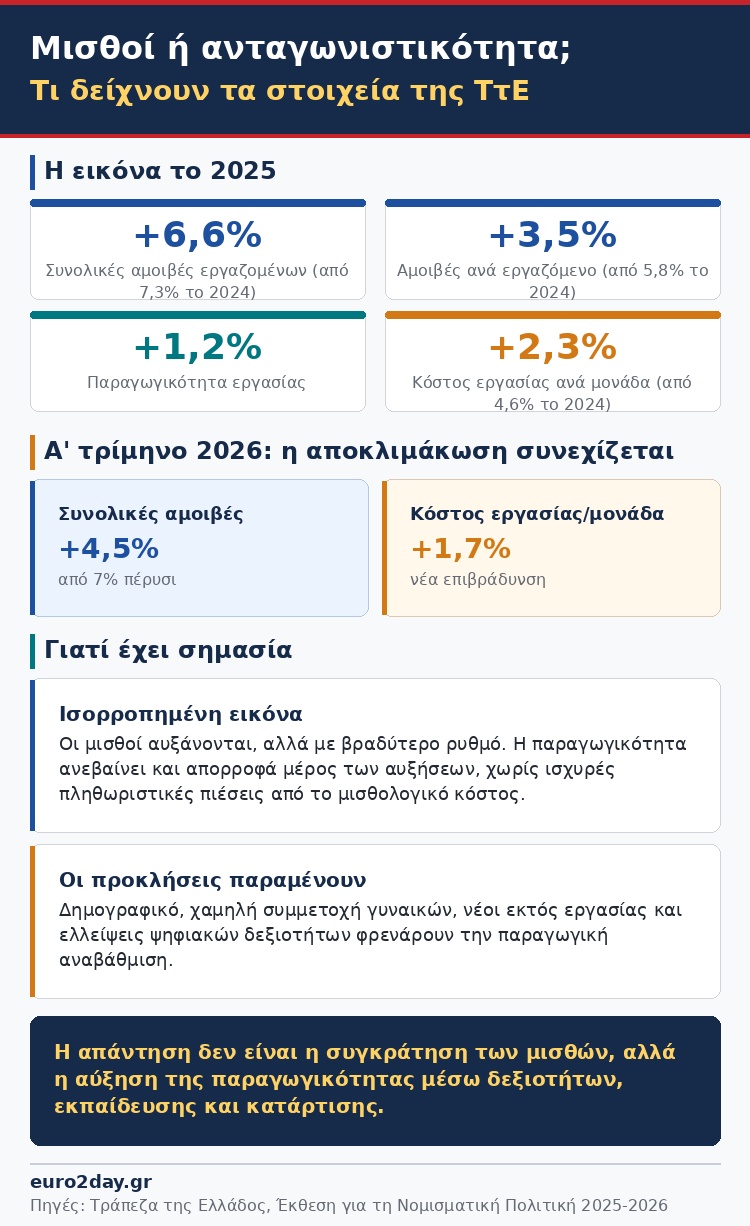
In 2025, total employee compensation rose by 6.6%, compared with 7.3% in 2024, while compensation per employee increased by 3.5%, down from 5.8% a year earlier.
At the same time, labor productivity rose by 1.2%, a development that contributed to a significant slowdown in unit labor costs. This indicator, a key measure of competitiveness, rose by 2.3%, compared to a 4.6% increase in 2024.
The same trend continued into early 2026. In the first quarter of the year, total compensation rose by 4.5%, compared with 7% in the same period of the previous year, while compensation per employee increased by 3.3%. Unit labor costs fell further to 1.7%, confirming that wage pressures are easing.
This development is of particular importance for both businesses and economic policymakers. Wage growth is a necessary prerequisite for improving living standards and boosting consumption, particularly at a time when households continue to face high costs for housing, energy, and basic goods. On the other hand, maintaining competitiveness requires that wage increases keep pace with productivity growth.
The Bank of Greece assesses that, at present, wage costs are not generating strong inflationary pressures. The fact that productivity is rising, albeit at a moderate pace, allows the economy to absorb part of the wage increases without significantly increasing production costs.
Despite these positive developments, significant challenges remain. The country continues to face demographic pressures, low labor force participation among women compared to the European average, high rates of young people neither in employment nor in training, and shortages of skilled workers in critical sectors.
At the same time, low participation in lifelong learning and a lack of digital skills limit the potential for faster productivity growth. For this reason, the report emphasizes that the real answer to the “wages versus competitiveness” dilemma does not lie in wage restraint, but in increasing productivity through better skills, education, training, and more effective utilization of human capital.
In a period of heightened international uncertainty, the long-term competitiveness of the Greek economy will depend less on low labor costs and more on its ability to generate greater value through more productive labor.