49.3% of the government’s platform has been implemented to at least some extent; another 42.3% is currently in progress; and 8.3% has either not been implemented or is not showing any progress at this time, according to an analysis by the Center for Liberal Studies (KEFIM).
The Index’s current results at a glance:
Based on the most recent available data (June 2026), of the 156 verifiable pre-election commitments made by the government:
- 20.5% have been fully implemented
- 28.8% have been partially implemented
- 42.3% are in progress
- 3.85% have not been implemented at all or have been abandoned
- 4.49% cannot be assessed due to a lack of publicly available data
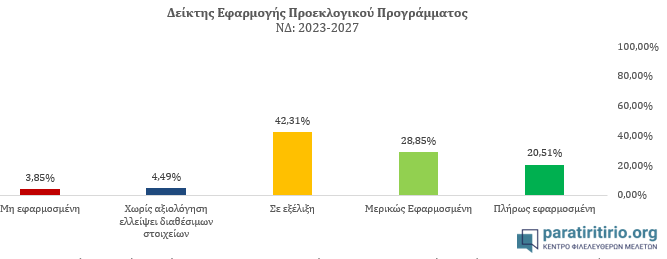
More specifically, of the total 156 commitments, 77 have been fully or partially implemented, 66 are in progress with actions already underway, while 6 have not been implemented, and for 7 there is insufficient data for assessment.
The sectors with the highest implementation rates are Defense & Foreign Policy (67%), Education (62.5%), and the Economy (59%), while the lowest implementation rates are found in Health (30%), Sustainability (33%), and Infrastructure (39%). However, in all these sectors, 45% to 60% of the commitments are currently in progress.
Compared to KEFIM’s previous assessment in September 2025, commitments in partial or full implementation have increased by 11 percentage points, while commitments with no implementation or progress have decreased by 9 percentage points.
The Index in simple terms:
The Election Platform Implementation Index is an easy-to-understand tool that tracks the degree of implementation of the government’s election platform, seeking to measure the extent to which the government is implementing the policies for which it received a democratic mandate during the election process.
The purpose of the Index is to provide reliable and transparent information to citizens and journalists, as well as data for scientific research. To achieve this, it extracts pre-election commitments from the ruling party’s platform in order to monitor their implementation during the respective term of office in a scientific, systematic, and impartial manner.
The Index follows the successful model of Polimeter, the corresponding observatory for the implementation of government pledges in Canada, and the Comparative Party Pledges Project (CPPP), an international research network that conducts comparative studies on the implementation of pre-election pledges, with the aim of assessing the degree to which they have been fulfilled by the end of the government’s term. The Index’s methodology is based on relevant publications in leading international academic journals such as the American Journal of Political Science (AJPS), the British Journal of Political Science (BJPolS), Political Studies, West European Politics (WEP), and Government and Opposition.
KEFIM President Nikos Rompapas stated:
“Three years after the June 2023 elections, the government has fully or partially implemented nearly half of the commitments it made to citizens during the campaign, while another 42.3% of these commitments are currently in progress.
With the Pre-Election Program Implementation Index published by KEFIM, citizens can more easily assess the government’s consistency not only quantitatively but also analytically with regard to specific policy commitments. In this way, we are creating a useful and easy-to-understand tool for the comparative assessment of Greek governments, in the hope that we are helping to increase public pressure on the government of the day to make measurable and assessable commitments that are not forgotten the day after the elections.”