Faster permitting for cross-border interconnection projects, such as those needed in Southeast Europe, centralized planning that takes into account the needs of the bloc as a whole rather than those of individual countries, and securing additional funding to cover part of the enormous investment needs in the coming years.
This is the essence of the compromise agreement surrounding the much-discussed “European Grids Package” (European Grids Package), which the ministers of the “27” finalized on Friday in Luxembourg after three years of disagreements and intense debates, with the final text being of particular interest to Greece.
This is because the text, which revises the Regulation on Trans-European Networks (TEN-E) as well as the new Directive on Authorization, adopts proposals that Greece has been advocating since 2023—most notably the need for new investments in aging networks—which the bloc so desperately needs for its energy security—be centrally coordinated by the EU rather than determined, as is currently the case, by each country’s priorities, as well as because it emphasizes facilitating projects that connect the “peripheral edges” of the European bloc, such as Southeast Europe.
In practice, the package creates a more favorable environment for projects of interest to Greece—whether they pass through Greece as interconnections with the Eastern Mediterranean and the Western Balkans, or strengthen its position as an energy hub—allowing them to be approved more quickly (currently 5–10 years), so that they can be planned centrally and gain easier access to EU funding instruments.
* In the case, for example, of the “Green Aegean” electricity interconnection project—which ADMIE has been promoting for years to facilitate electricity exports from Greece to Germany—the discussion surrounding the project is now taking place on a European level under the new framework. This is a direction that the Greek side also appears set to capitalize on, according to a source familiar with the proceedings, rather than having the Greek operator attempt to convince its Austrian and German counterparts of the project’s viability.
* The same reasoning applies to the Greece–Egypt cable (GREGY), which, under the new framework, also moves beyond the narrow bilateral level of Athens–Cairo and takes on a more European character.
* Had it not been agreed to triple the transmission capacity between Greece - Italy from 500 MW to 1,500 MW had not been agreed upon, and the discussion had taken place at the European level rather than between the two countries, it might have been possible to further increase capacity. This is something that may be addressed at a later stage.
By amending several provisions of the initial December 2025 package—in which the Commission estimated the required investments in electricity grids through 2040 at 1.2 trillion euros— it nevertheless left the financing up to further action by member states and the private sector; Friday’s text includes two substantial changes.
Both are the result of bold compromises and follow months of intense disputes and behind-the-scenes maneuvering with powerful countries such as Sweden, Finland, France, and Germany—which was the very reason the “Network Package” had been up in the air for so long.
Revenue from network congestion
On the major issue of financing, the Commission’s initial proposal called for utilizing a portion of the revenue generated by congestion on interconnections—that is, when the cables are “full”— (currently, these funds are held by the Transmission System Operators) to cover part of the investments in new networks.
The Commission’s initial proposal—that 25% be earmarked directly at the central level to finance interconnections of European interest—triggered a barrage of reactions from Sweden. Due to the structure of its market, the country accounts for more than 50% of total revenue from network congestion charges across the entire EU.
In fact, at the Energy Ministers’ Council last March, Swedish Energy Minister Emba Bush had warned that if the EU proposal were to pass, not only would the country limit electricity exports to its neighbors, but it would also “freeze” —as it did—new interconnections to Denmark and Finland.
“With all due respect to my esteemed colleague from Sweden, ultimatums are not the way we should be operating at this moment,” Greek Minister St. Papastavrou had replied to his counterpart at the time, illustrating the distance that still existed before an agreement was reached.
The gap was bridged to the extent possible, as Friday’s text shows. Instead of 25%, the agreement stipulates that the Commission will earmark 10% of congestion revenues for new European network projects starting in 2028, with the percentage gradually increasing to 25% by 2031. As for the earmarking of revenues, it will be done on an accounting basis, while “old” revenues collected before the Regulation entered into force, as well as congestion revenues arising from internal bidding zones, are excluded.
Although the provision appears to address Sweden’s main objections, as Ms. Busch stated, she clarified that the country will not proceed with work on the new interconnections with Denmark and Finland until the Networks Package enters into force.
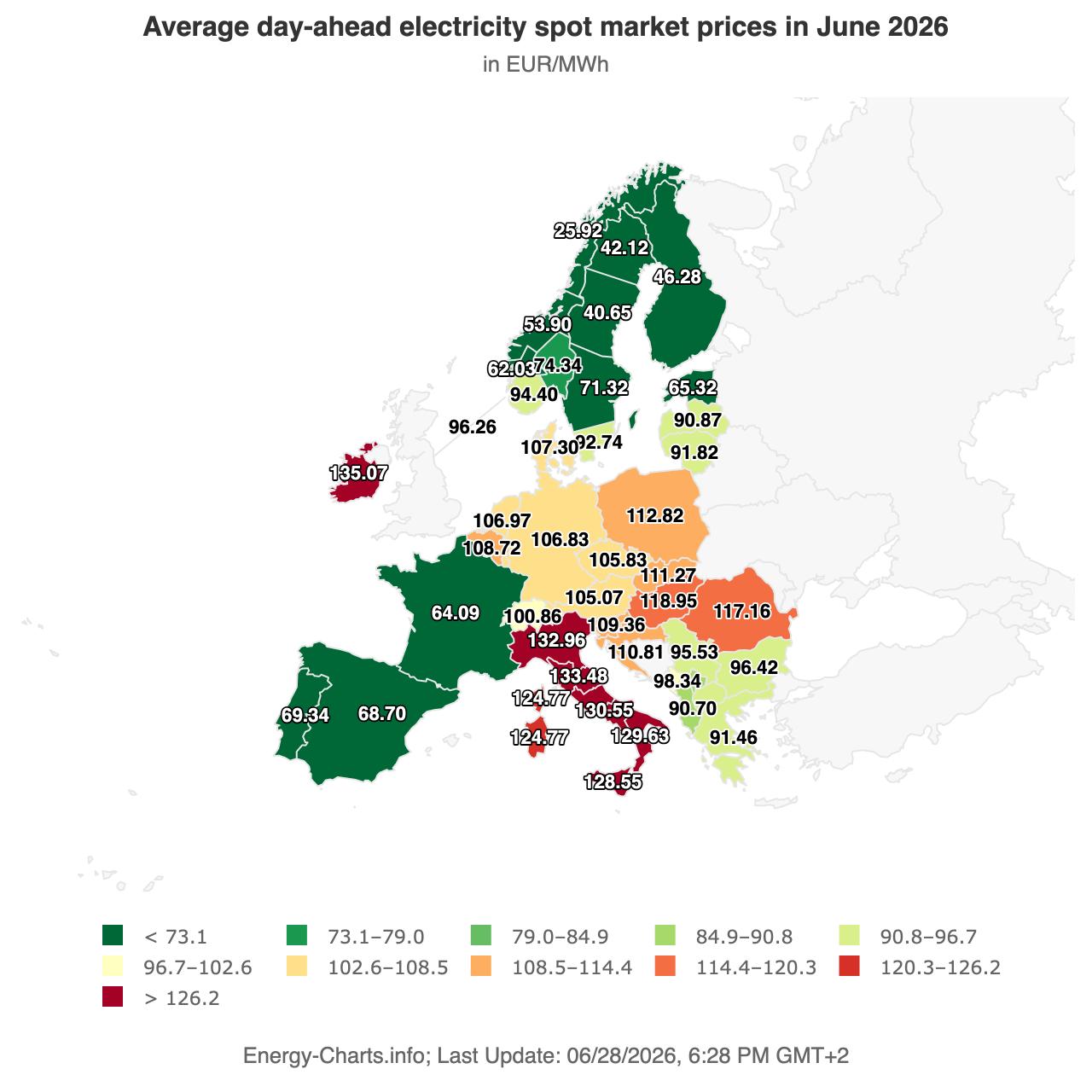
The significance of this regulation and how it affects us as a country is evident, for example, from the bottleneck currently occurring between Bulgaria and Romania—hence the high wholesale prices in both countries, which also affect Hungary, as shown by the relevant map of average prices for June.
If the new framework were already in place, Hungary, according to those in the know, could propose its financial contribution to upgrading the interconnections with Romania, in order to alleviate the congestion with Bulgaria—with all that this would mean for the Southeast European region.
Centralized Planning
The new trans-European networks will be planned centrally rather than under the “supervision” and according to the priorities of each capital city individually—something the Greek government has been seeking since 2023—though this does not mean that member states will lose control entirely. The details of each new plan will be “reviewed” by the participating states, and the so-called “central scenario” for network planning will be adopted via an executive act, following a relevant vote. At the same time, national and regional specificities will be taken into account. In short, the final decision will not be left solely to the Commission. The compromise is obvious.
This followed strong reactions in May from five countries—Bulgaria, Sweden, Finland, France, and Poland—which, in a joint letter, argued that the Commission was “encroaching” on national competences and misinterpreting how energy systems operate. The five countries insisted that the EU must take into account the coordination of regional systems rather than concentrating all current individual responsibilities in a single central body.
Tacit consent (but optional)
There was also significant opposition to the Commission’s proposal that, when a country’s national authority delays responding to a new interconnection request, the authorization process would proceed under so-called “tacit consent.”
Although an attempt was made to make this mandatory, opposition from countries that have not incorporated this principle into their national law—such as France, Germany, Austria, and the Netherlands—led to the measure being adopted on an optional basis.
In short, countries may apply tacit approval to environmental and final decisions, but they are not required to do so—only if they choose to.
Government Satisfaction
"The big picture is that this is a positive step toward better coordination of the European internal energy market. I believe a good balance has been struck between cooperation and the autonomy of member states,” said Stavros Papastavrou, Minister of Environment and Energy.
“In recent years, we have seen the European electricity market become more fragmented, with prices fluctuating unevenly among EU member states. The Grids Package is an important step toward addressing this problem and lays the groundwork for a more efficient system, with lower prices in the future,” said Nikos Tsafos, Deputy Minister of Environment and Energy, in a related post.
Tsafos, who, starting in 2023, served as an advisor to the Prime Minister at the time, spearheaded a series of initiatives to address distortions in the operation of European grids, to increase interconnectivity along the North-South axis, further integration of the Western Balkans and faster network licensing, as well as to secure additional resources for infrastructure, such as through the proposal for revenue from network congestion charges.