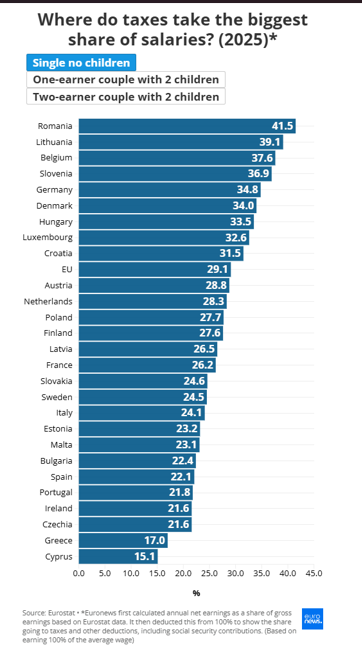
Workers in Greece, along with those in Cyprus, have the lowest tax and social security burden on wages in the European Union, according to data recorded by Eurostat and presented by Euronews Business for 2025. The percentage of gross earnings lost to taxes and social security contributions stands at 17% in Greece for a single person without children, compared to an EU average of 29.1%.
The picture becomes even clearer when compared to the countries with the highest tax and social security burdens: in Romania, the corresponding percentage reaches 41.5%, in Lithuania 39.1%, and in Belgium 37.6%—all well above Greek levels.
In other words, when the comparison is based on take-home pay rather than gross pay, the average worker in Greece retains a much larger portion of their gross pay compared to most European countries.
According to the Athens-Macedonian News Agency (ANA-MPA), the comparison is significant for yet another reason: it debunks the oversimplified notion that Greece ranks second, after Bulgaria, among countries with the lowest wages. When we examine what ultimately ends up “in the worker’s pocket” after deductions for taxes and social security contributions, the picture in our country is different and clearly more favorable.
What the data show
In the tables published by Euronews, based on Eurostat data, Greece ranks second after Cyprus in terms of the lowest tax and social security burdens and well below the European Union average, both for workers without children and for families with children.
Specifically for single-parent families with two children in Greece, the financial burden is even lower, placing this category among the most favorably treated in Europe.
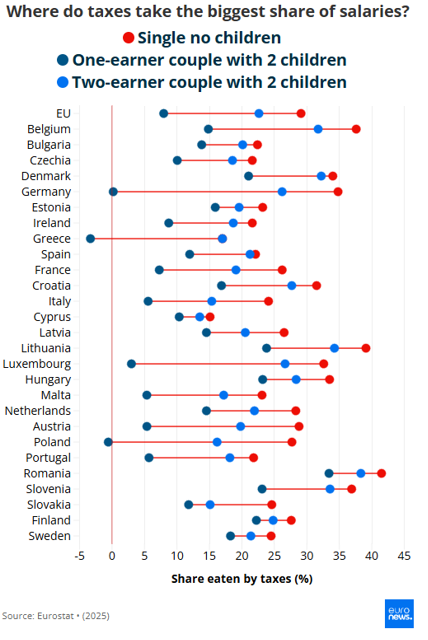
The picture is similar for couples with two children. Greece remains near the bottom of the rankings, with the burden rate again hovering at 17%, while in many other countries the corresponding rates are significantly higher.
The data refer to the year 2025. However, starting January 1, 2026, a new tax bracket will take effect in Greece, offering even greater tax cuts for everyone—and especially for families with children—a development that may alter the picture in future comparisons once tax returns for this year’s income are filed, incorporating the new wage increases that have already been implemented since April.
What ends up “in the pocket”
This difference is reflected not only in the tax rates but also in absolute amounts: the average worker in Greece has much less deducted from their pay than in countries where withholdings account for up to 40% or more of earnings.
How does this “translate” for workers?
As shown in the following table of average annual wages before and after tax and social security deductions applied in each country:
- Based on nominal wages, Greece ranks as the second country (after Bulgaria) with the lowest wages in the EU overall for 2025. With an average annual gross income of 18,124 euros, the average worker in Greece appears to earn less than half each year compared to the annual earnings of an average European worker, who earns 37,958 euros per year. In other words, they earn 19,834 euros less than the average nominal wage of workers in the EU.
- Based on net wages, Greece automatically moves up two spots in the ranking, while the gap compared to all other countries narrows significantly: the average deductions for Greek workers amount to 3,074 euros, and net earnings to 15,050 euros. This places Greece 4th in the EU.
In contrast, other countries—even those starting from higher nominal wages—“fall” below the “net” wage of the average worker in Greece.
Specifically, based on a comparison of take-home pay:
- The average European worker has 11,029 euros deducted annually (more than three times the amount lost by a Greek worker, who loses 3,074 euros per year).
- In Romania, where the average gross annual income was 22,620 euros, deductions amount to 9,387 euros per year. Consequently, net income “drops” to 13,233 euros per year, which is the third-lowest salary in the EU.
- Similarly, in Hungary, out of a gross income of 19,500 euros, taxes and social security contributions amount to 6,033 euros, and annual take-home pay is “reduced” to 12,967 euros “net,” below Bulgaria (16,774 euros gross with 13,017 euros net annually).
- In other countries, where starting salaries are much higher, deductions are also several times higher than in Greece.
For example, in Germany, the annual salary “drops” from 47,514 euros to 31,000 (-16,514 euros); in France, it it “drops” to 30,832 euros (-10,932 euros); in Spain, it falls from 32,446 to 25,263 euros (-7,210 euros); in Portugal, the average worker is left with 19,709 euros (-5,478 euros); in Croatia, from 25,199 euros, the average worker is left with 17,256 euros (-7,943 euros); while in Slovakia, from a nominal salary of 20,803 euros, the “take-home pay” for the worker does not exceed 15,686 euros (-5,117 euros), and the final difference in “take-home pay” is reduced to 636 euros per year.
Taxes and contributions by household type
Based on these figures:
- For unmarried individuals without children:
- Payroll deductions in Greece do not exceed 17%, and in Cyprus, 15.1%; in other words, Greece has the second-lowest burden in Europe. The EU average is 29.1%, so Greece is well below the European average.
- In the countries with the highest tax rates, the percentage reaches 41.5% in Romania, 39.1% in Lithuania, and 37.6% in Belgium.
- Compared to the countries with the highest tax burdens, Greece lags behind by approximately 20 to 24 percentage points—that is, nearly one-quarter of the difference in nominal earnings.
- For workers with children:
- A single-parent family with two children in Greece earns about 3.3 percentage points more than unmarried people without children.
- For a couple with two children, the burden in Greece remains at 17%.
Given this picture, Greece remains at the bottom of the list in terms of tax burdens for family categories, while in most other countries the tax burdens are significantly higher.
SOURCE: APE-MPE