Starting tomorrow, July 1, a new import duty of 3 euros will be imposed on online purchases of up to 150 euros from countries outside the European Union, making “packages” from China, the United States, the United Kingdom, and other non-EU countries.
In fact, this essentially amounts to multiple charges of 3 euros, since the fee will not be calculated based on the total weight of the package regardless of its contents, but rather on each different product category included in it. In other words, even a single order can be “split” for customs purposes into multiple items, causing costs to skyrocket.
For example, if a package contains two products from different categories, such as a T-shirt and a pair of shoes, the total duty comes to 6 euros. Similarly, as the number of different items in the same shipment increases, so does the final customs duty amount, rising to 9 or 12 euros, and so on.
The Impact
The regulation is expected to significantly impact costs, particularly for low-value online purchases from primarily Asian platforms, which have seen high demand in recent years due to their exceptionally low prices and the wide variety of products they offer.
The additional cost per product is expected to prompt some consumers to rethink their shopping habits, as even small orders will incur a significant surcharge.
Market analysts note that with the implementation of the new measure, it is possible that the trend toward shopping within the European Union—where no corresponding “cap,” resulting in European online stores gaining a competitive advantage in terms of the total final price.
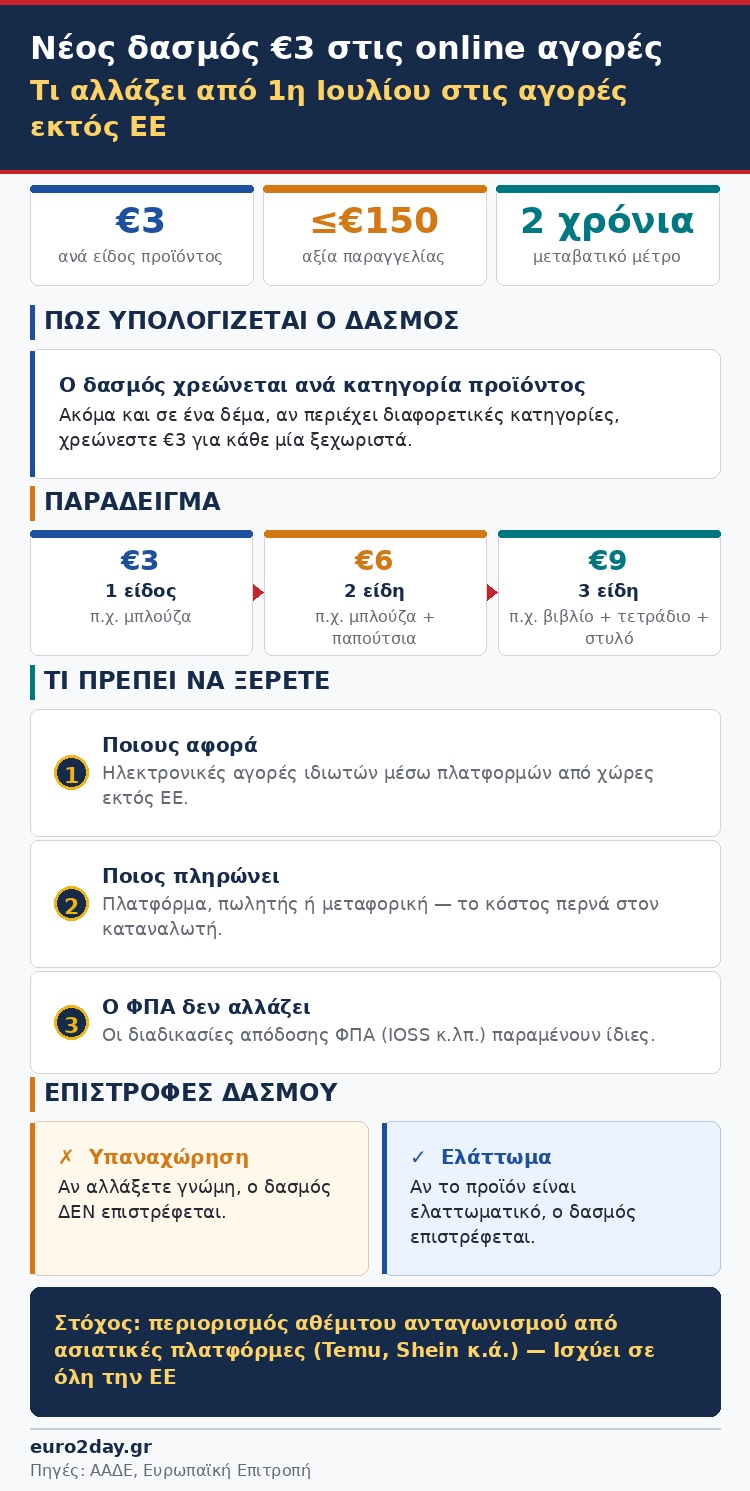
The guidelines
According to the AADE circular providing guidelines for the implementation of the new measure:
1. As of July 1, 2026, new customs rules for online purchases of goods valued at up to 150 euros from non-EU countries, which apply exclusively to online purchases by private consumers through e-commerce platforms.
2. A new special import duty of 3 euros is imposed on each distinct item of goods imported from third countries via e-commerce.
3. The new duty is a transitional measure and will remain in effect until June 30, 2028. Starting July 1, 2028, the standard tariff regime will apply, with the import duty calculated based on each product’s tariff category, regardless of its value or the method of purchase and shipment.
4. Calculation. The 3-euro charge is calculated per distinct product type, not per package.Example: If a package contains a book, a notebook, and a pen, these are three different items. In this case, a total duty of 9 euros is imposed (3 euros per item), plus the applicable VAT and any other charges. If a package contains two identical notebooks with the same characteristics, they are considered a single item, and a total duty of 3 euros is imposed.
5. Payment. The special import duty is paid to the customs authorities by the importer of record—that is, by the e-commerce platform, the seller, the shipping company, or their authorized representatives, depending on the shipment management model.
6. Returns. In the case of a simple product return due to the consumer’s withdrawal or change of mind, the duty paid upon importation is not refunded. However, in cases provided for by customs legislation—such as when products are found to be defective or do not meet the terms of the contract—the customs duty paid may be refunded in accordance with the applicable customs procedures.
7. The application of the new duty does not affect the existing procedures for VAT collection on distance sales of imported goods. VAT continues to be paid:
- At the time of purchase through the online platform, when the Import One Stop Shop (IOSS) system is used.
- Upon customs clearance of the product by the consumer, when the Special Arrangements or the standard VAT regime apply.
It should be noted that the new regulations do not affect the procedures for purchasing and shipping goods within Greece or between European Union member states.
It is recalled that the EU decision regarding the 3-euro import duty on goods from non-EU countries applies to all member states, with the aim of limiting unfair competition, primarily from major Asian platforms (e.g., Temu, Shein, etc.).