According to market analysts, the upcoming adoption in July of the new Spatial Plan for Renewable Energy Sources threatens to bring an increase in the number of wind turbines instead of a decrease, greater visual impact instead of less, and higher electricity costs.
This is the key message regarding the new roadmap for renewables, which introduces such generalized and sweeping restrictions that, according to a study by the Hellenic Scientific Association for Wind Energy (ELETAEN), whose members include both small and large players, excludes 61% of the country’s territory from new investments in wind turbines, as shown on the map.
The market is signaling that such an extensive exclusion not only fails to serve the goal of rational siting of renewable energy sources but also leads to results that are exactly the opposite of those intended, undermining the very philosophy of the new Spatial Plan, for which the public consultation concluded last week and is now on its way to final approval by the Ministry of Environment and Energy.
* By banning wind energy investments in two-thirds of the country’s territory, the average productivity of new wind farms on the mainland is reduced by 29%, according to a study by ELETAEN presented yesterday at a meeting with journalists.
* Since these new wind farms will have reduced productivity, the study shows that they will generate less energy at a 27% higher cost (Levelized Cost of Energy, LCOE), with all that this implies for the country’s overall energy costs.
* If, on the other hand, the average wind turbine produces 29% less energy, 29% more wind turbines will need to be installed in Greece for the country to meet its renewable energy targets. This will also require more land use interventions for the facilities and infrastructure.
“All of this carries the risk that, rather than easing local opposition, the opposite will likely occur, thereby undermining the main argument for the new restrictions in the Spatial Planning Law. At the same time, when production decreases, it is simply a matter of mathematics that costs will rise,” said ELETAEN President Panagiotis Ladakakos, speaking about the contradictions in the new framework.
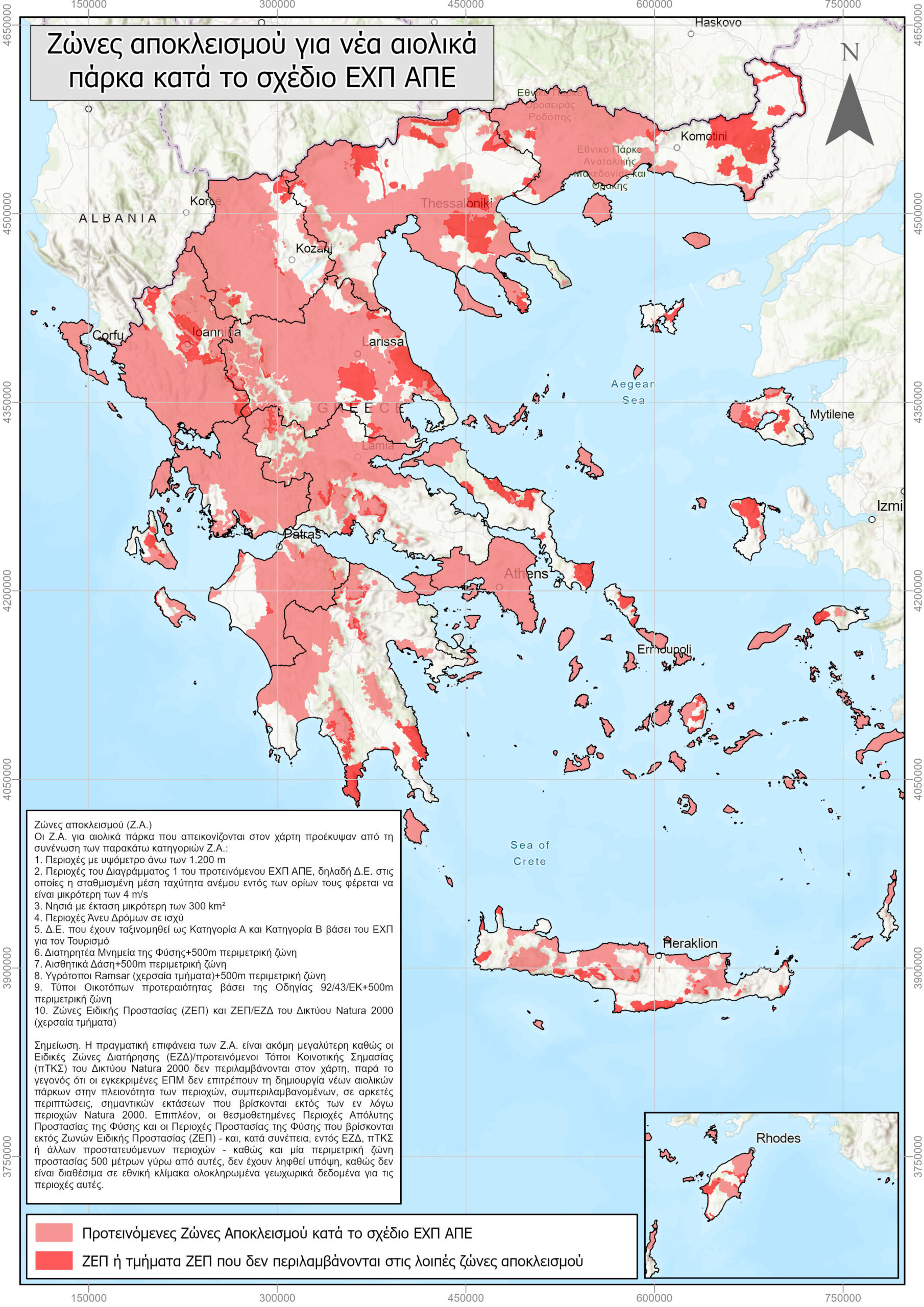
In reality, the criticism leveled at the government is that, in the midst of an election year and facing a widespread wave of opposition to wind power, it chose to introduce the new Spatial Planning Law now —the decision to replace the existing one, which dates back to 2008, had been postponed for years—introducing extremely strict restrictions that are virtually unheard of anywhere else in Europe, as acknowledged by energy market executives, not just those in the wind power sector.
“In essence, this legitimizes the bad-faith opposition to wind power, especially at a time when fake news about renewable energy sources is on the rise again,” as Mr. Ladakakos noted.
At this juncture, while the Ministry of Environment and Energy is still reviewing the comments from the public consultation and considering possible changes —the nature of which remains unknown—the wind energy market is calling on the ministry, before any decision is made that will set the rules of the game for the next 15–20 years, to conduct a detailed, accurate, and independent assessment of the quantitative impacts that the new restrictions will have. These impacts include electricity bills, energy security, the environment, and other critical factors.
The 3 Horizontal Exclusion Zones
In summary, the exclusion zones in the new Spatial Plan, which is pending approval, concern:
- Areas with an elevation above 1,200 meters, even though wind energy potential in mainland Greece is primarily found in mountainous regions. “However, there is no other major European renewable energy market where a horizontal altitude cap is in effect,” according to the agency’s General Director, Panagiotis Papastamatiou. The industry is calling for areas with the best wind potential to be exempted.
- This would include islands with an area of less than 300 square kilometers, excluding all islets and exempting only 13 islands. If the restrictions imposed by the Spatial Planning Act for Tourism are also taken into account, only 11 islands remain where wind farms can be installed. It is considered certain that all 11 of these islands will request the same treatment as the rest. The industry is calling for the limit to be lowered to 100 square kilometers.
- These are Special Protection Areas (SPAs), which are protected areas for birdlife. In practice, these are the areas with the strongest wind potential in Greece, which is why they serve as stopover sites for migratory birds that use the strong updrafts to cover long distances. The new Spatial Plan stipulates that wind turbines are permitted in these areas only if two conditions are cumulatively met. They must be approved by the relevant Special Environmental Study (which almost never happens), and the wind speed must exceed 7.5 meters per second.
They are not only sold but also purchased
However, in response to the question of whether all of the above will undermine the competitiveness of the wind energy sector in Greece—especially given that foreign players have withdrawn from the domestic market in recent years— the General Director of ELETAEN commented that, in addition to sales, we are also seeing a steady stream of purchases.
“Even when a foreign group decides to withdraw from the Greek market or reduce its exposure to it, there is always someone else—Greek or foreign—to buy its portfolio. This means that the international market values wind energy and renewable energy sources in general in Greece, something the government must take seriously into account when drafting the Spatial Plan,” said Mr. Papastamatiou.
In response to the above, the Ministry of Environment and Energy argues that the country has licensed far more wind farms than it needs, including a large number of 15 GW projects that have already received environmental permits and are not affected by the new framework, meaning they can proceed as normal.
For its part, the market argues that such figures are misleading. According to ELETAEN, of the 15 GW of wind power mentioned by the Ministry of Environment and Energy, 5.5 GW is already installed, leaving approximately 9 GW; of this amount, only 3 GW has received grid connection offers, meaning it is ready for implementation.
At the same time, it points out the sluggish licensing procedures for wind projects, where the average success rate does not exceed 3.5% (according to earlier estimates), while adding that the narrative of Greece as a clean energy exporter—which the government touts at every opportunity—makes sense at night. That is, when wind farms are generating power and a country has cheap energy stored in batteries—not at midday, when everyone in the region, from North Macedonia to Bulgaria and Romania, is producing green megawatt-hours.