It may have sparked a storm of controversy over the significant increases in premiums for lifetime health insurance plans it recently announced, NN Hellas, the leader in total premiums, has turned into a… profit-generating machine, and within three fiscal years (2024–2026), it will have paid its Dutch parent company nearly 200 million euros in dividends and capital returns.
NN Hellas has recently been at the center of a heated controversy. The increases in premiums for lifetime health insurance plans were considered extreme and unjustified: the company itself cites an average increase of 7.6%, while EKPOIZO reports increases of 9%–12%, and older policyholders reported increases in the range of 30%.
In any case, the increases were much higher than those that would be justified by the Annual Adjustment Index for Long-Term Health Insurance (EDA), which ELSTAT announced in June, after the increases had already been imposed by the companies. Specifically, for 2024, the ARI, taking age into account, showed an increase of 6.24%, while excluding the effect of age, the increase was 1.25%.
“Margin over volume” strategy
Behind the public pressure NN faced over the large increases lie the figures from the company’s official financial reports, which “illustrate” a strategy that has transformed the Greek subsidiary into a highly efficient profit-generating machine for the Dutch parent group.
NN Hellas, which remains the largest insurance company in Greece based on total written premiums, has adopted a strategy that gives absolute priority to profit margin over production volume (“margin over volume”).
In 2024, this strategy became evident in the health insurance sector: the company chose not to pursue an aggressive pricing policy to maintain its market share in the sector, a decision that led to a modest increase in premium revenue (5.6%) and a decline in its market share range to 15–25% from the previous 25–35%—according to data published by the Competition Commission. As a result, it allowed Ethniki Insurance to regain its top market position.
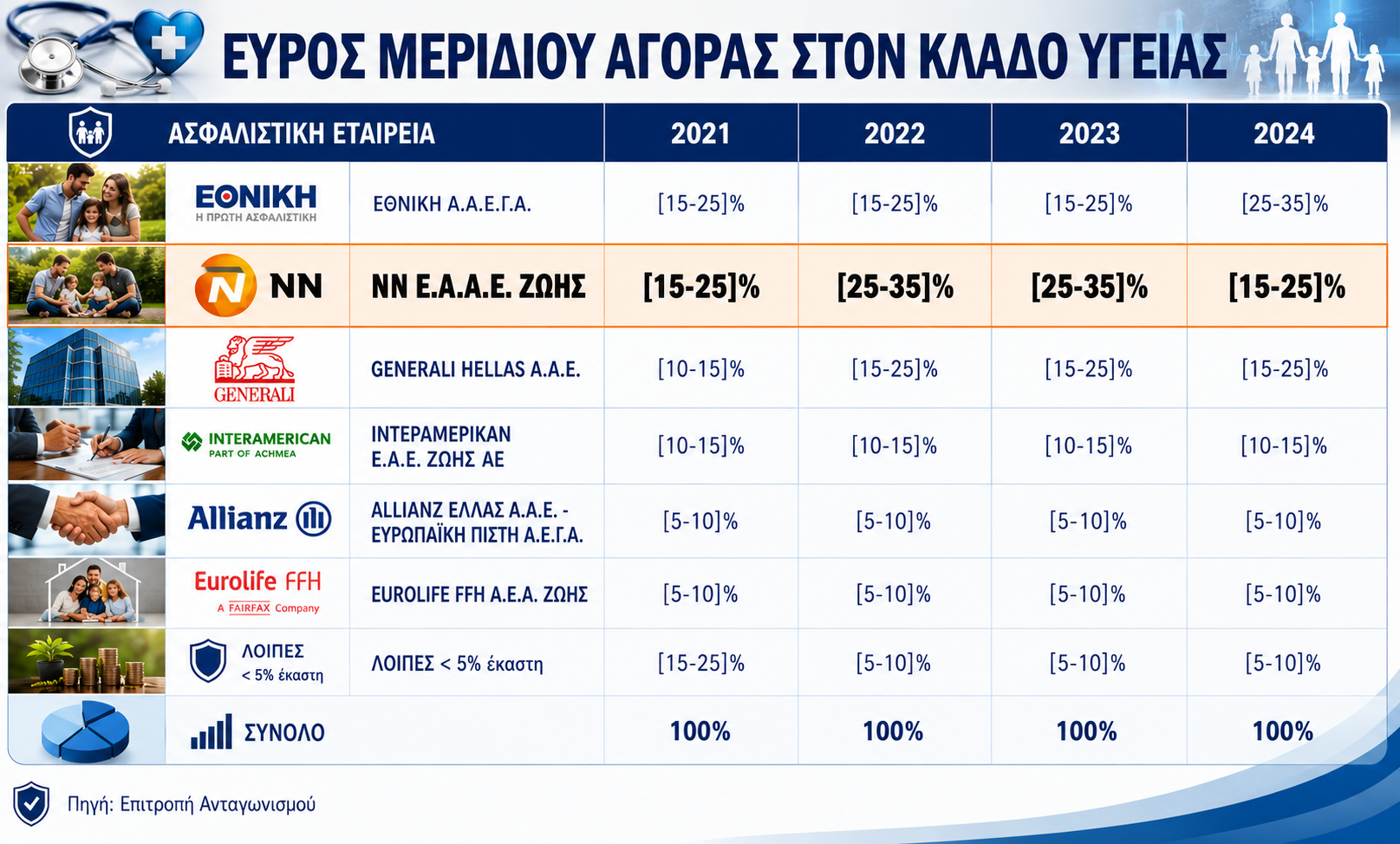
Instead of fighting for market share, NN Hellas has focused on the profitability of its portfolio. In this context, the adjustment of premiums for whole life policies in recent years is not merely a response to medical inflation, but a tool for improving profitability and managing morbidity risk, as the company seeks first and foremost to increase the efficiency of its portfolio rather than its size.
The financial boom of 2024
The financial results confirm that this strategy is extremely profitable:
- In 2024, NN Hellas’s pre-tax profits reached 87.4 million euros, a 260% jump from the 24.3 million euros recorded in 2023. When compared to the performance of previous fiscal years, it becomes clear that the company is “changing course” in terms of profitability. Its operating profit stood at 90.2 million euros, nearly double the 47.9 million euros recorded in 2023. All of this was achieved with a modest increase in total premium income (7.7%), which rose to 950 million euros, compared to 882 million in 2023.
- The trend continued in 2025, with operating profit strengthening further to 97.2 million euros, confirming that the significant increase in the previous fiscal year was not a one-off. It should be noted that these figures are taken from the 2025 solvency report, as the company’s financial statements—which would also show the trend in pre-tax profitability—have not yet been published.
- The Contractual Profit Margin (CSM), a critical indicator of portfolio efficiency that also foreshadows future profitability, rose from 355.9 million euros in 2023 to 464.7 million euros in 2024.
- Despite medical inflation, the company managed in 2024 to keep gross insurance claims in the health and accident segment at €175 million (down from €176.9 million in 2023), reflecting the “improved morbidity profile of insurance policies.”
A windfall for the parent company
NN Hellas has now begun to return large sums each year to its parent group, NN:
- In 2024, the Greek subsidiary made a capital repayment to the parent company in the amount of 60 million euros.
- In 2025, it distributed a dividend of 64 million euros. Thus, over a two-year period, it returned a total of 124 million euros to the parent company.
- These distributions will continue in 2026, with an additional dividend distribution of 70 million euros, bringing the “Greek” return for the NN Group to 194 million euros over a three-year period.
The “key” to the increases
Increases in health insurance premiums—for both annual and whole-life plans—are part of NN’s business strategy, aimed at maximizing profitability. Lifetime plans, in particular, are a “burden” for companies that continue to manage a large volume of such policies.
As confirmed by data recently published by ELSTAT, the costs of whole-life policies are exorbitantly higher than those of annual policies, where coverage has been “scaled back.” It is telling that, on average, for each insured person, companies pay 950 euros per year for whole-life policies—an amount 2.6 times greater than the corresponding cost for annual policies.
The sharp increases in premiums—not only this year but also in previous years—lead down two paths: either the risk will be priced more accurately, or the policyholder will… relieve the company of their presence by canceling the policy due to high costs.
In the case of NN, the recorded increase in the Contractual Profit Margin and the decrease in health claims confirm that the goal of a more… profitable portfolio is being achieved, even if this may mean that policyholder dissatisfaction is “flaring up.”