Full steam ahead: The Independent Authority for Public Revenue (IAPR) to implement the Digital Customer Registry in new professional sectors, following the findings revealed by the Authority’s audits in the automotive sector, where the measure has been in effect since last July.
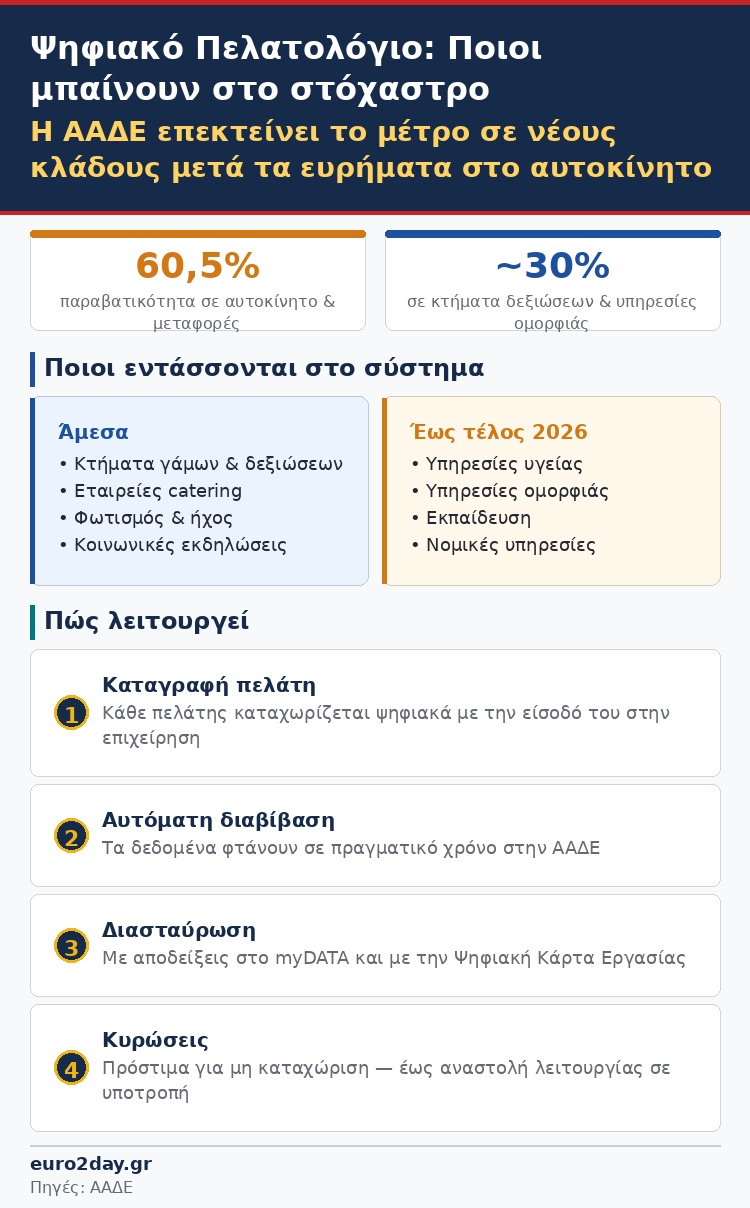
Wedding and reception venues, lighting and sound companies, catering firms, and, more generally, businesses operating in the social events sector will be next in line, while the gradual integration of all other professionals providing services in the fields of health, beauty, education, and legal services into the new system is being considered by the end of 2026.
The selection of these specific sectors is not random, as they are areas in which a large portion of transactions continues to be conducted in cash, a fact that makes it difficult to monitor and record them.
It is worth noting that the average tax non-compliance rate in the automotive and transportation sectors stands at 60.5%, according to the most recent official data from targeted audits conducted by the Independent Authority for Public Revenue (AADE).
In the sectors of event venues (weddings, baptisms, parties) and beauty services (hair salons, beauty salons), the rate of non-compliance hovers around 30%.
The main violations concern:
- Failure to submit issued tax documents to the myDATA system.
- Failure to issue receipts for retail sales or services rendered.
- Discrepancies between digitally recorded incoming customers/vehicles and the final receipts issued.
A Powerful Tool
With the implementation of the Digital Customer Registry, the Independent Authority for Public Revenue (AADE) gains a powerful tool to combat tax evasion and strengthen tax compliance.
Through the electronic recording of customers visiting specific businesses, the tax administration is able to monitor in real time the activity of business sectors of high audit interest.
The data entered into the Digital Customer Registry is automatically transmitted to the Independent Authority for Public Revenue (AADE) and used to cross-check against receipts and invoices issued and transmitted to myDATA. In this way, tax authorities can verify whether a corresponding tax document has been issued for each registered customer.
The system’s goal is to detect tax evasion by directly linking a customer’s presence to the obligation to issue a receipt or invoice.
In the event of an on-site inspection, if a customer is found on the business premises without having been previously registered in the Digital Customer Registry, the business owner faces penalties, and the incident may trigger a further tax audit.
Data Utilization
Beyond the immediate impact of implementing this measure, the Tax Authority utilizes data from the Digital Customer Registry to analyze businesses’ transactional activity. An increased or unusual flow of customers may lead to targeted audits, especially when it is not accompanied by the corresponding submission of tax documents to myDATA.
Cross-checking with the work card
Cross-checking the data from the Digital Customer Registry with that of the Digital Work Card is also of particular importance. For example, if a business shows increased customer traffic but the Digital Work Card data indicates a limited number of employees on shift, a risk indicator may be triggered for an audit of undeclared or underreported work.
Entries in the Digital Customer Registry are treated as the submission of an informational declaration.
Consequently, failure to register a customer or late registration may be considered a failure to file and result in fines, depending on the type of violation and the size of the business. In cases of repeat offenses, the penalties may be even more severe, with the risk of the business’s operations being suspended.
“Big Fish”
The use of data from the Digital Customer Registry by the Independent Authority for Public Revenue (AADE) has played a decisive role in the targeted selection of audit cases for businesses operating in the sectors of vehicle repair and maintenance, vehicle and parts sales, transportation, parking, car washing, painting, and other related activities.
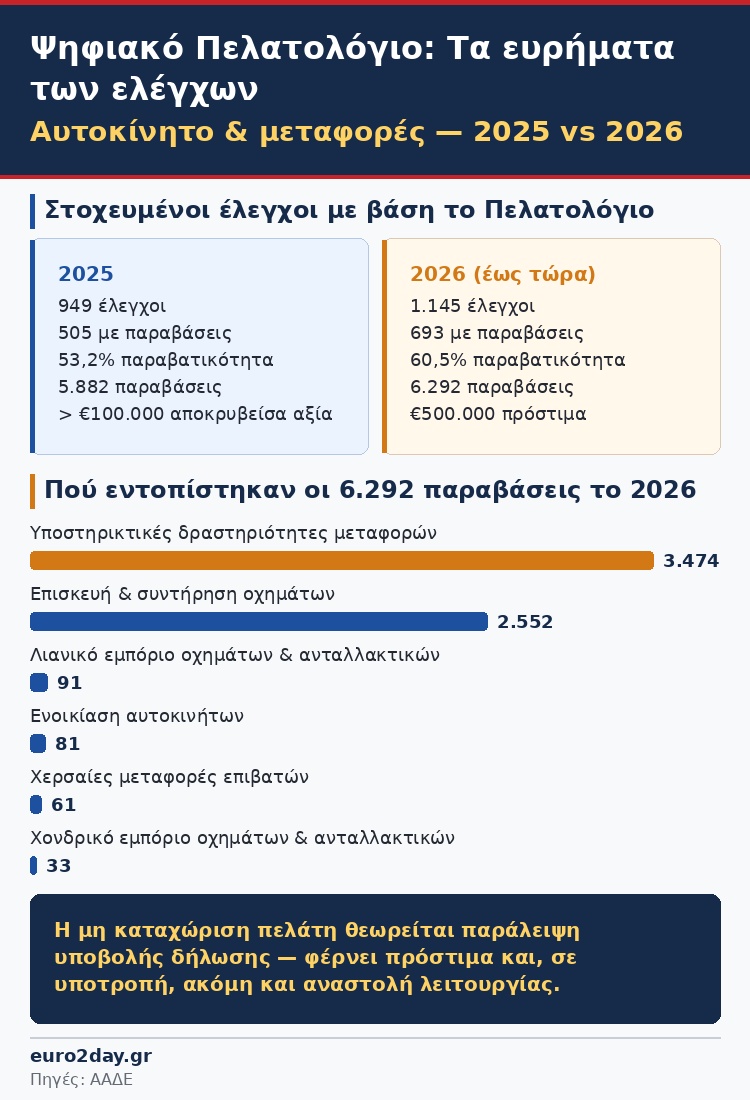
In 2025, 949 targeted inspections were conducted based on data from the Digital Customer Registry.
- Violations were found at 505 businesses, representing a violation rate of 53.2%, with the total number of violations reaching 5,882.
- Specifically, 1,095 violations involving the failure to provide receipts were recorded, 1,026 violations involving the failure to issue or the issuance of inaccurate receipts/invoices, 4 violations involving the failure to present documentation, and 3,753 other violations.
- The total concealed value exceeded 100,000 euros.
- In addition, in sectors related to the automotive and transportation ecosystem, 2 suspensions of operations were recorded at businesses engaged in the wholesale and retail trade and repair of motor vehicles and motorcycles, and 2 suspensions of operations were recorded at land transportation companies.
Inspections are being stepped up
As announced by the Independent Authority for Public Revenue (AADE), the use of data from the Digital Customer Registry continues this year, with even more targeted audit efforts in the automotive and transportation sectors. Specifically, 1,145 audits have already been conducted, of which 693 revealed violations, with an average violation rate of 60.5%.
Specifically, the following were identified:
- 2,552 violations in the motor vehicle and motorcycle repair and maintenance sector
- 3,474 violations in transportation support activities
- 91 violations in the retail trade of motor vehicles and parts
- 33 violations in the wholesale trade of motor vehicles and parts
- 81 violations in car rental and
- 61 violations in land passenger transport.
In total, 6,292 violations were identified in sectors directly related to the automotive and transportation ecosystem, while the fines imposed amounted to 500,000 euros.