On June 11, 2026, the European Central Bank raised its interest rates for the first time since 2023, ending a period of nearly two years of stability at relatively low levels.
The move came in response to an external shock: the war in the Middle East had disrupted oil flows through the Strait of Hormuz, sending energy prices soaring and pushing inflation to its highest level since 2023.
Interestingly, just a few days after the ECB’s decision, the U.S. and Iran appear to be close to an agreement to end hostilities and reopen the Strait of Hormuz. Oil prices fell sharply worldwide (though not at the pump), and the markets breathed a sigh of relief—but the ECB had already acted, and the question now is whether this was a one-off, necessary move or the beginning of a new cycle of tightening.
What the ECB Decided
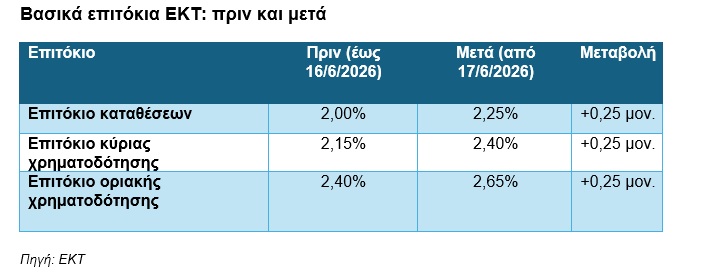
The ECB’s Governing Council raised its three key interest rates by 25 basis points, bringing the deposit rate—the ECB’s key policy indicator—to 2.25%.
It was the first increase since September 2023, when the rate had peaked at 4.0% before the cycle of rate cuts began, which lasted until early 2026.
The decision was not a foregone conclusion. Markets had priced it in with near certainty in the weeks leading up to the meeting, and as the minutes of the previous meeting in April show, several members of the Governing Council would have supported a hike at that time if the issue had been put to a vote. The conditions were already in place.
Why inflation spiked
The cause had nothing to do with factors inherent to Europe. It was purely geopolitical: the war in the Middle East had cut off a large portion of the oil flow through the Strait of Hormuz, through which approximately one-fifth of global oil and liquefied natural gas production had passed before the war.
This disruption caused the greatest oil supply shock in history, and the effects quickly rippled through the entire price chain.
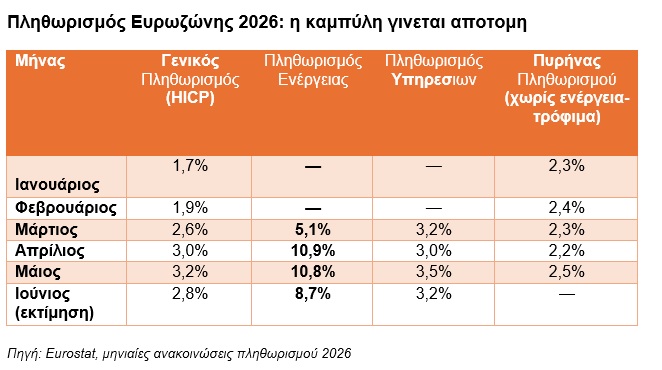
Within three months, headline inflation nearly doubled. What was concerning for the ECB was not only this development in itself, but also the fact that inflation—excluding energy and food—also rose, from 2.2% to 2.5%.
Statistically—and as we see in our daily lives—this meant that price increases were no longer limited to fuel but had begun to spread to broader categories of prices.
The ECB’s Executive Board had warned prior to the meeting that “the risk of inflation expectations becoming unanchored is increasing,” arguing that the ECB could no longer ignore the shock, regardless of the outcome of the peace negotiations.
A fragile peace was reached a few days later
Four days after the ECB’s decision, the U.S. and Iran announced a new agreement to end the war, with the immediate reopening of the Strait of Hormuz and the lifting of the U.S. naval blockade of Iranian ports. The markets reacted immediately: Brent crude oil fell by about 8% within a week, while stocks worldwide staged a relief rally.
The decline in the energy component of inflation in June (from 10.8% to 8.7%) likely already reflects this development. However, analysts warn that a full recovery of production and refinery operations will take months, and the ECB itself has described any truce as “fragile,” with a risk of a relapse. The question that remains is whether the easing of tensions will be enough to avoid the need for another interest rate hike at the next meeting on July 24.
What the ECB Forecasts
The Eurosystem’s projections, which accompanied the June decision, were revised significantly upward for inflation and downward for growth—even before the impact of the peace agreement was fully factored in.
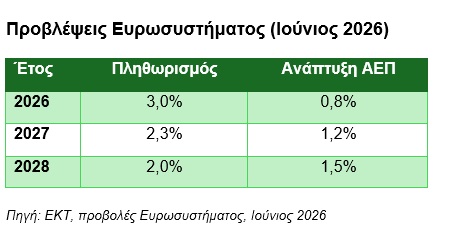
The eurozone had already contracted by 0.2% in the first quarter of 2026 compared to the previous quarter, even before the energy shock had fully materialized—a factor that heightened concerns about stagflation (weak growth combined with persistent inflation).
The ECB acknowledges that the environment remains unusually uncertain, with upside risks to inflation if peace proves fragile, and downside risks to growth if high prices dampen consumption.
What this means for loans and deposits
Rises in key interest rates are gradually being passed on to bank rates, but the transition is neither immediate nor uniform. The ECB’s most recent official data, covering April, show the situation just before the rate hike.
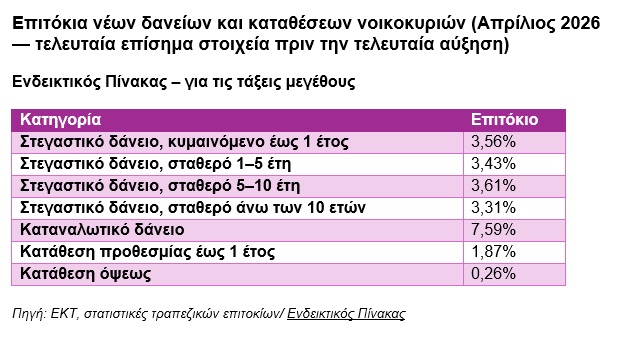
Mortgage rates were already on the rise even before the ECB raised its rates in June, as banks had begun to factor in expectations of tighter monetary policy. Deposits, by contrast, continue to yield low returns—much closer to 1.9% than to 3%+—which means that savers are not yet seeing any real benefit from the tightening.
Greece and Cyprus: Exposed, but More Resilient
Greece and Cyprus face a dual exposure in the current environment. Due to a lack of deep capital markets, they rely more heavily on bank financing than other European economies.
As a result, rising borrowing costs have a more immediate impact on the real economy. On the other hand, both countries are net energy importers and are therefore more vulnerable to oil price shocks—and will benefit proportionally more from a de-escalation if peace holds.
The positive aspect is that both banking sectors are entering this phase in much better shape than in the past: with lower levels of non-performing loans and stronger capital adequacy. This does not eliminate the risk, but it means that the system has more room to absorb the pressure without turning it into a crisis.
What’s Next
The ECB’s next monetary policy meeting is scheduled for July 24, 2026. Markets are already pricing in the possibility of another rate hike this year, although the prospect of a peace agreement in the Middle East is dampening those expectations.
The ECB has stated that it will take a “meeting-by-meeting” approach, without committing to a specific interest rate path, while assessing incoming data on inflation and growth.
Conclusion: A necessary move, not the start of a new crisis
The June 2026 rate hike is not a sign that the European economy is spiraling out of control. It is the response of a central bank that, after nearly two years of stability, was confronted with an exogenous shock it could not ignore—and which, ironically, began to subside just a few days after its decision.
The crucial question for the coming period is no longer whether the shock was triggered, but how deeply it has already penetrated the economy. Rising core inflation indicates that the battle is not yet over, even if energy prices begin to fall.
For households and businesses, the message is clear: the cost of money will not return to its 2025 lows anytime soon, and planning—for borrowing, saving, and investing—must take into account an environment of heightened uncertainty, at least until it becomes clear that peace in the Middle East will hold.
Sources: European Central Bank (ECB) — Monetary Policy Decision, June 11, 2026; ECB — Monetary Policy Statements and Press Conference, June 11, 2026; ECB — Hearing before the European Parliament’s Committee on Economic and Monetary Affairs, June 22, 2026, ECB — MFI Interest Rate Statistics, January–April 2026, Eurostat — Monthly Eurozone Inflation Releases (HICP), January–June 2026, Euronews — “ECB raises interest rates for the first time in three years as Iran war fuels inflation,” June 11, 2026, NBC News — “Oil prices fall on Iran peace deal, but may not go much lower,” June 15, 2026, Al Jazeera — “Oil prices fall, stocks rally as US, Iran sign framework to end war,” June 18, 2026
* Nicholas Havoutis has many years of experience leading strategic financial units, having served as an executive at JPMorgan (New York), Chase Manhattan Bank (London), and Eurobank (Athens). He also has a significant presence in the media sector. Today, as the head of SoZone Limited, he advises companies and investors on international expansion, operational optimization, and merger and acquisition strategies.