Two of the heaviest industrial names on the Athens Stock Exchange, ElvalHalcor and Cenergy Holdings, announced first-half results during the summer that exceeded market estimates.
ELHA was supported by the appreciation of aluminum and copper, as well as by an ambitious investment plan that was just financed with new capital, while CENERGY benefited from the wave of investments in electricity networks sweeping across Europe, reaching a record order backlog.
We ran our own discounted cash flow model to see where the valuation is justified: ElvalHalcor comes out with a target price of 5.35 euros, while Cenergy is slightly above its fair value, at 22.50 euros.
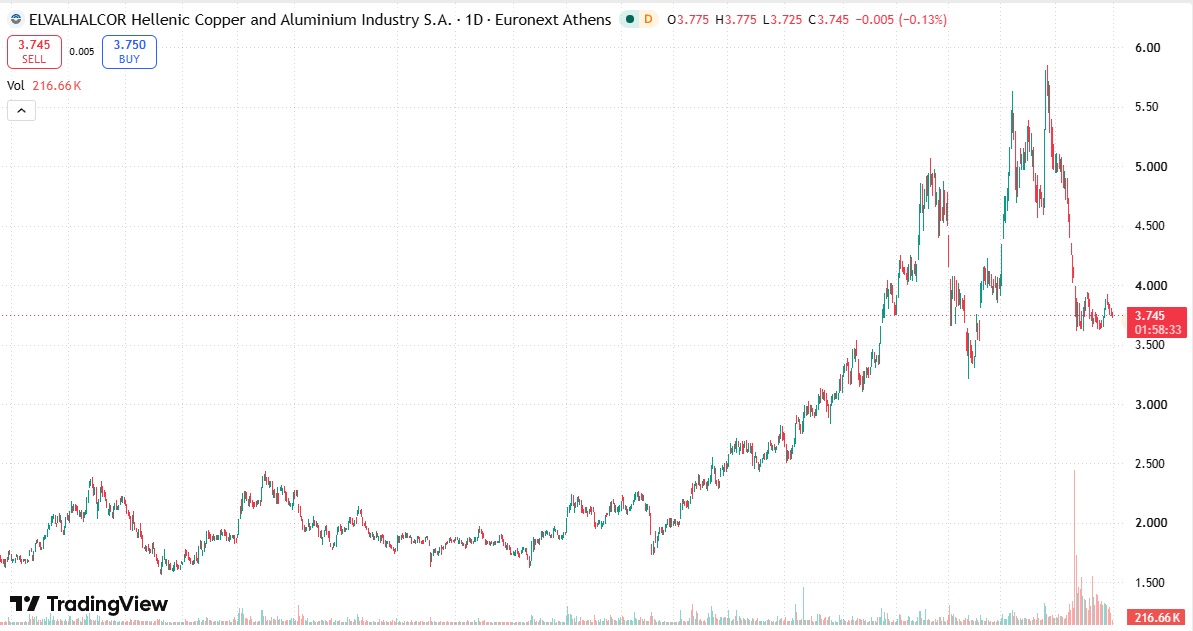
ELHA’s consolidated turnover amounted to 2,197.5 million euros, up 18% from 1,862 million euros in 2025. The increase came both from higher sales volumes and from the appreciation of base metals: the average price of aluminum stood at 2,897 euros per ton versus 2,331 euros last year, while zinc also followed an upward path, at 2,871 euros per ton from 2,516 euros.
The aluminum segment moved with sales volumes of 227 thousand tons, up 7%, with rigid packaging and the expansion of applications in transport as the main drivers.
At the profitability level, adjusted EBITDA increased more moderately, by 6.6%, to 143.3 million euros, while profit before tax surged by 78.6% to 158.5 million euros and net profit came in at 128.9 million euros. The difference between the growth rate of EBITDA and profit before tax suggests that part of the improvement also came from financial and non-operating items, beyond purely productive activity.
The most important news, perhaps, for shareholders came from the capital structure: in July, a share capital increase of 250 million euros was completed, with the issuance of 59,523,810 new shares at 4.20 euros, which began trading on July 22.
These funds are intended to support an ambitious investment program worth 850 million euros with a completion horizon by the end of the decade, an element showing that management has chosen to finance growth by combining equity with strengthened operating cash generation, instead of further burdening borrowing.
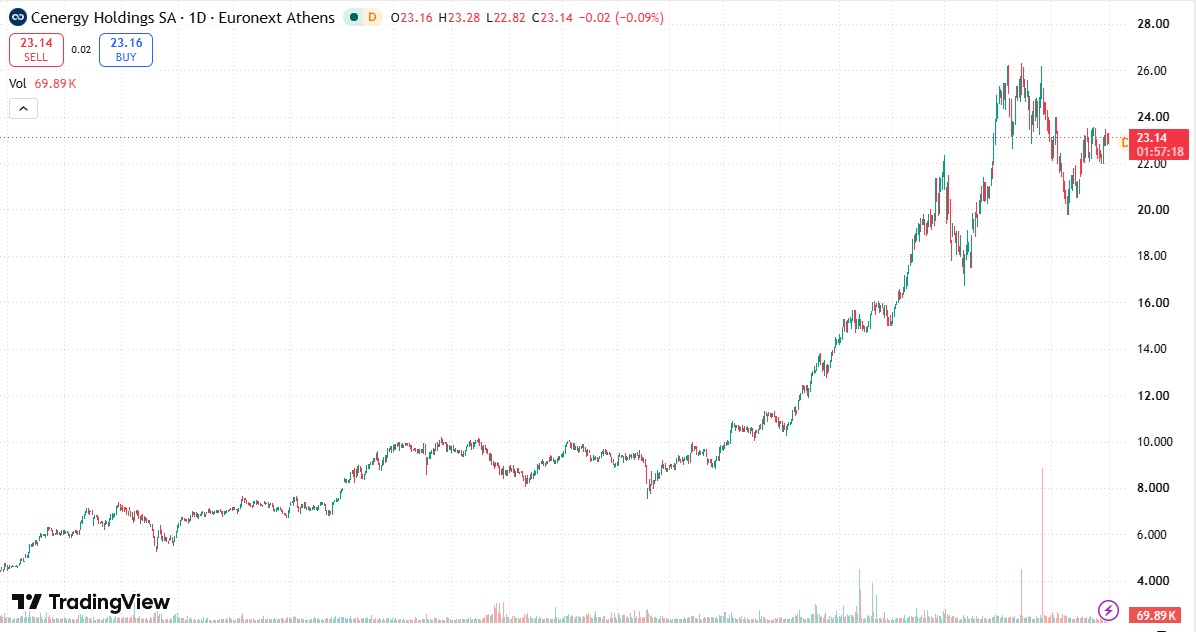
Cenergy Holdings: Cables are “running” ahead of estimates
CENER is active in the cables and steel pipes sectors and benefits directly from the wave of investments in electricity networks in Europe.
The group’s consolidated sales reached 1.15 billion euros, up 13%, with growth in both main business sectors. Adjusted EBITDA increased by 26% to 216 million euros, while net profit after tax jumped 45% and came in at 137.8 million euros.
The element that will probably concern analysts the most is the order backlog, which reached a new all-time high, close to 3.9 billion euros. A catalytic role in this development was played by the new framework agreement of subsidiary Hellenic Cables with ADMIE, worth approximately 1.15 billion euros, concerning the electrical interconnections of islands in the North Aegean and the Dodecanese. Given the size of this backlog, revenue visibility for the coming years improves noticeably.
Management took the opportunity to revise upward its target for full-year 2026: adjusted EBITDA is now expected to range between 390 and 420 million euros, from 370 to 400 million euros in the previous estimate.
This is an upgrade that is not based on temporary factors, but on projects already signed, a fact that gives it greater credibility compared with a simply optimistic forecast.
The valuation based on the DCF model for the next 12 months
According to our own free cash flow discounting model (DCF) for both companies, with a five-year forecast horizon and a steady growth rate of 3% in the terminal value, which may prove to be a conservative estimate.
For ELHA we forecast adjusted EBITDA scaling from about 300 million euros this year to 415 million euros in 2030, as the new aluminum and copper units of the 850 million euro investment program gradually begin to deliver.
Capital expenditures remain elevated in the first two to three years, around 200 million euros annually, and decline toward the end of the decade. With a discount rate of 9% and net debt of 548 million euros after the capital increase, the model gives a target price of 5.35 euros per share, about 44% above the current price.
In a sensitivity range, with a discount rate of 8.5%-9.5% and a growth rate of 2.5%-3.5%, the price ranges between 4.39 and 6.70 euros—an indication that about 86% of the valuation comes from the terminal value after 2030, so the result is quite sensitive to the assumptions.
At CENER the picture is different. EBITDA is projected to reach 628 million euros by 2030, more than double this year’s level, but capital expenditures remain large earlier in the period (front-loaded) due to investments in Baltimore and Hartlepool, which shifts the large free cash flows toward 2028-2030.
With a discount rate of 8.5%, net debt of 433 million euros on June 30, 2026 and the same long-term growth rate of 3%, the target price comes to 22.50 euros, very close to the current trading price.
The sensitivity range, from 18.60 to 28.09 euros, shows that the stock has already incorporated a large part of the expected growth: to justify prices above 25-26 euros, either a lower discount rate or a higher growth rate in the terminal value is needed than what we consider conservatively reasonable today.
Based on this analysis, ELHA offers the greater upside potential of the two, mainly because the market does not seem to have yet fully priced in the impact of the new investment cycle on profitability. CENER remains the higher-quality story at the business model level, with revenue visibility that few Greek companies possess, but the current price leaves less room for error, especially if the transition from investments to free cash flows is “delayed.”
We present below the key figures of the two companies in summary form for easier comparison:
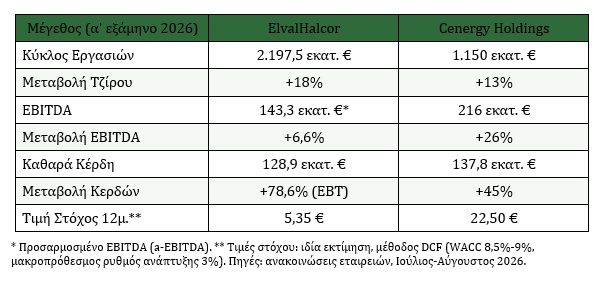
The two stories, however, are not the same. ELHA bases its growth on a more structural logic, with increased sales volumes and a long-term investment plan now financed also with new equity, while remaining exposed to fluctuations in international metal prices.
CENER perhaps represents the more “pure” structural growth story between the two, as its performance is directly linked to the investment cycle of energy networks in Europe and is confirmed by a record backlog extending over many years, with the risk here shifting to the pace of disbursement of public and European funds, a process that historically has shown delays compared with the original planning.
Both groups entered the second half with a strengthened capital position. CENER shows this with official revised guidance, ELHA with tangible support for its investment program. Whether this is a one-off, particularly favorable period or the beginning of a larger upgrade cycle for heavy Greek industry will be shown by the next announcements, especially the third-quarter figures.