We believe that the rise in yields is not merely a technical feature of fixed-income markets, but a development with a direct, measurable impact on equity valuation worldwide — through a higher discount rate and portfolio reallocation in favor of bonds.

The sharpest move in bonds of the last decade
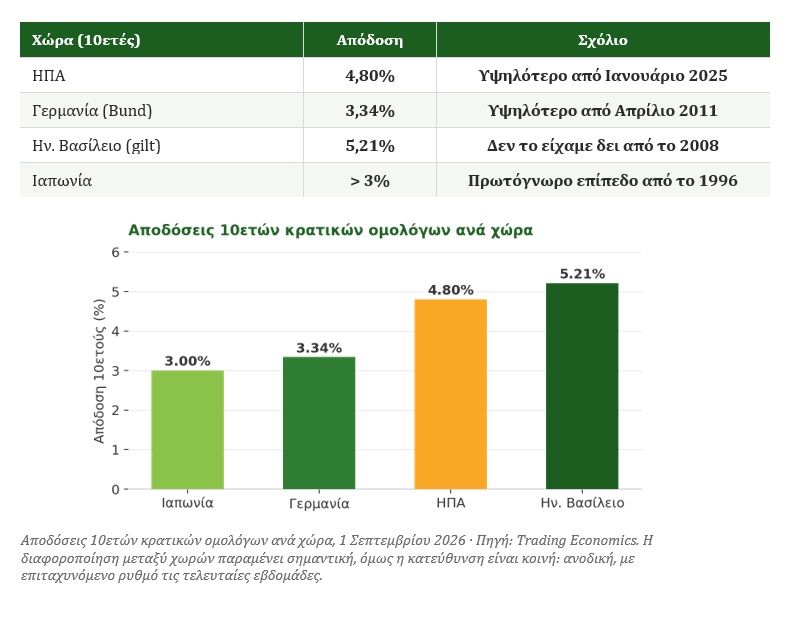
In recent weeks we have been observing one of the sharpest moves in global bond markets of the last decade. The yield on the U.S. 10-year reached 4.80% on September 1, 2026, the highest level since January 2025, while a corresponding —in some cases even stronger— rise is also being recorded in Europe, Britain, and Japan.
This is not a phenomenon limited to the U.S.: the sell-off is synchronized and global, fueled by persistent energy inflation, geopolitical tension in the Middle East, and tougher rhetoric from central banks.
The bridge mechanism between bonds and equities: The discount rate
The main link between bond yields and stock prices runs through the discount rate we use to value a company’s future cash flows. Within the framework of a DCF/DDM model, the “fair” value of a stock equals the sum of future earnings, discounted to the present:

The discount rate r is in turn defined as the sum of two components:
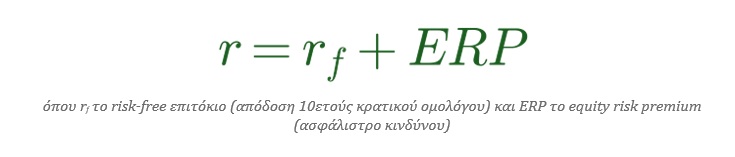
When the risk-free rate rises, the denominator (1+r)ᵗ increases for each future year t, with the result that present value —and therefore the theoretical valuation of the stock, ceteris paribus— declines, even if the risk premium remains constant.
The “duration effect” also carries over to equities
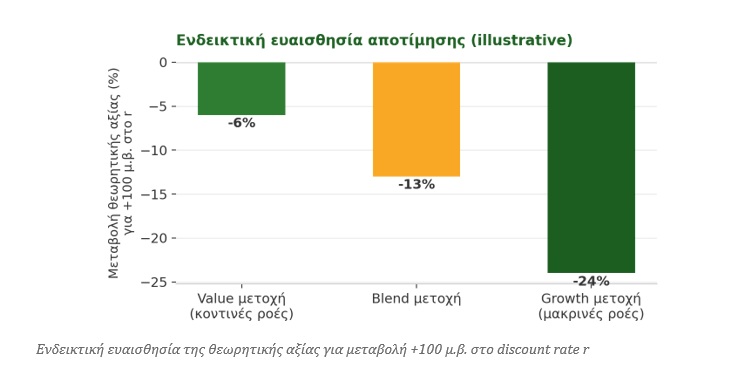
The more distant the cash flow, the greater its sensitivity to the discount rate — a phenomenon known from fixed-income assets, which similarly carries over to equities.
Growth stocks, especially in technology and in large-cap companies without mature profitability, are more vulnerable as the greater part of their value is based on earnings far in the future.
By contrast, value stocks, utilities with stable short-term cash flows, and the banking sector remain more resilient.
Banks: They benefit, but only up to a point
The banking sector benefits from wider lending margins (net interest margin) in a higher-rate environment, and is generally considered more resilient than growth stocks. However, the benefit is not unlimited: the rise in the cost of money hurts demand for loans and increases credit risk in the loan portfolio, limiting the benefit to NIM.
It is not only the level that matters, but also the speed
A sharp, unexpected increase in yields causes greater turmoil in equity markets than a gradual, anticipated path — investors do not have time to adjust expectations and positions smoothly.
Japan: The end of three decades of low interest rates
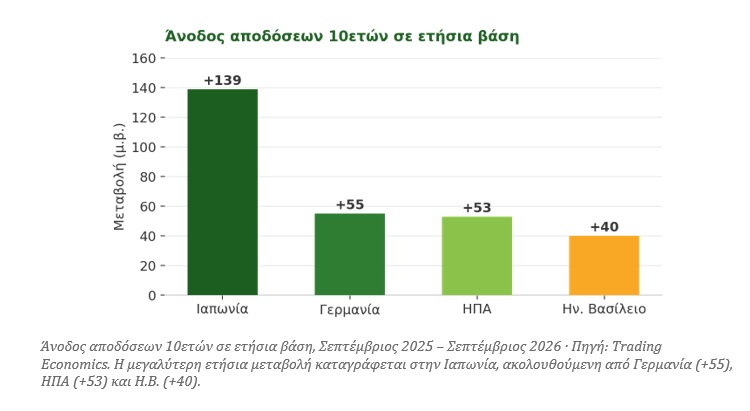
A market that for decades operated with zero to negative interest rates is now seeing its yields soar to 30-year record levels (>3%, unprecedented since 1996), with pressure toward a revision of the monetary policy of the Bank of Japan. The yen has for decades remained a funding currency (carry trade), and a potential rate increase by the BOJ could trigger a broader global reallocation of capital.
The second mechanism: Portfolio reallocation
Beyond the accounting effect on valuation, there is also a second, equally important transmission channel: as government bonds offer a higher “safe” return, they become more attractive relative to equities.
With the U.S. 30-year having reached 5.28% and the 2-year 4.39% (10-year: 4.80%), government bonds are prompting institutional investors, insurance companies, and pension funds to reduce the relative weighting in equity portfolios — a pure reallocation of capital, not just an effect on valuation.

The reversal of the “TINA effect”
Between 2008 and 2021, with bonds offering an almost zero or negative yield, investors were forced to turn to equities — the well-known “There Is No Alternative”. Today, with yields above 4-5% on “safe” government bonds, the risk-return equation changes substantially, in favor of fixed income and at the expense of equities.
Three more forces reinforcing the pressure
- Tension in the Middle East maintains upward pressure on oil, fueling inflation and forcing the Fed, ECB, and Bank of England to maintain tight monetary policy.
- The fiscal deficits of major economies, with the U.S. as a characteristic example, increase the supply of government debt, requiring higher yields (term premium) for the increased issuance to be absorbed.
- The depreciation of currencies such as the yen strengthens imported inflationary pressures, creating a vicious cycle between monetary policy, exchange rates, and bond yields.
Equity risk premium and valuation
The following simplified, indicative framework (not market data) shows how the total discount rate changes as the risk-free rate rises, with a constant equity risk premium of ~4.5%:
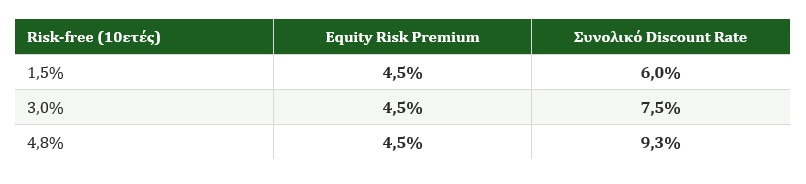
As the risk-free rate rises from 1.5% to 4.8%, the total discount rate increases by about 55% (6.0% → 9.3%), with corresponding pressure on the present value of long-term cash flows.
In summary, it is worth monitoring the following:

However, the question is not simply where yields will stabilize, but whether the equity market will adjust smoothly or require a more abrupt correction. There are two scenarios with corresponding parameters:

In any case, the chances have increased significantly that we have entered an era of higher inflation and interest rates.