The economic staff detailed the new interventions for the period up to 2030. According to it, the main new interventions concern:
- The exemption for compliant self-employed professionals from surcharges based on turnover and staff payroll, when calculating the minimum amount of net income,
- the reduction to zero of the tax rate up to 20,000 euros for professional farmers and parents with three children, following the 2026 tax reform,
- the permanent increase of the November support for pensioners, persons with disabilities and uninsured elderly from 300 to 400 euros net and the expansion of the support to all pensioners over 65 from November 2026,
- the establishment of a Christmas holiday allowance of 500 euros gross for public employees from 2027,
- the establishment of a special investment account which parents can open for infants during the first two years from their birth, where the state will deposit into the account the amount that the parent contributes each year, up to 1,200 euros annually, until the age of 18,
- the reduction of social security contributions by 0.5% from April 2027 for the private sector,
- the abolition of the business levy starting from the Greek Region and Thessaloniki,
- the reduction of the tax prepayment from 55% to 50% for self-employed professionals from tax year 2027 and the gradual annual reduction by 5% of the tax prepayment for legal entities from tax year 2028 so that from 80% today it will gradually be reduced to 50%,
- the establishment of accelerated depreciation over 6 years, from 10 years that applies today, for investments in companies’ mechanical equipment,
- the indexation of disability benefits,
- the abolition from 2027 of ENFIA in settlements of up to 2,000 inhabitants and up to 2,200 inhabitants in Western Macedonia and
- the increase of the National Public Investment Program with new investments that will contribute, among other things, to reducing the price of electricity.
In addition to the above measures, a target is set for increasing the minimum wage to 1,000 euros (1,300 euros with seniority increments) by 2028 from 920 euros today, through two increases that will take place in April 2027 and January 2028. The total increase from 2021, when the minimum stood at 650 euros, will amount to 54%.
The increase in the minimum wage also brings increases in linked benefits and allowances such as unemployment benefit, maternity benefit, overtime pay, and others. In addition, the basic salary of public employees will be adjusted horizontally both in April 2027 and in January 2028 proportionally to the increase in the minimum wage.
In addition, a series of measures that have been adopted to address the housing problem, such as the three-year exemption from tax on vacant properties that are rented out, the reduction of income tax for building upgrade expenses, the VAT exemption on new buildings and the restrictions on short-term rentals in Athens and Thessaloniki, are being extended.
Furthermore, a new measure is introduced to limit demand for housing from third countries and consequently reduce pressure on property prices, which provides for increasing the transfer tax from 3% to 15% for homes purchased by citizens of third countries (outside the EU). In addition, a new “My Home III” Program is being established to support the purchase of a first home through low-interest housing loans totaling 2 billion euros through the Hellenic Development Bank.
Additionally, 1.5 billion euros from the loans of the Recovery Fund that were transferred to the Hellenic Development Bank will be used to finance two new programs exclusively for small and medium-sized enterprises, a lending program amounting to 1.1 billion euros and a guarantee program of 400 million euros which, with the participation of the banking system, will support SMEs with a total of 5 billion euros in loans.
In addition, taking into account that in certain cases of members of Boards of Directors and senior executives particularly high remuneration is distributed from profit participation, which today is taxed with the 5% dividend tax rate, this remuneration, for the amount exceeding 60,000 euros, will be taxed from 1/1/2027 at 15%.
The total cost of the new measures that have not yet been legislated is estimated at 605 million for 2026 and 2.2 billion euros for 2027, gradually increasing to 3.6 billion euros by 2030. In addition, the measures that have already been legislated and have not yet been delivered have a fiscal cost estimated at 940 million euros in 2026 and 2.8 billion euros in 2027, gradually increasing to 5.4 billion euros by 2030. Therefore, the total annual cost of the measures that have not yet been delivered (legislated and non-legislated) is estimated at 1.54 billion euros for 2026 and 5 billion euros in 2027, gradually increasing to 9 billion euros by 2030.
Analysis of the main measures
A. Exemption from surcharges based on turnover and staff payroll, when calculating the minimum amount of net income, for compliant self-employed professionals
From tax year 2026 (returns in 2027), taking into account the full development of electronic tax tools, but also as an incentive to reward compliant self-employed professionals, professionals who meet specific criteria will be exempt from the following surcharges that apply when calculating the minimum amount of net income:
(a) an amount equal to ten percent (10%) of the annual cost paid by the liable person for the payroll of the staff they employ and
b) an amount equal to five percent (5%) of the amount by which the liable person’s turnover exceeds the average annual turnover of the Activity Code (K.A.D.).
The criteria that compliant self-employed professionals must meet in order to receive the above exemption are the following:
- (a) they have sent the necessary data to myDATA for the respective tax year,
- (b) if they are obliged to connect cash registers and pos, they have completed their connection and remain connected throughout the respective tax year,
- (c) they have not been fined by the tax authority or the labor inspection authority for the periods of the last 5 tax years,
- (d) they have submitted all VAT and income tax returns concerning the last 5 tax years by 31/12 of the last tax year, provided they were legally obliged to submit them.
In addition:
- For TAXI operators, the imputed amount is reduced according to the ownership percentage of the vehicle (thus if someone has a 50% co-ownership share, then the imputed amount is reduced by 50%). In addition, minor children up to 18 years old who hold a TAXI license are exempt from imputed criteria (usually due to the death of a parent).
- Imputed criteria are reduced by 50% in settlements with a population of up to 2,000 (from 1,500), excluding those located in the Region of Attica (except the Regional Unit of Islands) and specifically for the Region of Western Macedonia in settlements with a population of up to 2,200 (from 1,700) inhabitants (concerns 131 new settlements).
Approximately 156,000 sole proprietorships are burdened by the surcharges based on turnover and staff payroll (in addition to the imputed income determined by the minimum wage and seniority increments). The fiscal cost is estimated at 170 million euros for the first year of application of the exemption and 108 million euros for 2028 and subsequent years.
It is noted that overall, out of the 755,000 sole proprietorships, 427,000 are subject to taxation due to declaring incomes lower than the minimum amount of net income. Of these, 271,000 are taxed only on the basis of the minimum wage plus seniority increments (with annual tax ranging from 1,476 euros without seniority increments to 2,249 with three seniority increments for a self-employed professional over 30 without children, and lower or even zero amounts for self-employed professionals with children or under 30 years old).
The 156,000 businesses, however, are burdened with additional surcharges due to turnover or employee payroll that significantly increase the calculated tax (for 24,000 of them the surcharge is over 2,000 euros, while for 3,000 of them the surcharge is over 10,000 euros).
Example 1: Sole proprietorship in food service (café) operating for 15 years, with 5 employees and annual payroll cost of 105,000 euros. The minimum net income corresponds to 16,744 euros (minimum wage plus seniority increments) plus 10,500 euros (10% of staff payroll), total 27,244 euros. The corresponding tax amounts to 4,783 euros. With the new regulation, the minimum net income will correspond to 16,744 with corresponding tax of 2,249 euros, i.e. a benefit of 2,534 euros.
Example 2: Sole proprietorship in retail shoe trade operating for 4 years, with 2 employees, annual payroll cost of 21,000 euros and turnover of 120,000 euros (average KAD 48,564 euros). The minimum net income corresponds to 12,880 euros, plus 2,100 (10% of staff payroll), plus 3,572 (5% of the difference between turnover and the average turnover of the KAD), total 18,552 euros. The corresponding tax amounts to 2,610 euros. With the new regulation, the minimum net income will correspond to 12,880 with corresponding tax of 1,476 euros, i.e. a benefit of 1,134 euros.
Example 3: Accountant who has had a sole proprietorship for 20 years without employees and turnover of 90,000 euros (average KAD 28,479 euros). The minimum net income corresponds to 16,744 euros (minimum wage plus seniority increments) plus 3,076 euros (5% of the difference between turnover and the average turnover of the KAD), total 19,820 euros. The corresponding tax amounts to 2,864 euros. With the new regulation, the minimum net income will correspond to 16,744 with corresponding tax of 2,249 euros, i.e. a benefit of 615 euros.
The range of benefit and the corresponding number of businesses is shown in the table below.
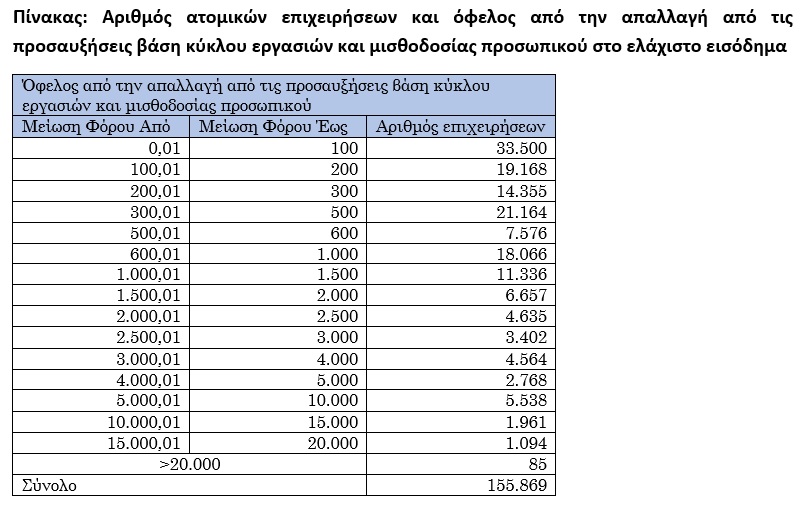
It is noted that the above regulation particularly favors sole proprietorships that employ workers, such as retail trade and food service. According to the data of the GEMI on active businesses, 53,722 of the 85,965 (62.5% of the total) food service businesses are sole proprietorships and 99,518 of the 141,616 (70.3% of the total) retail trade businesses are sole proprietorships.
In addition, self-employed professionals in 2027 will also benefit from the reduction in income tax made with the 2026 income tax reform.
Furthermore, from tax year 2027 (returns in 2028), a reduction of the tax prepayment for self-employed professionals from 55% to 50% is provided for, with a fiscal cost of 82 million euros.
In the same year (2028), self-employed professionals with three children will see a significant tax reduction with the zeroing of the scale up to 20,000 euros.
B. Reduction of the tax rate for professional farmers to 0% up to 20,000
With this regulation, the income tax rate is reduced to zero for incomes up to 20,000 euros for those who are professional farmers-natural persons who have more than 50% of their income from agricultural activity, in analogy with what was applied for young people up to 25 years old and for large families. The tax reduction applies from tax year 2026 (returns in 2027).
The significant reduction in the income tax of professional farmers aims, beyond strengthening their income, at providing incentives both for current producers to remain in the agricultural sector and for attracting new farmers, with the ultimate goal of increasing agricultural production.
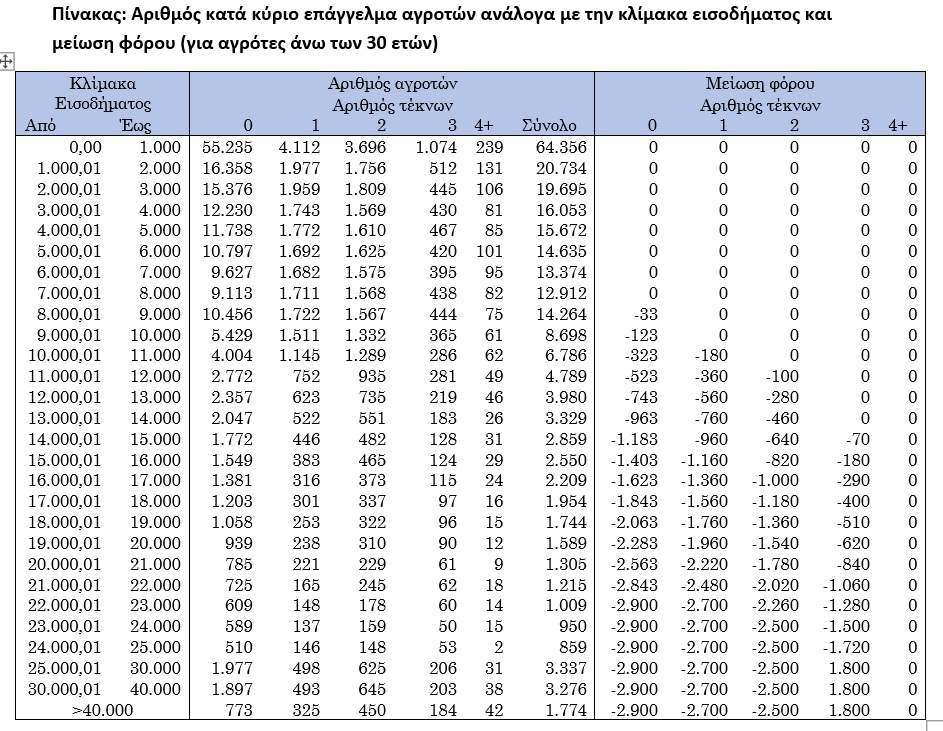
It is noted that income from agricultural activity for those who are professional farmers-natural persons who have more than 50% of their income from agricultural activity (245,907 natural persons) is currently taxed separately with the employees’ scale.
Reductions will be seen by 47,091 of the 245,907 professional farmers who are above the tax-free threshold, which with the zeroing of the rate increases for a farmer without children from 8,633 euros to 22,204 euros. It is noted that these 47 thousand farmers declare approximately 56% of total income (850 million out of 1.5 billion euros). The maximum benefit amounts to 2,900 euros.
The fiscal cost is estimated at 87 million euros for the first year of application of the exemption and 56 million euros for 2028 and subsequent years.
Example 1: Farmer without children with annual income of 15,000 euros. He paid tax of 1,183 euros and today it is reduced to zero.
Example 2: Farmer with two children with annual income of 20,000 euros. He paid tax of 1,540 euros and today it is reduced to zero.
Example 3: Farmer without children with annual income of 30,000 euros. He paid tax of 5,083 euros and now will pay 2,183 euros, benefit 2,900 euros.
It is noted that from November 2026 the refund of the excise tax on agricultural diesel at the pump will also apply, where the benefit for farmers will increase as there will also be an exemption from the VAT corresponding to the excise tax (total 50.8 cents of which 41 cents per liter excise tax and 9.8 cents VAT on the excise tax).
C. Reduction of the tax rate for parents with three children to 0% up to 20,000 euros
With this regulation, the income tax rate is reduced to zero for incomes up to 20,000 euros for those who have three dependent children, in analogy with what was applied for young people up to 25 years old and for large families. The tax reduction applies from tax year 2027 (employees will see the reductions from 1/1/2027 and self-employed professionals in the 2028 returns).
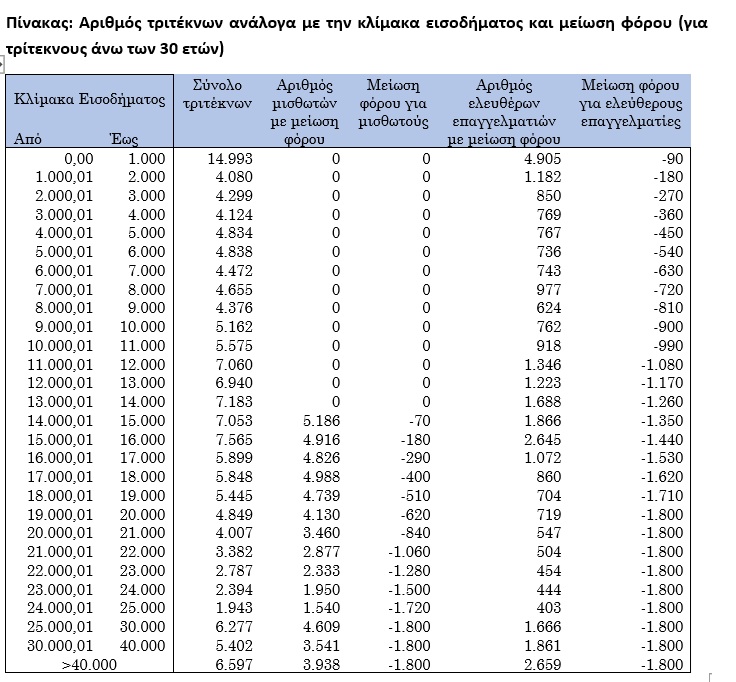
Reductions will be seen by 86,927 (of whom 33,894 are self-employed professionals) of the 152,039 parents with three children who are above the tax-free threshold, which with the zeroing of the rate increases from 14,364 euros to 25,364 euros. The maximum benefit amounts to 1,800 euros.
The fiscal cost is estimated at 55 million euros for the first year of application of the exemption, 107 million euros in 2028 and 90 million euros in 2029 and subsequent years.
Example 1: Employee with three children with annual income of 20,000 euros. He paid tax of 620 euros and today it is reduced to zero.
Example 2: Employee with three children with annual income of 30,000 euros. He paid tax of 2,820 euros and now will pay 1,020 euros, benefit 1,800 euros.
Example 3: Self-employed professional with three children with annual income of 15,000 euros. He paid tax of 1,350 euros and now it is reduced to zero.
D. Increases in pensioners’ earnings
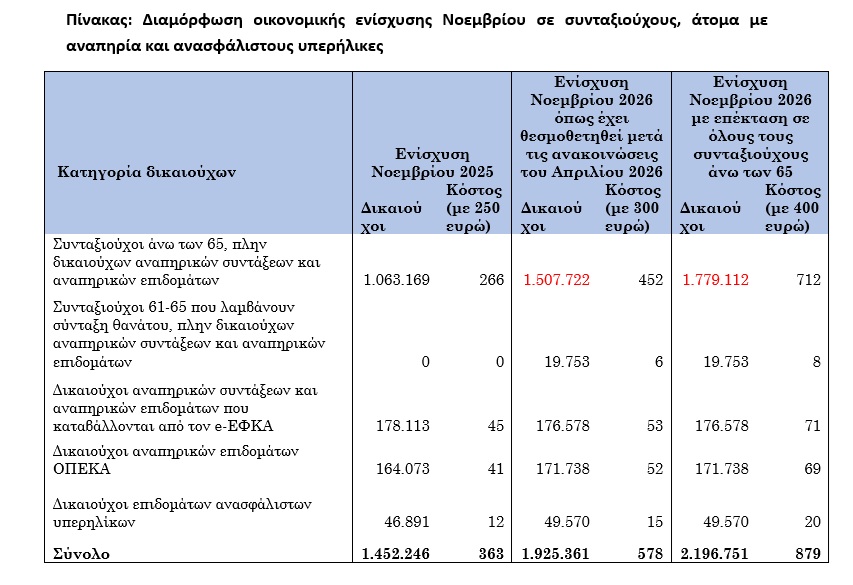
From November 2026, the annual financial support increases to 400 euros net from 300 and is expanded to all pensioners over 65 years old. The same amount will be received by pensioners over 60 who receive only a survivor’s pension, persons with disabilities regardless of age, and uninsured elderly persons.
In total, beneficiaries will be 2.2 million citizens (an additional 270,000 pensioners compared to the April announcement) and the total annual fiscal cost of the support amounts to 879 million euros.
In detail, the evolution of the benefit and the beneficiaries is presented in the table below.
In addition, pensioners from 1/1/2027 will receive an increase in pensions based on the average of inflation and GDP, without offsetting the personal difference. Therefore, all pensioners will receive an increase.
Based on the estimates of April 2026 incorporated into the annual progress report of the Medium-Term Program, the increase is calculated at 2.6% and the corresponding fiscal cost at 750 million euros. It is noted that the final percentage increase will be determined based on the macroeconomic estimates of the final Budget draft to be submitted in November 2026.
It is noted that pensions have increased based on GDP and inflation by 7.75% in 2023, 3.0% in 2024, 2.4% in 2025 and 2.4% in 2026. Cumulative increase 2023-2026 16.4%, with a total annual cost of 2.5 billion euros.
With the increase of January 2027, the cumulative increase from 2023 will reach 19% with an annual fiscal cost of around 3.25 billion euros. Pensions will continue to increase every year without offsetting the personal difference, with the estimated annual cost increasing by an additional approximately 2.7 billion euros in 2030 compared to 2026.
Furthermore, as has been announced, the 50% reduction of survivor’s pensions after the lapse of three years is abolished and the national survivor’s pension continues to be paid in cases of beneficiaries who also receive a pension in their own right. The fiscal cost from the increases that the approximately 8,500 public sector pensioners for whom the cut had been applied will receive is estimated at 48 million euros annually.
Indicative examples
- Pensioner with 10,000 euros taxable income and monthly net income of 823 euros will receive 208 euros net from the increase based on GDP and inflation and 400 euros from the November support, total 608 euros net annually.
- Pensioner with 14,000 euros taxable income and monthly net income of 1,086 euros will receive 284 euros net from the increase based on GDP and inflation and 400 euros from the November support, total 684 euros net annually.
- Pensioner with 20,000 euros taxable income and monthly net income of 1,476 euros will receive 374 euros net from the increase based on GDP and inflation and 400 euros from the November support, total 774 euros net annually.
- Pensioner with 24,000 euros taxable income and monthly net income of 1,716 euros will receive 449 euros net from the increase based on GDP and inflation and 400 euros from the November support, total 849 euros net annually.
E. Increases in public employees’ earnings
From December 2027, a Christmas holiday allowance is established for public employees amounting to 500 euros gross. The allowance is counted in regular earnings and counts toward pensionable earnings. For public employees who serve part of the year, the allowance is paid proportionally for the months they serve from 1/1/2027. The fiscal cost for the approximately 720,000 public employees covered by the state budget, including employer contributions, is estimated annually at 433 million euros.
The net amount ranges from 257 to 389 euros, depending on the category, and is presented below.
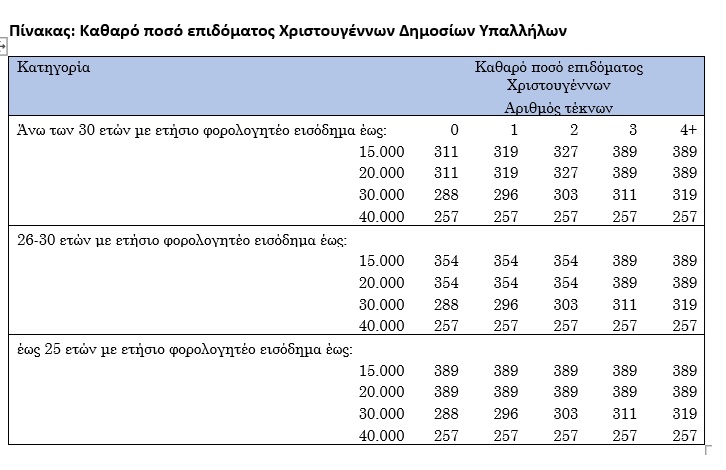
In addition, public employees will receive increases in their earnings based on the minimum wage, which is expected to be set at 1,000 euros by January 2028 from 920 euros today, through successive increases in April 2027 and January 2028. The above means that earnings will increase by 80 euros gross monthly or 960 euros annually by January 2028.
Indicative examples
Under the assumption that earnings will increase by 40 euros gross in April 2027 and an additional 40 euros in January 2028, public employees in combination with the Christmas allowance will receive the following increases:
- Public employee aged 40 with two children and gross monthly salary of 2,000 euros corresponding to 1,447 euros net: In 2027 he will receive in addition compared to this year a total of 562 euros net, 327 euros from the Christmas bonus plus 235 euros (26 net monthly for 9 months) from the increase based on the minimum wage. In 2028 he will receive in addition compared to this year a total of 964 euros net, 327 euros from the Christmas bonus plus 637 euros (52 net monthly for 12 months) from the increase based on the minimum wage.
- Public employee aged 29 without children and gross monthly salary 1,500 euros corresponding to 1,123 euros net: In 2027 he will receive in addition compared to this year a total of 609 euros net, 354 euros from the Christmas bonus plus 255 euros (28 net monthly for 9 months) from the increase based on the minimum wage. In 2028 he will receive in addition compared to this year a total of 1,033 euros net, 354 euros from the Christmas bonus plus 679 euros (57 net monthly for 12 months) from the increase based on the minimum wage.
- Public employee aged 55 without children and gross monthly salary 3,000 euros corresponding to 1,956 euros net: In 2027 he will receive in addition compared to this year a total of 495 euros net, 288 euros from the Christmas bonus plus 207 euros (23 net monthly for 9 months) from the increase based on the minimum wage. In 2028 he will receive in addition compared to this year a total of 841 euros net, 288 euros from the Christmas bonus plus 553 euros (46 net monthly for 12 months) from the increase based on the minimum wage.
- Public employee aged 24 without children and gross monthly salary 1,200 euros corresponding to 933 euros net: In 2027 he will receive in addition compared to this year a total of 669 euros net, 389 euros from the Christmas bonus plus 280 euros (31 net monthly for 9 months) from the increase based on the minimum wage. In 2028 he will receive in addition compared to this year a total of 1,136 euros net, 389 euros from the Christmas bonus plus 747 euros (62 net monthly for 12 months) from the increase based on the minimum wage.
- Public employee aged 49 with three children and gross monthly salary 2,500 euros corresponding to 1,832 euros net: In 2027 he will receive in addition compared to this year a total of 1,944 euros net, 311 euros from the Christmas bonus plus 280 euros (31 net monthly for 9 months) from the increase based on the minimum wage, plus 1,353 euros from the tax reduction. In 2028 he will receive in addition compared to this year a total of 2,411 euros net, 311 euros from the Christmas bonus, plus 747 euros (62 net monthly for 12 months) from the increase based on the minimum wage, plus 1,353 euros from the tax reduction.
ST. Increase in the minimum wage and reduction of social security contributions for private sector employees
The minimum wage is expected to increase to 1,000 euros (1,300 euros with seniority increments) by 2028 from 920 euros today, through two increases that will take place in April 2027 and January 2028. The total increase from 2021, when the minimum stood at 650 euros, will amount to 54%.
At the same time, from April 1 social security contributions of private sector employees are reduced by 0.5%, with a fiscal cost of 163 million euros for 2027 and 218 million euros for 2028. The reduction in contributions will come from the deductions in favor of DYPA, while the corresponding cost will be covered by the state budget through a permanent increase in the subsidy to DYPA.
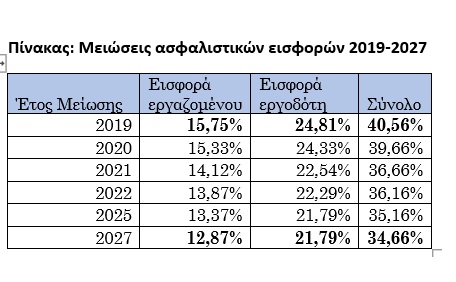
The entire reduction will come from the social security contributions withheld from the employee so that employees receive the full benefit from the reduction in contributions. After this reduction, total social security contributions in the private sector will have decreased from 40.56% in 2019 to 34.66% in 2027, that is by 5.9 points. Employee contributions will have decreased from 15.75% to 12.87% and employer contributions from 24.81% to 21.79%. The successive reductions are presented in the table below.
Indicative examples
Under the assumption that the minimum will increase by 40 euros in April 2027 and an additional 40 euros in January 2028, in combination with the reduction in social security contributions from April 2027:
- For a 23-year-old new worker without seniority increments, the gross salary will increase from 920 to 960 euros in April 2027 (with social security contributions reduced by 0.5%) and to 1,000 euros in January 2028. The net salary will increase from 797 to 836 euros in April 2027 and 871 euros in January 2028. Overall, compared to this year he will receive an additional 414 euros in 2027 and 1,040 euros net in 2028.
- For an employee aged 34 with three seniority increments and no children, the gross salary will increase from 1,196 to 1,248 euros in April 2027 (with social security contributions reduced by 0.5%) and to 1,300 euros in January 2028. The net salary will increase from 959 to 999 euros in April 2027 and 1,035 euros in January 2028. Overall, compared to this year he will receive an additional 420 euros in 2027 and 1,055 euros net in 2028.
- For an employee aged 45 with three children and a gross salary of 2,000 euros. The net salary will increase from 1,621 to 1,733 euros from January 2027 due to the zeroing of the tax and to 1,743 euros from April 2027 due to the reduction in social security contributions. Overall, compared to this year he will receive an additional 1,673 euros net in 2027.
- For an employee aged 40 with one child and a gross monthly salary of 3,000 euros, the net salary will increase from 2,109 to 2,119 euros net from April 2027 due to the reduction in social security contributions. However, it is noted that in many business cases the increase in the minimum wage also pulls up increases in higher wage brackets.
Z. Tax reductions for businesses
Establishment of accelerated depreciation for mechanical equipment
The profit from business activity on which income tax is calculated is considered to be the total revenue from business transactions after deducting business expenses, depreciation and provisions for bad debts. Today, the acquisition or construction cost, including the cost of improvement, renewal and reconstruction as well as environmental restoration, is depreciated according to the table below.
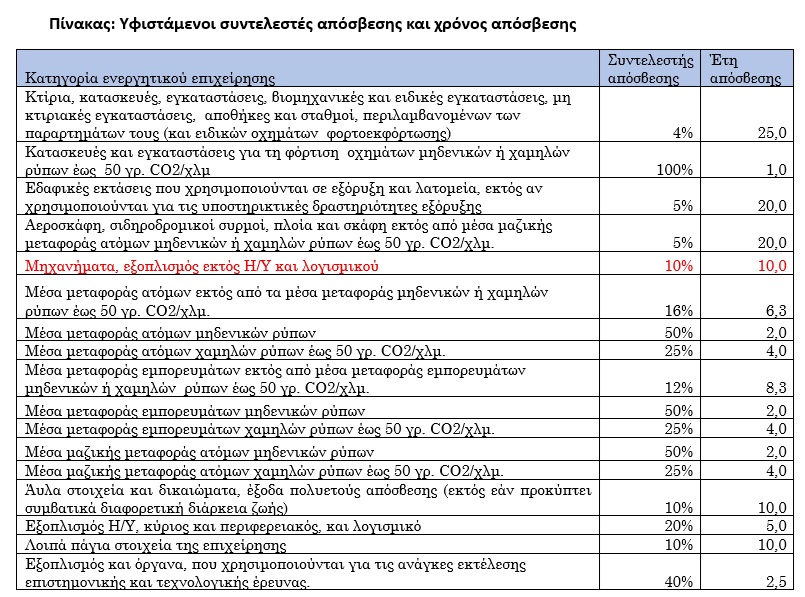
With the new regulation, the acquisition or construction cost, including the cost of improvement, renewal and reconstruction of Machinery and equipment (except PCs and software which are depreciated over 5 years), will be depreciated over 6 years (instead of 10 years) at an accelerated rate as follows: 1st year: 10%, 2nd year 10%, 3rd year 15%, 4th year 15%, 5th year 25% and 6th year 25%. The new depreciation rates will apply to expenses incurred from 1/1/2027 onwards.
In this way, investments in Mechanical equipment are incentivized and accelerated, as they will be depreciated over 6 instead of 10 years, with a corresponding benefit in corporate income tax. In addition, accelerated depreciation is more representative of the progressively increasing impairment of the value of machinery, taking into account technological developments.
Based on investment data in mechanical equipment by private businesses, which are estimated based on macroeconomic forecasts to amount to approximately 9.7 billion euros in 2027, in combination with tax data on business profitability, the above regulation is expected to lead to a reduction in the assessment of legal entities’ tax by 48 million in 2030, 125 million in 2031, 299 million in 2032, 530 million in 2033, 523 million in 2034, 368 million in 2035, 213 million in 2036 and 59 million in 2037. However, the above estimate is a static estimate without change in business behavior. In the event of accelerated investments, additional revenues are expected from economic growth.
Example: A business proceeds in 2027 with the purchase of mechanical equipment worth 100,000 euros. With the existing depreciation method, 10,000 euros annually would be deducted from the business’s expenses and it would have a tax reduction (with a 22% rate) of 2,200 euros annually. With the new method it will have a tax reduction of 2,200 euros in 2028 and 2029, 3,300 euros in 2030 and 2031 and 5,500 euros in 2032 and 2033.
Abolition of the business levy starting from the Greek Region and Thessaloniki
From 2027 (tax year 2026), the business levy is abolished for the headquarters and branches of legal entities located outside the Region of Attica (except the Regional Unit of Islands where it is also abolished). In addition, in 2028 (tax year 2027) the business levy is reduced by 50% in the Region of Attica as well and in 2029 (tax year 2028) it is abolished.
The cost, taking into account the collection rate, is estimated at 82 million euros in 2027, 138 million euros in 2028, 195 million euros in 2029 and 201 million euros in 2030.
It is noted that in 2025 business levy was assessed on 245,003 legal entities, of which approximately half (121,922) are headquartered outside Attica.
Example 1: Business headquartered in Larissa without a branch. In 2026 it paid a business levy of 800 euros. In 2027 it is abolished.
Example 2: Business with headquarters and one branch in Thessaloniki. In 2026 it paid a business levy of 1,600 euros. In 2027 it is abolished.
Example 3: Business headquartered in Heraklion with two branches, one in Chania and one in Rethymno. In 2026 it paid a business levy of 2,000 euros. In 2027 it is abolished.
Example 4: Business headquartered in Athens with two branches, one in Thessaloniki and one in Patras. In 2026 it paid a business levy of 2,200 euros. In 2027 it will pay 1,000 euros, in 2028 500 euros and in 2029 zero.
Example 5: Business headquartered in Thessaloniki with one branch in Athens. In 2026 it paid a business levy of 1,600 euros. In 2027 it will pay 600 euros, in 2028 300 euros and in 2029 zero.
It is noted that today the business levy is set at:
a) legal entities and legal persons of a for-profit nature, which have their headquarters in tourist areas and in cities or villages with a population of up to 200,000 inhabitants, at 800 euros annually,
b) civil non-profit companies that have their headquarters in tourist areas and in cities or villages with a population of up to 200,000 inhabitants, at 400 euros annually,
c) legal entities and legal persons of a for-profit nature, which have their headquarters in cities with a population of over 200,000 inhabitants, at 1,000 euros annually,
d) civil non-profit companies that have their headquarters in cities with a population of over 200,000 inhabitants, at 500 euros annually,
e) for each branch established by a legal entity or legal person of a for-profit nature at 600 euros annually and for each branch established by a civil non-profit company at 300 euros annually.
Today, the following are exempt from payment of the business levy: a) agricultural cooperatives, school cooperatives, Social and Solidarity Economy Bodies in the form of a Social Cooperative Enterprise or Workers’ Cooperative, b) legal entities and legal persons that are under liquidation, bankruptcy or inactivity, c) legal entities and legal persons that carry out their activity in villages with a population of up to five hundred (500) inhabitants and on islands with fewer than three thousand one hundred (3,100) inhabitants, unless they are tourist areas, and d) legal entities and legal persons that increase by at least three twelfths (3/12) the average number of employees with a full-time employment relationship in one year compared to the previous year, provided that their gross revenues in the tax year for which the exemption is granted do not exceed two million euros.
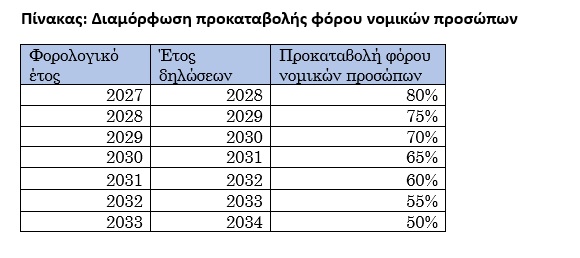
Reduction of tax prepayment by 5% annually for legal entities from tax year 2028 (returns 2029) and each year until it reaches 50% from 80% today
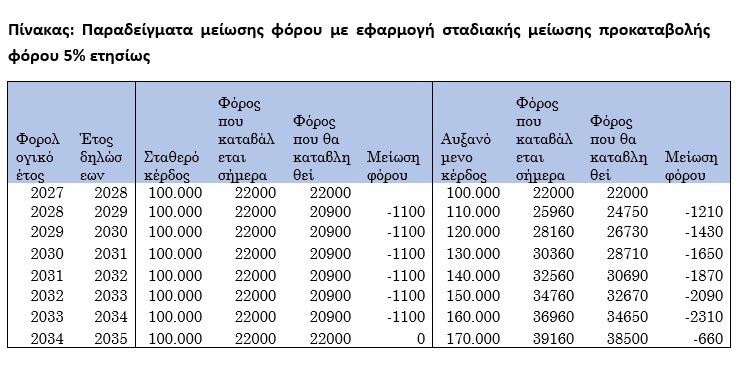
From tax year 2028 (returns 2029), the goal is for the tax prepayment of legal entities to be reduced by 5% annually and for 6 years, until it reaches 50% in tax year 2033 (returns 2034). In this way, the tax prepayment of legal entities will be equalized with that of sole proprietorships, which will already have been reduced in tax year 2027 to 50% (from 55% today). Therefore, the tax prepayment of legal entities is expected to be shaped as shown in the table below.
The reduction of the tax prepayment is an incentive for the expansion of business activity, as today for any increase in net income the tax corresponding to the respective tax year is paid plus 80%. In addition, the reduction of the prepayment strengthens business liquidity, while through the gradual reduction the tax that businesses will pay from 2029 to 2034 will in practice be reduced by 5%. It is noted that the tax prepayment remains at 100%, as applies today, for banking institutions.
The fiscal cost is estimated at 373 million euros in 2029, 394 million in 2030 and increasing by approximately 23 million euros annually until 2034, when it is expected to amount to approximately 483 million euros.
Example 1 (business with stable profits): Business that has stable profits of 100,000 euros. With the annual 5% reduction of the prepayment, it will have a tax reduction of 1,100 euros for the return years from 2029 to 2034.
Example 2 (business with increasing profits): Business that has profits of 100,000 euros and which increase by 10,000 euros annually. With the annual 5% reduction of the rates it will have a tax reduction of 1,210 euros in 2029, 1,430 in 2030, 1,650 in 2031, 1,870 in 2032, 2,090 in 2033, 2,310 in 2034, while even after the end of the reduction of the rates the tax it will pay in 2035 as well as in subsequent years will be lower (by 660 euros), as on the increase it will prepay tax at 50% instead of 80%.
Increase of transfer tax from 3% to 15% for homes purchased by citizens of third countries
Today the real estate transfer tax is 3% (3.09% including the 3% surcharge on the tax in favor of municipalities) on the taxable value. The purchase of a first home is exempt from the tax provided the property has a value of up to 200,000 euros for an unmarried person and 250,000 euros for a married person plus 25,000 euros for each child (30,000 euros for the third and subsequent children).
Beneficiaries of the exemption are Greeks, ethnic Greeks from Albania, Turkey and countries of the former Soviet Union, citizens of the member states of the European Union and the European Economic Area, recognized refugees as well as citizens of third countries who enjoy long-term resident status in Greece and citizens of third countries who hold a second-generation residence permit in Greece.
New Regulation:
The transfer tax for the purchase of homes (it does not concern business premises, plots or other real estate) for citizens who are not Greeks, ethnic Greeks or citizens of the EU and the EEA or are not long-term residents (that is, they do not belong to the categories exempt also for the first home), will be set at 15% (15.45% including the 3% surcharge on the tax in favor of municipalities).
The establishment of an increased transfer tax on the purchase of a home by natural persons who are tax residents of third countries is legislated in the context of increased housing demand, which contributes to rising prices and limiting permanent residents’ access to housing.
It is noted that in 2025, according to data from the Bank of Greece, 1.2 billion euros were invested in real estate purchases from third countries. Of these, it is estimated based on tax data that approximately 800 million euros concerned homes.
Taxation with an additional 10% of high executive remuneration from profit participation
For remuneration received by members of Boards of Directors, managers and labor staff in the form of dividends from the profits of the legal entity or legal person, the tax rate is set at 15% (instead of 5%) for the amount of annual remuneration exceeding 60,000 euros. It applies to remuneration paid from 1/1/2027.
It is noted that with this regulation
(a) fairer taxation of these high remunerations is provided, as today the 5% tax is lower than the capital gains tax on transfer of capital or stock options, which is 15%, while at the same time the incentive of more favorable tax treatment remains compared to income taxation, which aims to incentivize employees to improve the financial results of the legal entity, taking into account that these remunerations relate to distributed profits that have already been taxed at 22%,
(b) it does not negatively affect the returns of shareholders who take the business risk, as shareholders’ dividends continue to be taxed at 5%, which is an incentive for attracting investments and expanding business activity, and
(c) it does not affect the majority of business employees who as a rule receive amounts lower than 60,000 euros from profit distribution. It is estimated that this regulation concerns approximately 1,400 business executives (with income tax from dividends of approximately 12 million euros in 2025), however the possible future additional fiscal revenue (up to 24 million euros) depends on the decisions on profit distribution to the executives of these businesses in the coming years.
Extension of the abolition of ENFIA for main residences in settlements with a population of up to 2,000 inhabitants (from 1,500 previously) and up to 2,200 inhabitants in the Region of Western Macedonia
From the year 2027, natural persons, tax residents of Greece, whose main residence is located in settlements with a population of up to 2,000 inhabitants, according to the most recent population census each time, are exempt from payment of ENFIA, excluding settlements in the Region of Attica (except the Regional Unit of Islands). Specifically for the Region of Western Macedonia the limit is set at 2,200 inhabitants.
The exemption concerns exclusively rights over the main residence of persons located in these settlements and provided that the total value of one hundred percent of the full ownership of the residence calculated for the purposes of imposing the tax does not exceed 400,000 euros.
The measure concerns 131 additional settlements and approximately 62,000 property owners with an additional fiscal cost of 8 million euros annually. The fiscal cost of the total exemption concerning 12,855 settlements is estimated at 86 million euros annually.
Indexation of disability benefits
From 1/1/2027, disability benefits granted by OPEKA and disability benefits granted by e-EFKA (institutionalization allowance and absolute disability allowance), which today are not adjusted, will be adjusted annually based on the average of inflation and GDP (with inflation as the maximum limit), by the same annual percentage that applies to the adjustment of pensions.
In total, the benefits are received by approximately 218,000 citizens with disabilities and 1.69 billion euros are paid (1.15 billion euros by OPEKA for approximately 171,700 beneficiaries and 540 million euros by e-EFKA for approximately 46,400 beneficiaries).
The fiscal cost is estimated at approximately 47 million euros for 2027, increasing by approximately 40 million annually. The average benefit per beneficiary for 2027 is estimated at approximately 220 euros (with significant differentiation depending on the combination of benefits each beneficiary receives depending on the type of disability), which will increase annually depending on inflation and GDP.

* See details in the Accompanying Material column.