Telecommunications, cement and shipping do not have many common points in their business model. The H1 2026 results released by OTE, TITAN and Safe Bulkers nevertheless show a similar picture of resilience, albeit each for different reasons.
OTE: FTTH stability
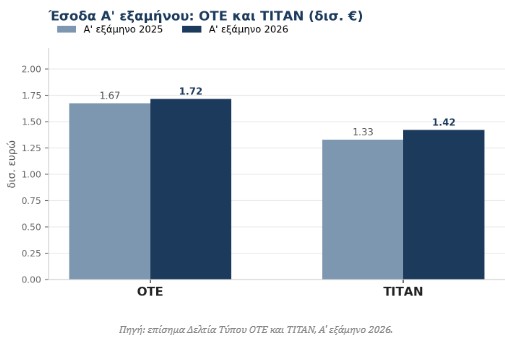
The OTE Group announced on July 29 revenue of 1.715 billion euros for the first half of 2026, up 2.5% compared with the corresponding period last year. Adjusted EBITDA came to 681.7 million euros, up 2.9%, while profit attributable to shareholders reached 283.2 million euros, increased by 0.8%.
The momentum was supported mainly by fixed telephony and the broadband network: FTTH now covers 2.2 million households and businesses, with a target of 2.4 million by the end of the year. In mobile, revenue increased 2.3% in the second quarter, driven by the migration of subscribers from prepaid to contract plans.
Management confirmed the target for EBITDA growth of around 3% for full-year 2026, noting that Recovery Fund projects are expected to gradually shrink in the second half, with private ICT projects taking a larger share.
TITAN: Acquisitions and pricing
The TITAN group announced on July 28 sales of 1.42 billion euros for the first half, up about 7% year-on-year, with EBITDA strengthening to 312 million euros (+8.7%) and net profit increasing 16%, to 153.2 million euros.
The increase was supported by the three cement company acquisitions —Traçim, Keystone and Vracs de l'Estuaire— all of which were completed within the half, adding about 80 million euros to sales, while organic growth contributed a further 86 million euros, with increased volumes in aggregates and ready-mix concrete.
Cement volumes reached 9.5 million tons (+7%), with growth in all geographic regions for a second consecutive quarter. In the second quarter alone, sales reached 784 million euros (+14%) and EBITDA 174.2 million euros (+6%, or +3.4% on a comparable basis), with management pointing out that the quarter's figures were affected by non-recurring events in Florida —mainly the prolonged shutdown of the Pennsuco plant— as well as disruptions in the supply chain due to the conflict in Iran.
Nevertheless, the group proceeded with an upgrade of its forecasts for the full year, while the share of lower-carbon-footprint products rose to 35.5% of sales, from 27% last year.
Safe Bulkers: Profitability
The sharpest change came from Safe Bulkers, which also announced on July 28 net profit of 57.4 million dollars for the half, versus just 8.9 million dollars last year. Net revenue rose 24% to 161.9 million dollars, while EBITDA almost doubled, to 97 million dollars from 53.1 million. The average charter rate (TCE) came to 18,862 dollars per day, from 14,756 dollars last year, reflecting the improvement in the dry bulk market.
The company's chairman, Dr. Loukas Barmparis, linked the performance to the decision to increase the quarterly dividend to 7.5 cents per share. A separate milestone for the company was the start of trading of its stock also on the Athens Stock Exchange in June, in addition to New York —making it the first shipping company with a simultaneous listing on the NYSE and Euronext Athens.
The fleet numbered 46 vessels at the end of July, with orders for another 10 newbuilds, while during the half the company also proceeded with sales of older vessels.
These three sets of results essentially show one trend, however: that this year is moving upward in very different parts of the economy at the same time — in a mature, regulated market such as telecommunications, in a capital-intensive sector such as building materials, but also in a cyclical, inherently volatile sector such as shipping.
The question that remains open is how sustainable this momentum is. OTE is moving on familiar, predictable ground, with management having already priced in the gradual withdrawal of the boost from the Recovery Fund. TITAN relies partly on acquisitions that do not recur every year, although the organic component remains healthy.
Safe Bulkers, finally, operates in a market where freight rates can reverse just as quickly as they rose — something the company itself explicitly acknowledges in its risk warnings.
Now in the autumn, with the mass publication of results coming, it will show whether these three “good” half-years were the prelude to a broader trend or simply three isolated, well-documented, successes.