The government's interventions to address the major social problem of housing are moving along seven axes, establishing tax incentives for closed properties to return to long-term rental, launching a new "My Home III" program, strengthening renovation and placing restrictions on short-term rental, in areas where there is great pressure.
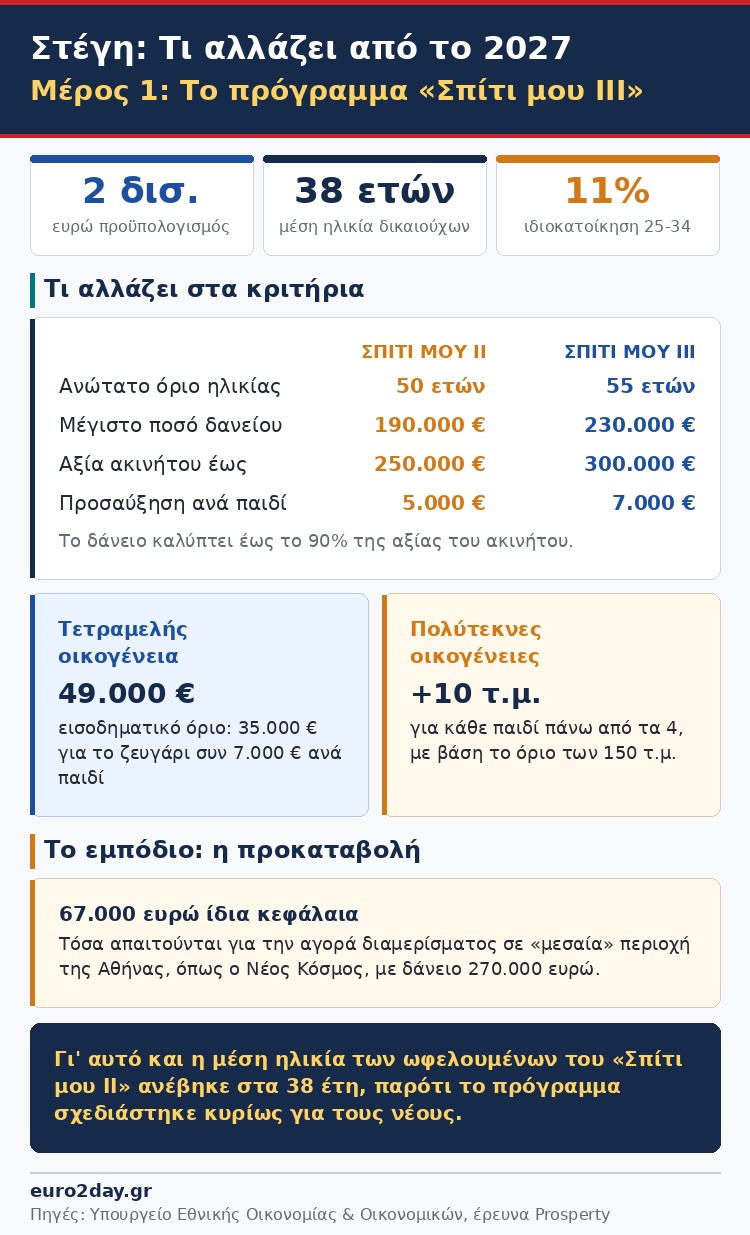
For the new "My Home III" program, which constitutes a central tool of social mobility and security for the new family, a total of 2 billion euros will be allocated.
Access for interested parties to first-home financing is becoming easier as certain restrictions that excluded many are being modified, as happened with the previous "My Home II" program.
The maximum age limit is increased from 50 to 55 years, while the maximum loan amount is increased from 190,000 euros to 230,000 euros, with a limit of 90%. The maximum commercial value of the eligible property is increased from 250,000 euros to 300,000 euros, so that the program better responds to today's market prices.
For large families, the square meter limit is also increased. From 150 square meters, now for each child above 4, another 10 square meters are added.
Changes also in the income limits. They are increased to 35,000 for each couple, with an increase of 7,000 euros (from 5,000 as it was) for each child. Therefore, a family of four with income criteria now at 49,000 euros can join the program.
It is worth noting that the first two "My Home" programs focused mainly on young people, as homeownership rates in the 25-34 age group have collapsed to around 11%. However, the final data of "My Home II" showed that the average age of the beneficiaries was 38 years.
What was the decisive factor? Beyond cheap lending, those interested had to have significant capital of their own to complete the price and this proved extremely difficult, if not impossible for younger people, who as a rule have lower earnings and savings.
According to a survey by Prosperty, to buy an apartment in a "middle" area, e.g. Neos Kosmos, an initial capital of around 67,000 euros is required as a down payment, for a loan of 270,000 euros.
ENFIA
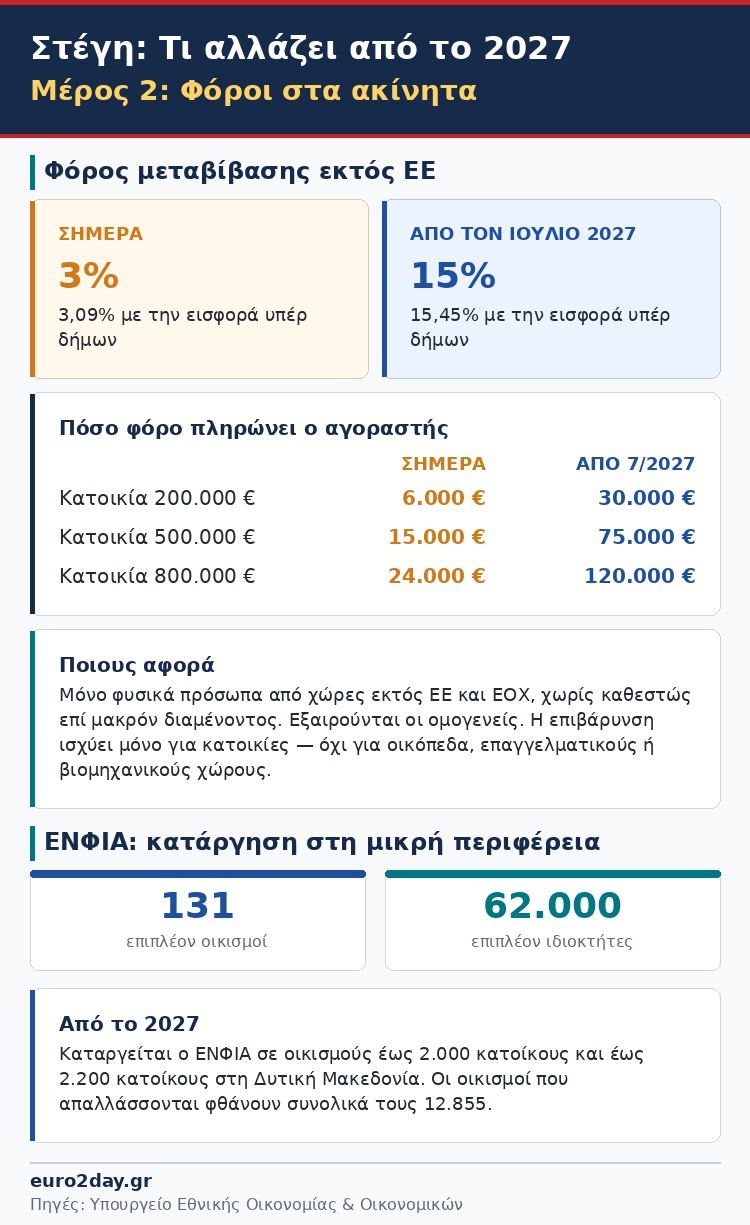
From 2027, ENFIA is abolished in settlements of up to 2,000 inhabitants and up to 2,200 inhabitants in Western Macedonia. The measure concerns 131 additional settlements (in total the settlements reach 12,855) and approximately 62,000 additional property owners.
As the Deputy Minister of National Economy and Finance notes, "this choice is not a simple tax relief; it is an incentive to remain in and return to the Region, support for small property ownership and a contribution against demographic shrinkage".
To 15% for "foreigners"
From July 2027 (so that there is no surprise) the transfer tax for the purchase of a residence by citizens of third countries outside the European Union is increased from 3% to 15%, with the aim of limiting the distortions caused by external investment demand in areas with housing pressure, and at the same time strengthening the position of permanent residents in the market.
The increase concerns exclusively the purchase of a residence by natural persons who are citizens of countries outside the European Union and the European Economic Area and do not have long-term resident status.
Together with the 3% levy on the tax in favor of municipalities, the total burden is in practice set at 15.45%, from 3.09% today.
The measure concerns citizens of third countries outside the European Union who are not long-term residents. That is, expatriates are exempt, and long-term residents are also exempt.
Also, the burden concerns only transfers of residences. It does not concern purchases of business premises, plots, or other properties. Therefore, purchases of commercial and industrial buildings are not included in the new burden provided that, at the time of transfer, the property is not used as a residence. All details will be clarified with the forthcoming legislative regulation.
In any case, the burden for those who fall under the new regime is significant. In the purchase of a residence with a taxable value of 200,000 euros, the main transfer tax increases from 6,000 to 30,000 euros.
For a residence worth 500,000 euros the main tax rises from 15,000 to 75,000 euros, while for a property of 800,000 euros it increases from 24,000 to 120,000 euros.
Vacant properties
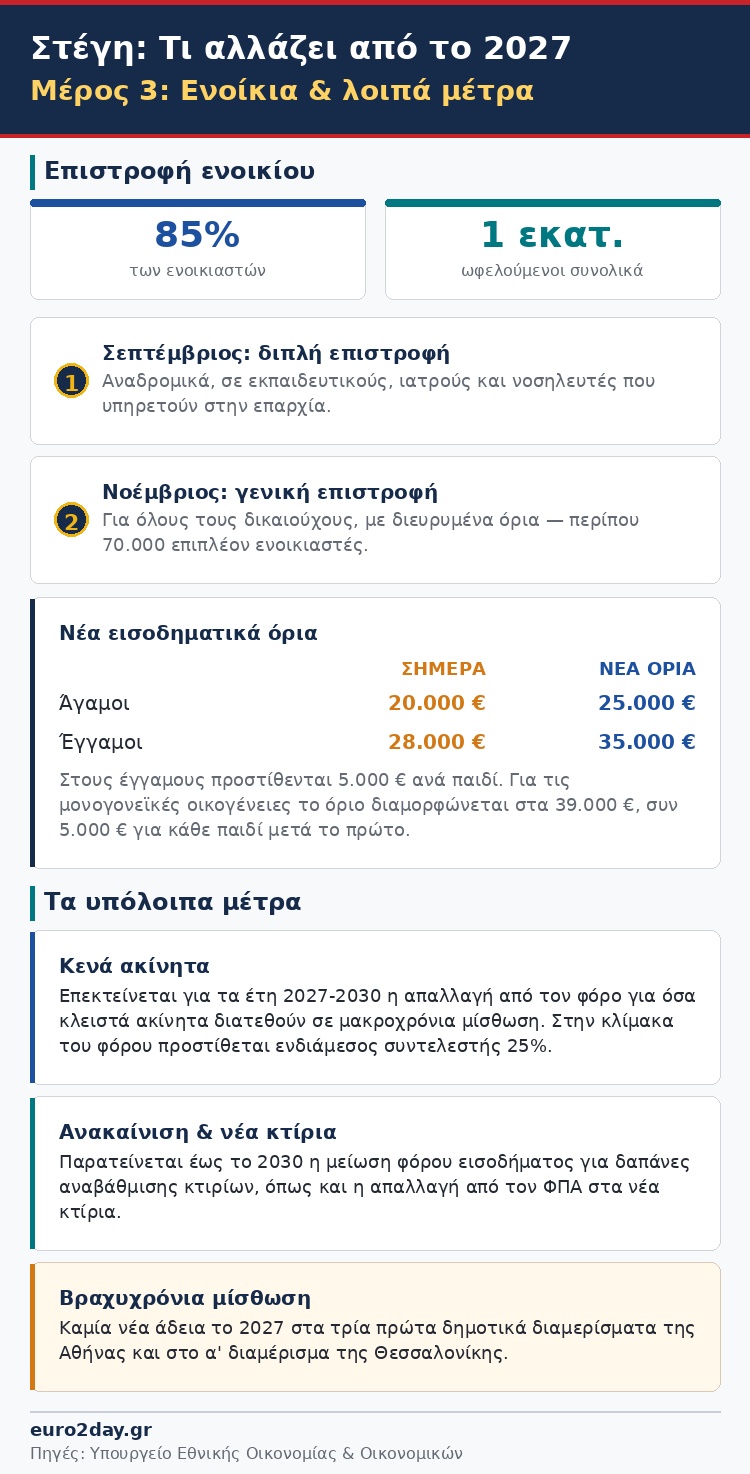
The exemption from the tax on vacant properties that are rented out is extended for 2027-2030.
It is worth noting that in the tax scale for properties, an intermediate rate of 25% (between 15% and 35%) has also been established, so that taxation becomes more proportional.
Also:
- The reduction of income tax for building upgrade expenses is extended for the years 2027-2030.
- The VAT exemption on new buildings is extended for 2027-2030, while:
- No new short-term rental licenses (airbnb etc.) will be granted in the 3 municipal districts of Athens and in the 1st district of Thessaloniki in 2027 as well.
Rents
Within September, the retroactive double rent refund will begin, for teachers, doctors and nurses in the provinces.
In November, the general rent refund with expanded limits will take place (from 20,000 to 25,000 euros for singles and from 28,000 to 35,000 plus 5,000 for each child for married couples and for single-parent families 39,000 plus 5,000 for each child after the first).
The measure concerns 85% of tenants (approximately 70,000 additional tenants and a total of 1 million tenants).