As the next electoral contest approaches -the prime minister has placed the horizon in the spring of 2027- political uncertainty is gradually beginning to enter investors' radar.
This article examines four main electoral outcome scenarios and what each could signal for the Greek market — as a framework for political risk analysis, not as a forecast.
No assessment here constitutes investment advice; the market's actual reaction will depend on far more factors than an article can summarize, including the international environment at that particular time.
Today's political landscape
Recent polls show New Democracy (ND) in first place with voting intention around 26-29%, with a double-digit lead over the second force, the Greek Left Alliance (EL.A.S.) of Alexis Tsipras, at 13-15%.
PASOK follows at 12-13%, with Greek Solution close to 9% and the KKE at 6-7%. More than five additional parties are vying for entry into Parliament with percentages around the 3% threshold, something that shows a strongly fragmented picture.
The current electoral law provides for a scaled seat bonus for the first party: 20 seats at 25% and one additional seat for every half percentage point up to 40%, where the bonus reaches 50 seats — the threshold of "self-reliance" in practice is placed around 38-40%.
With ND moving well below this level in current measurements, the scenario of no self-reliance is not unlikely, opening discussion about what would follow.
Indicative placement on the political risk spectrum
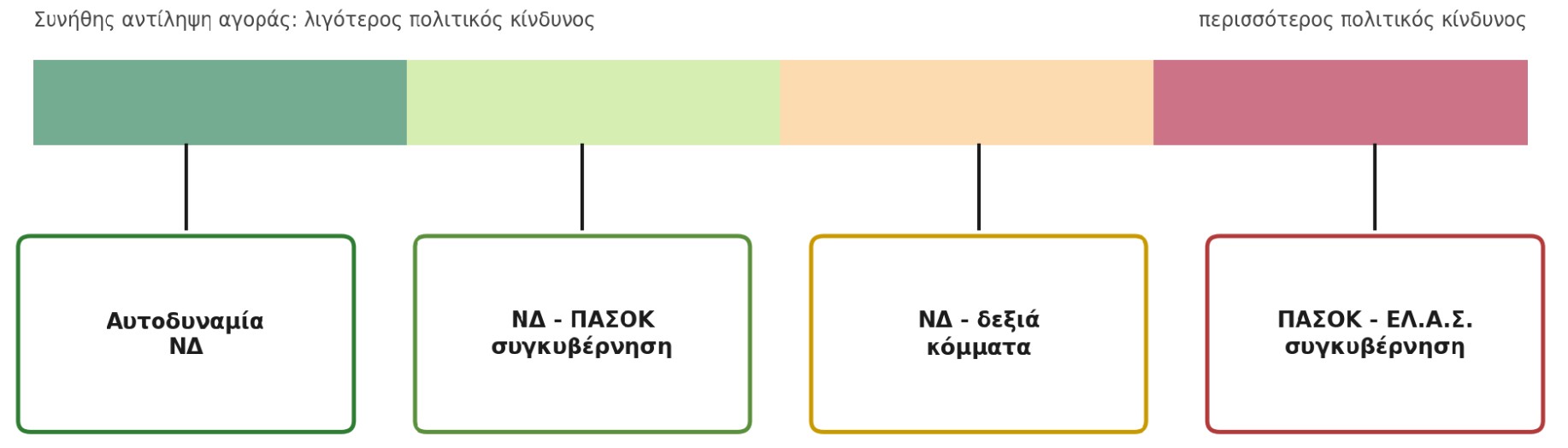
Electoral outcome scenarios and political risk
Scenario 1: Self-reliant New Democracy
The scenario historically associated with the greatest policy continuity. A self-reliant ND would mean continuation of the existing economic direction — fiscal maintenance, a business-friendly framework, continuation of privatizations and reforms.
Given that the current upward course of the ATHEX and its upgrade to a developed market are taking place under this government, such a result would likely be treated as the scenario of minimal political uncertainty, with foreign institutional investors —who are expected to increase after the upgrade— having already largely incorporated this prospect into their valuations.
This does not automatically mean that it would be "better" for the economy in every dimension, but that it would minimize the risk premium that markets currently incorporate for a change in policy direction.
Scenario 2: No self-reliance → ND-PASOK coalition government
If ND remains the first party but without self-reliance, cooperation with PASOK would be —according to the usual market reading of centrist coalitions at the European level— the scenario with the second-lowest uncertainty. Both parties move within a broader pro-European, pro-market framework, with relatively converging positions on issues of fiscal discipline and relations with European institutions.
The main question here would not be so much the direction of policy as its pace: coalition governments tend to require more time for consensus, something that could slow —not necessarily reverse— the pace of reforms and privatizations. Historically, collaborations of this type (e.g. the Papademos government in 2011-2012) did not by themselves cause particular volatility beyond what already existed.
Scenario 3: ND coalition government with parties to its right
A scenario of ND cooperation with smaller parties positioned further to the right (Greek Solution, Voice of Reason, or a possible formation under Antonis Samaras, which according to the same polls could gather a double-digit percentage) would introduce greater uncertainty compared with the ND-PASOK scenario, although clearly less than a left-wing coalition government scenario.
The uncertainty here would stem less from economic policy itself —these parties tend to be market-friendly on issues of taxation and the business environment— and more from possible tensions on institutional or foreign policy issues, as well as from the question of whether such a cooperation would be stable over a four-year term or would lead to an early repeat election — something that political uncertainty itself (more than policy direction) tends to be punished for.
Scenario 4: PASOK-EL.A.S. coalition government
The scenario historically associated with the greatest possible volatility, at least in the short term. The experience of 2012 and especially 2015 —when the prospect of governance under SYRIZA was linked to sharp falls in the Athens Stock Exchange, a surge in Greek bond yields, and intense discussions of "Grexit"— remains a reference point for many investors, even if conditions today differ significantly.
The program presented by EL.A.S. includes elements —new tax burden at the top of wealth, significant increase in public spending, a more active state role in sectors such as energy— which, depending on their final form and on how markets receive their fiscal sustainability, could rekindle questions regarding the country's relationship with the EU's fiscal rules.
At the same time, caution is needed in the analogy with 2015: today's Greece is outside the memoranda, with much lower borrowing from the markets compared with then, a fresh institutional upgrade at market level, and an EL.A.S. political landscape that its own leadership presents as more moderate and fiscally cautious compared with 2015 — something strongly disputed by the government but constituting the party's explicit assurance.
How convincing the markets would find this assurance would, in practice, be the determining factor for how intense any reaction would be.
What is worth keeping in mind
The basic principle behind this analysis is simple: markets price political risk according to uncertainty about policy direction, not necessarily according to where a government stands on the political spectrum.
A cooperation scenario between parties with converging economic positions (ND-PASOK) tends to be treated as lower risk than a scenario with greater distance in positions (PASOK-EL.A.S.), regardless of whether each scenario would ultimately prove better or worse for the real economy over time — two questions that do not necessarily coincide.
In any case, with the elections still several months away and the correlations changing constantly, any such analysis remains a working scenario and not a forecast — and certainly not a substitute for one's own investment judgment or professional advice.
* Director of Research at Solidus Securities S.A., leads portfolio analysis and asset allocation optimization, developing comprehensive financial models for risk assessment and forecasting market trends. President of EEPAMA - HACSA.
** This article is for informational and educational purposes and does not constitute investment, tax, or legal advice. The data are indicative, based on publicly available historical data, and do not guarantee future returns. Before making any investment decision, consult a certified investment advisor.