Bond portfolio management is often underestimated compared with equity portfolio management, yet it requires an equally systematic approach — perhaps an even more technical one, since a bond’s price is determined by clearly identifiable variables (interest rates, duration and credit risk) that can be analysed and managed more precisely than equity valuations usually allow.
This analysis sets out the basic principles, the main portfolio construction techniques and the strategies used by professional fund managers.
Types of bonds
Before turning to the principles of portfolio management, it is worth clarifying the types of securities a portfolio manager may have to manage. The bond market is not uniform: bonds differ substantially according to their issuer, how they pay interest and the specific features that affect both their risk and their return.
Classification by issuer
Depending on the issuer, the main categories are:
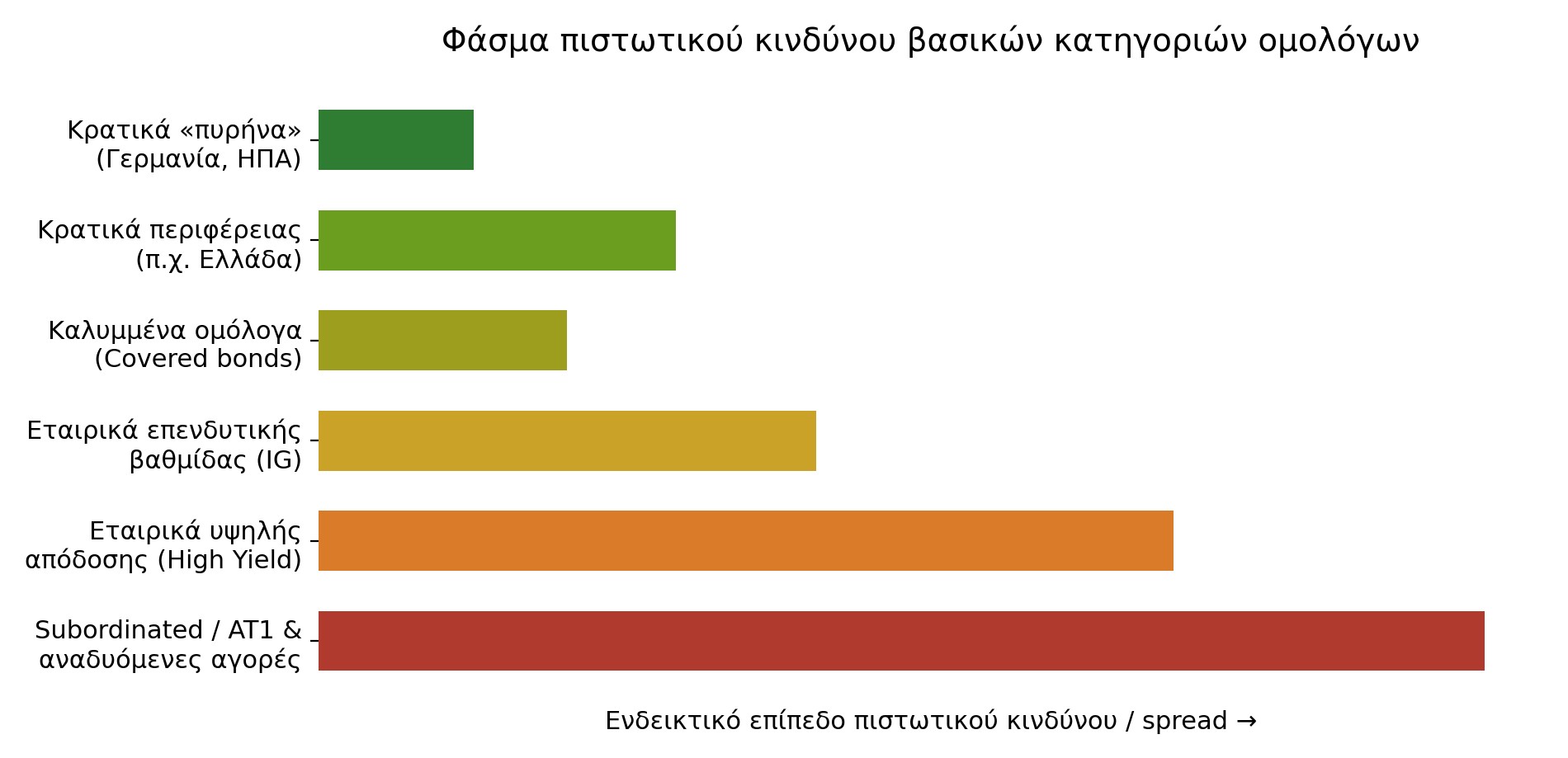
Government bonds (Government bonds): Issued by national governments to finance budgetary needs. Credit risk varies significantly between issuers — from German Bunds and US Treasuries, which are considered almost risk-free, to bonds issued by peripheral economies such as Greece, where the spread reflects the additional risk.
Corporate bonds (Corporate bonds): Issued by companies and divided into two broad categories: investment grade, for issuers with high credit ratings, and high yield (high yield or junk bonds), for issuers with lower credit ratings, which offer a higher coupon to compensate for the additional risk.
Supranational bonds (Supranational bonds): Issued by international organisations such as the European Investment Bank (EIB) or the World Bank, usually with very high credit ratings.
Municipal and sub-sovereign bonds (Municipal / sub-sovereign bonds): Issued by local authorities, regions or federal states — and more common in markets such as the US and Germany.
Classification by coupon
Regardless of the issuer, bonds are also classified according to how they pay interest:
Fixed-rate (Fixed rate): The coupon remains unchanged throughout the life of the bond — the most common form, with predictability its main advantage.
Floating-rate notes (Floating Rate Notes — FRN): The coupon is reset periodically against a benchmark interest rate (e.g. Euribor or SOFR) plus a fixed margin. Because the rate resets in line with market rates, duration remains low, regardless of the time to maturity.
Zero-coupon (Zero-coupon): These pay no periodic interest. They are sold at a discount to their face value, and the holder’s return comes entirely from the difference between the purchase price and the face value at maturity. They have the highest duration of bonds with the same maturity, since all the cash flow is concentrated at the end.
Special categories of bonds
Beyond these two main classification criteria, some categories of bonds have additional, specific features:
Convertible bonds (Convertible bonds): Give the holder the right to convert them into a predetermined number of shares in the issuing company, combining the features of a bond with an equity option.
Callable and puttable bonds (Callable / puttable bonds): Callable bonds give the issuer the right to repay them early (usually when interest rates fall), while puttable bonds give the corresponding right to the holder.
Inflation-linked bonds (Inflation-linked bonds): Examples include US TIPS and French OATi. The principal and/or coupon is adjusted in line with the consumer price index, offering protection against the inflation risk mentioned above.
Covered bonds (Covered bonds): Secured against a specific pool of assets (usually mortgage loans), giving them lower credit risk than the same issuer’s unsecured corporate debt.
Subordinated and Additional Tier 1 (AT1): Bank bonds with lower repayment priority in the event of bankruptcy, and correspondingly higher risk and returns — a category of particular importance in the Greek and European banking systems since the debt crisis.
Perpetual bonds (Perpetual bonds): These have no fixed maturity date — the holder receives coupons indefinitely, unless the issuer exercises any call option it may have.
Green, social and sustainability-linked bonds (Green / Social / Sustainability-linked bonds): Proceeds from the issue are earmarked to fund projects with an environmental or social impact — a category that has gained a rapidly growing share of the international bond market over the past decade.
Synthetic bonds: the Box Spread example
Beyond bonds in the strict sense, the derivatives market also allows investors to create “synthetic bonds” — positions with no underlying bond that nonetheless replicate precisely the cash flow of a zero-coupon security. The most typical example is the Box Spread, a combination of four options (two calls and two puts) with the same strikes and expiry, on an index or a stock with listed options (a typical example is options on indices such as the S&P 500).
Long Box (buying a box): A combination of a bull call spread and a bear put spread at the same two strikes. Regardless of the underlying’s price at expiry, the position delivers the fixed difference between the two strikes — a guaranteed cash flow with no market risk. By buying the box for less than the discounted value of that difference, the investor is effectively lending capital at a fixed, predetermined rate until expiry — in other words, creating a synthetic long position in a zero-coupon bond.
Short Box (selling a box): The reverse position: the investor receives the box price today and is obliged to pay the fixed difference between the strikes at expiry — in other words, borrowing capital at a fixed rate and effectively creating a synthetic issue (sale) of a zero-coupon bond.
The main advantage of box spreads is that, in markets with deep liquidity in index options, they can occasionally offer more competitive borrowing or lending rates than traditional money markets. At the same time, they carry risks not found in a straightforward bond — margin requirements, counterparty credit risk in clearing, and the potential for early exercise with American-style options — which is why they are aimed mainly at experienced institutional investors.
Core principles
The inverse price-yield relationship: The first and most fundamental principle: when interest rates rise, the prices of existing bonds fall, and vice versa. This is because a fixed-rate bond becomes less attractive when new issues offer higher yields — so its price adjusts downwards until its actual yield is in line with the market.
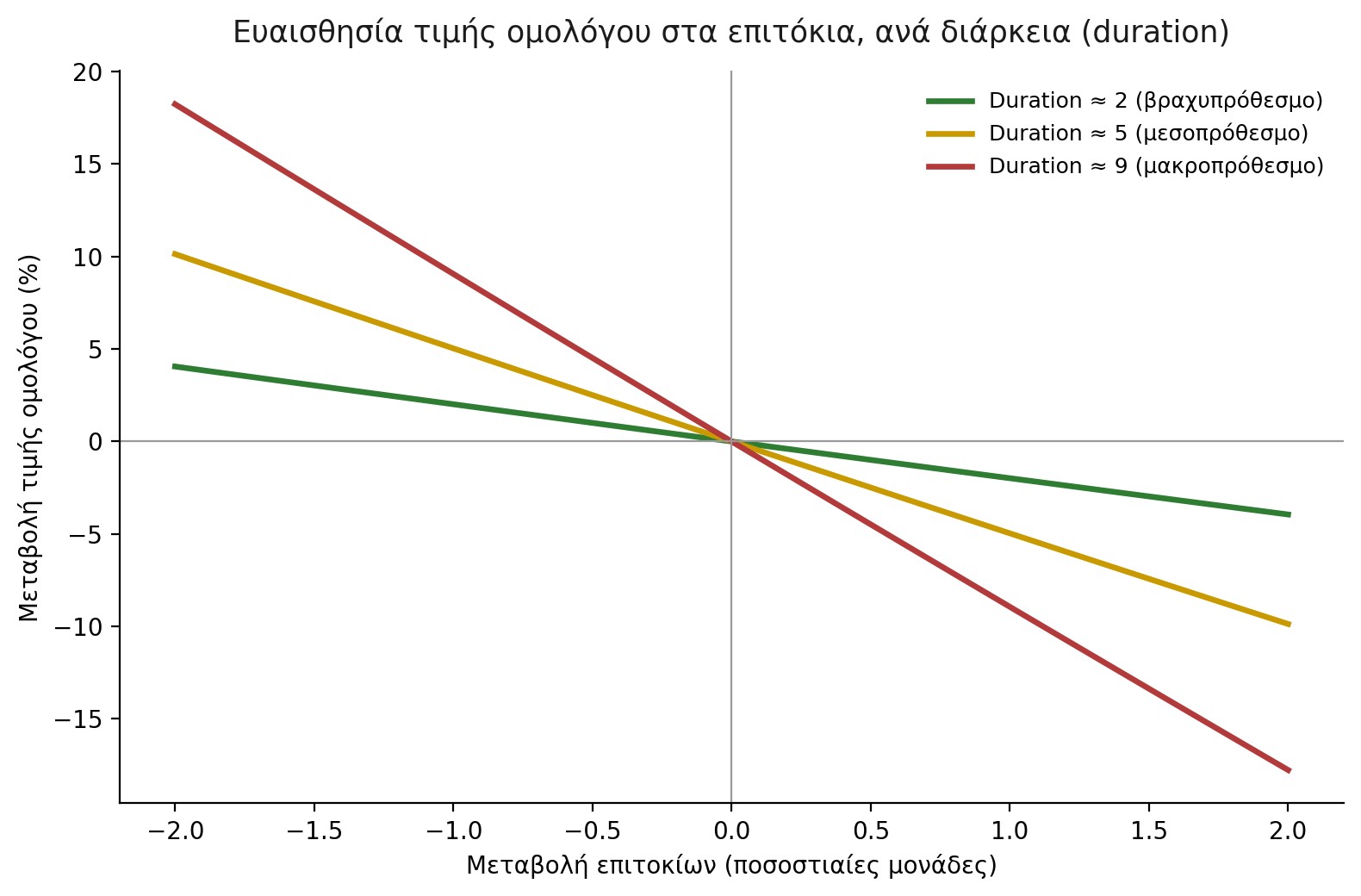
Duration: the key measure of interest-rate risk: Duration measures how sensitive a bond’s price is to changes in interest rates. A bond with a duration of 7 will lose about 7% of its value if interest rates rise by one percentage point, and gain a similar amount if they fall. The longer the time to maturity and the lower the coupon, the higher the duration — and therefore the greater the sensitivity to interest rates.
Convexity: correcting the linear approximation: Convexity corrects this inaccuracy: for a bond with positive convexity, the price gain when interest rates fall is greater than the price decline when they rise by the same amount — an asymmetric advantage that is particularly valued during periods of uncertainty about the path of interest rates.
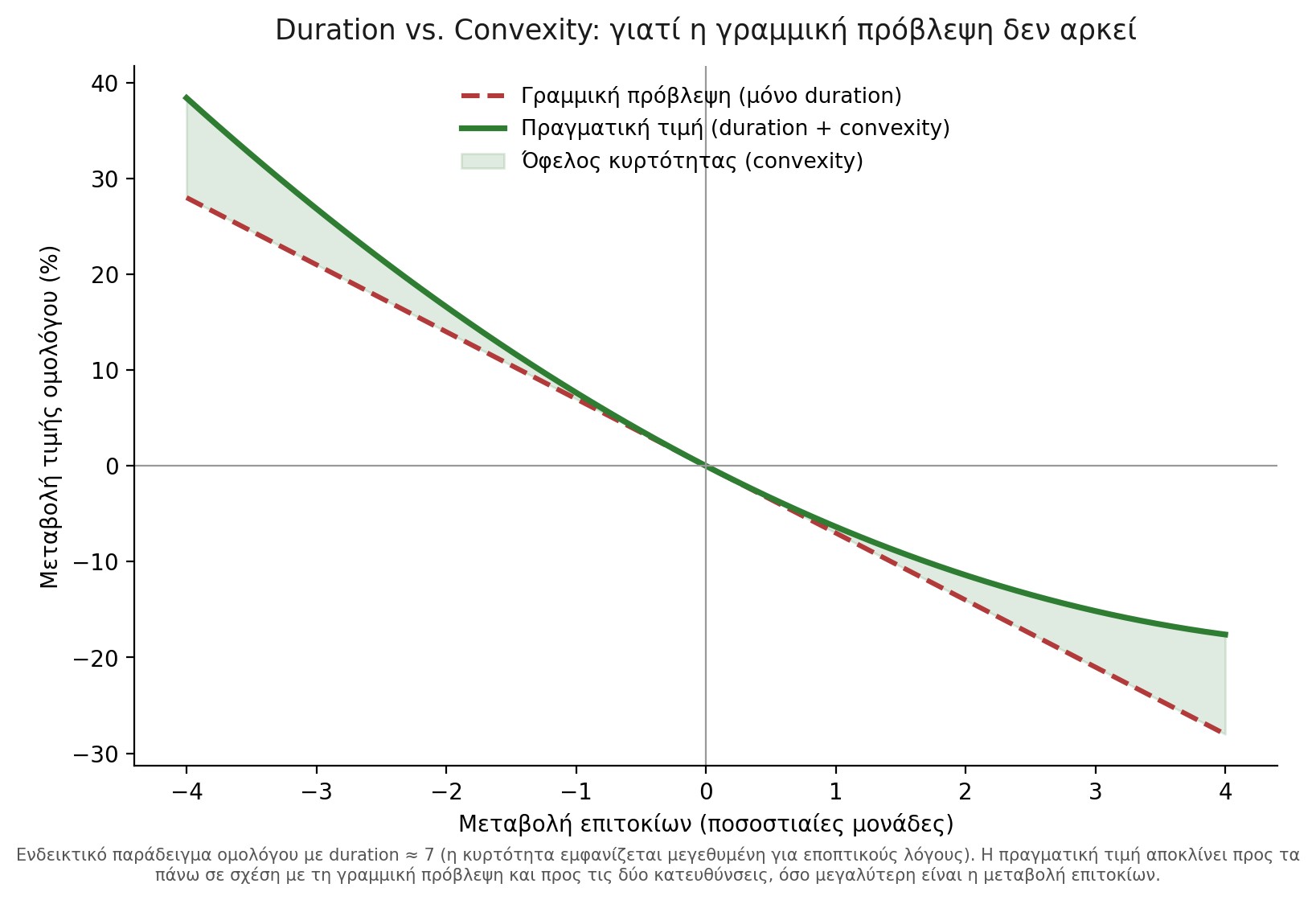
The chart shows why the linear forecast based solely on duration (the dashed red line) diverges increasingly from the actual price (the green line) as the change in interest rates grows — and why this divergence always works in the bondholder’s favour, not against them: the actual price is always above the linear forecast, whether interest rates rise or fall.
Credit risk and spreads: In addition to interest-rate risk, every bond carries the risk that its issuer will default or be downgraded. This is reflected in the spread — the difference in yield compared with a “safe” benchmark bond (usually a German Bund in Europe, or a US Treasury internationally). Greek bonds, for example, are priced against the spread over the equivalent German security — and the recent narrowing of that spread reflects the improvement in the country’s credit profile.
The yield curve: The yield curve shows the yields on bonds from the same issuer at different maturities. Under “normal” conditions it slopes upwards (longer-term bonds offer higher yields to compensate for greater time-related risk), while an inverted curve (where short-term yields are higher than long-term ones) has historically been considered a warning sign of recession.
Portfolio construction techniques
Beyond these theoretical principles, managers use specific techniques to structure the maturities in a bond portfolio according to their objectives:
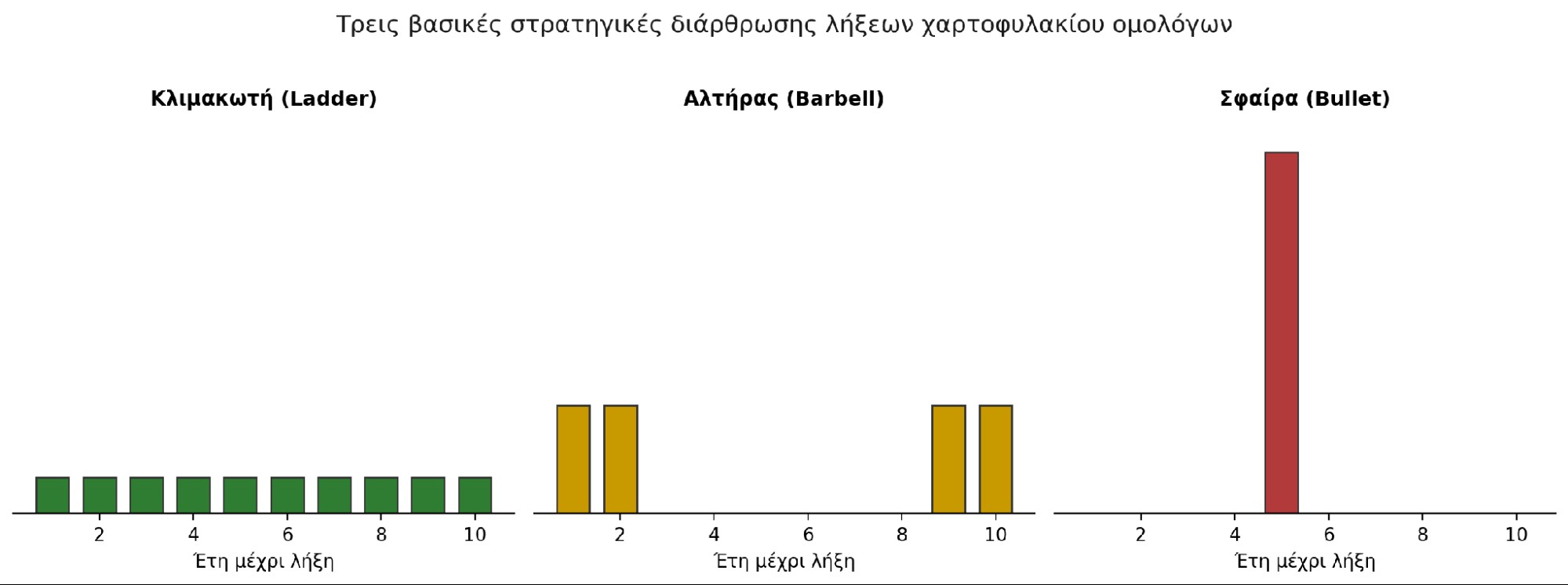
Bond maturity structuring strategies
Ladder: Capital is spread equally across bonds with staggered maturities (e.g. 1, 2, 3... 10 years). As each bond matures, the proceeds are reinvested at the longest maturity, keeping the portfolio’s average duration stable. This provides a steady source of liquidity and smooths reinvestment risk over time, rather than concentrating it at a single point.
Barbell: Holdings are concentrated in very short- and very long-term bonds, avoiding the intermediate range. This combines the liquidity and flexibility of short-term securities with the higher yields of long-term bonds, and allows the portfolio to be restructured more quickly when interest-rate expectations change.
Bullet: Maturities are concentrated around a specific target date (e.g. all bonds mature in five years). This is often used when a specific future liability must be met on a particular date (e.g. a pension fund with a known payment date).
Immunisation: A technique that aligns the portfolio’s duration precisely with the time horizon of a future liability, so that the portfolio is “immune” to interest-rate changes until that point — a key management tool for insurers and defined-benefit pension schemes.
Management strategies
Passive management: The simplest approach: buying and holding bonds to maturity (buy-and-hold), or tracking a bond benchmark through corresponding ETFs or mutual funds. Low cost and predictable cash flows, but no attempt to exploit short-term opportunities.
Active management based on interest-rate expectations: A manager increases the portfolio’s average duration when expecting interest rates to fall (to benefit more from rising prices), and reduces it when expecting them to rise (to limit losses). This requires a sound reading of the macroeconomic environment and central bank policy — and carries the corresponding risk of mistiming the market.
Credit strategies: The focus is on selecting issuers, rather than on duration: seeking bonds whose spread appears excessively high relative to their actual credit risk (that is, bonds undervalued by the market), in the expectation that the spread will narrow — generating corresponding outperformance — as the market’s perception of the issuer improves. Investing in Greek government or corporate bonds over the past decade is a classic example of this strategy.
Roll-down / riding the yield curve: On an upward-sloping yield curve, a manager buys a bond with a longer maturity than their investment horizon and sells it before maturity. As time passes, the bond “rolls down” the curve towards points with lower yields (and therefore higher prices), generating a capital gain in addition to the coupon — a strategy that performs particularly well when the curve remains consistently upward-sloping.
Currency and geographic diversification: In an international portfolio, spreading investments across bonds from different countries and currencies reduces concentration risk in any one economy or monetary policy, although it introduces foreign-exchange risk, which is often hedged separately.
The key risks addressed by each strategy
In short, each of the techniques and strategies above addresses a different combination of the following risks: interest-rate risk (price changes due to movements in interest rates), credit risk (issuer default or downgrade), liquidity risk (difficulty selling without a significant price discount), reinvestment risk (lower returns when reinvesting maturing bonds or coupon payments), and inflation risk (erosion of real returns by inflation — a risk often addressed with inflation-linked bonds).
Bond management is not simply a matter of “low-risk investing” — it is a field with its own specialised toolkit, where the choice of technique and strategy (passive, active, credit or roll-down) depends directly on the investment horizon, risk tolerance and expectations for the path of interest rates. Understanding duration and the yield curve remains the foundation on which every more complex approach is built.