A small part of the April increase in the minimum wage will pass into workers' pockets, with the net benefit amounting to about 31.6 euros per month for those who do not have a three-year increment and reaching up to 40 euros for workers with three three-year increments.
The increase in the minimum wage by 40 euros, from 920 to 960 euros gross, will not be translated in its entirety into net income, as part of it will be absorbed by taxes and social security contributions. However, the simultaneous reduction in employee contributions by 0.5 percentage points limits deductions and strengthens the final benefit.
At the same time, the intervention has a greater fiscal and employer footprint, as the increase in the basic wage also pulls up the pay of workers with three-year increments, while increasing the total payroll cost of businesses. In fact, employers expected the reduction in contributions to pass in its entirety to their own contributions and not exclusively to workers' contributions. In the end, however, the reduction in contributions applies only to workers and horizontally, offering additional net benefit also to workers with higher earnings, regardless of the increase in the minimum wage.
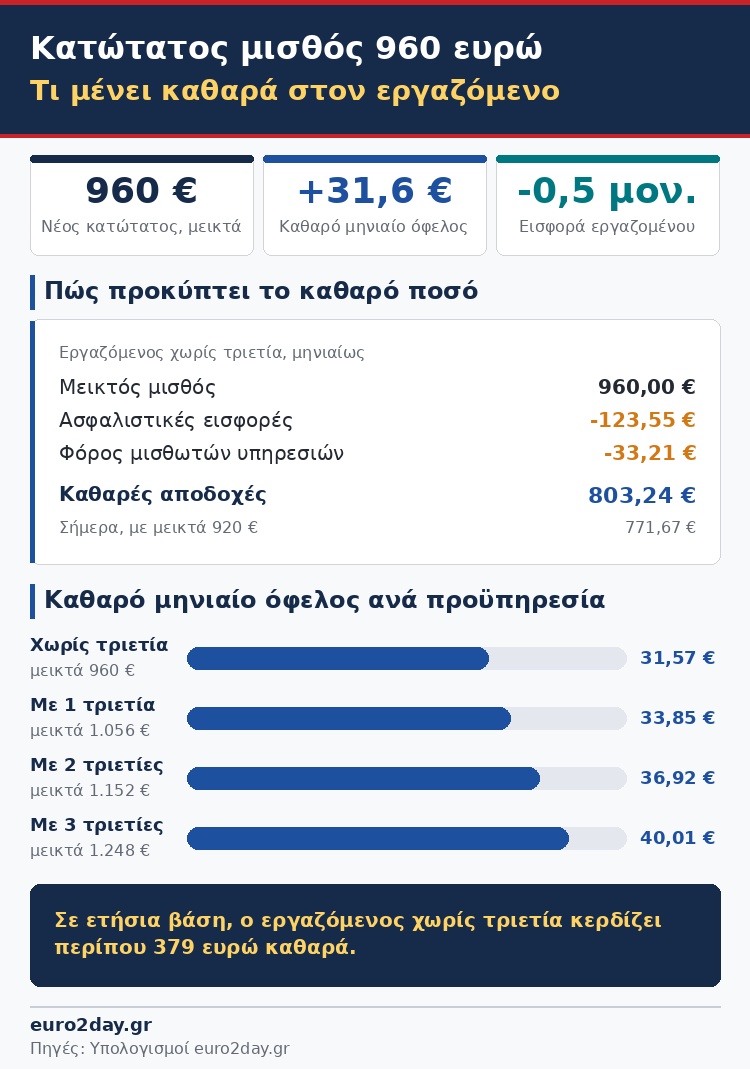
Based on the calculations, for a worker without a three-year increment, the gross wage increases from 920 to 960 euros, that is by 40 euros per month. The employee's contribution, despite the increase in earnings, is formed at approximately 123.55 euros, as the insurance burden declines by 0.5 percentage points. The wage tax is calculated at approximately 33.21 euros, with the result that net earnings are formed close to 803.24 euros, compared with 771.67 euros with gross earnings of 920 euros. The net benefit for the worker thus amounts to approximately 31.57 euros per month or about 378.8 euros on an annual basis.
The picture changes upward for those who have secured seniority and receive three-year increments. With one three-year increment, the gross wage reaches 1,056 euros, from 1,012 euros, while net earnings are formed at approximately 868.89 euros, compared with 835.04 euros. The increase in net income is calculated at 33.85 euros per month. With two three-year increments, the gross wage rises to 1,152 euros and the net amount to approximately 934.13 euros, compared with 897.21 euros, with the monthly benefit reaching 36.92 euros. For a worker with three three-year increments, the gross wage is formed at 1,248 euros and net income approaches 999.37 euros, compared with 959.36 euros, that is an increase of about 40 euros per month.
The increase in the minimum wage correspondingly entails higher costs for businesses. For the worker without a three-year increment, employer contributions are calculated at approximately 209.19 euros, compared with 200.47 euros today, increased by about 8.72 euros per month.
The cost
The total payroll cost for the employer, provided that the gross wage and employer contributions are taken into account, is formed at approximately 1,169.19 euros per month, compared with approximately 1,120.47 euros, recording an increase close to 48.72 euros.
A similar picture applies in the higher seniority brackets as well. With one three-year increment, the additional cost for the employer from wages and contributions is formed at approximately 53.59 euros per month, with two three-year increments at 58.46 euros and with three three-year increments at approximately 63.33 euros. Thus, the increase of 40 euros in the basic minimum wage creates a multiplier effect on the wage expenditure of businesses, as it also pulls up the earnings of those entitled to an increase due to seniority.
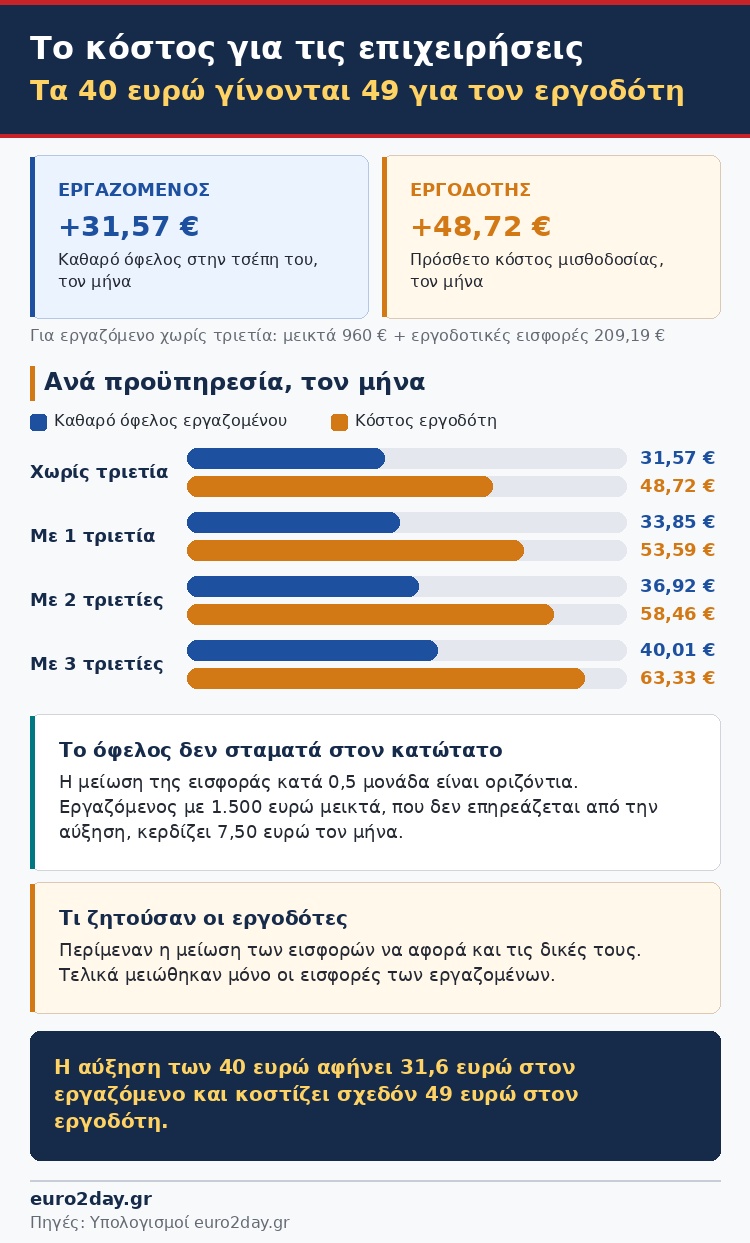
The basic economic footprint of the change is therefore twofold. The worker sees their gross income increase by 40 euros at the minimum wage base and, thanks also to the reduction in the insurance contribution, keeps about 31.6 euros more in their pocket every month. For the employer, however, the corresponding change is greater, as the total labor cost increases by almost 49 euros for a worker without a three-year increment.
The reduction in contributions, however, from April 1, 2027, will have a broader impact on the labor market as it is not limited to those paid the minimum wage. Thus, for example, a worker who receives gross earnings of 1,500 euros and is not affected by the increase in the minimum wage will see the benefit exclusively from the reduction in their contribution by 0.5 percentage points, that is an additional 7.50 euros per month.